Archive for May 2018
Little Things Matter (in Relationships, Too)
In a way, this is part two of my last post about how little things matter. But it also stands on its own…enjoy!
Recently, I read something about what makes interpersonal relationships work, whether they’re friendships or something of a romantic nature. I’d expected something profound — yes, even me, someone who’s experienced a successful and happy marriage — but that’s not what the writer talked about.
Nope.
What this writer — whose name escapes me — said was that the way to predict whether a friendship or romantic relationship was going to work well was whether or not you shared the little, mundane, ordinary things with your friend or partner.
And my jaw dropped. (Seriously. It did.)
Maybe this idea, that all the little things — the petty annoyances, the grievances, the frustrations, not to mention the small victories (like remembering to pick up the milk when you’re dead tired, so your partner can have it for her cereal in the morning) — add up to something major may not strike you as earth-shattering.
But here’s the reason it struck me as exactly that.
We’re told all the time that little things like that don’t matter. That we’re supposed to talk about profound things instead. And that if we can’t or won’t talk about deeper issues, there’s no point to being there.
There’s a certain amount of truth to that last part, mind, insofar as you have to be able to talk over deep and difficult things, too. That shows you trust the other person, and without trust, you cannot have intimacy, whether it’s emotional, physical, or any other way there is.
But the reason the little things matter just as much, if not more, than the big revelations that we trust our friends and partners with, is because they show our vulnerability.
See, when we’re willing to talk about how much our feet hurt, or how the traffic on the road was, or any other thing that seems piddly on its face, it all adds up to something much more profound.
Talking about things like that, when taken in their totality, say, “I trust you” to the other person. And as I said before, trust is absolutely essential to any form of intimate, interpersonal contact.
So, when you share your vulnerabilities, you promote deeper connection between yourself and someone else you care about. And you do that not just by the ‘big reveals” of the stuff you don’t trot out on the first date (or even the fiftieth); you do that by showing every day who you are, why you care, and what on Earth you’re doing spending any of your time with your loved one (or friend).
That’s why the little things do matter, in relationships, just as they do in anything else.
What little things do you do to show your friends (and/or loved ones) that you care? And what little things did you never, ever, in a million years think would be important, but maybe actually are? Tell me about them in the comments!
With Creativity, Little Things Count
Most of the time, it seems that when we don’t make major progress in one area or another, that we aren’t doing enough.
And yet, little things count. Little things add up. Little things, when they accumulate in big enough numbers, turn into medium-sized things, then big things…but it takes time.
It’s easier sometimes to pretend that these little things don’t count, mind. Because making a bunch of little things accumulate into something bigger takes time, effort, commitment, persistence, and a lot of faith.
With all that’s been going on lately in the news, and all the frustrations, headaches, and worries (not to mention utterly despairing things like the U.S. immigration system “misplacing” over 1400 children, some as young as two years old), it’s hard to believe in time, effort, commitment, persistence, and most especially the last item on the list: faith.
And yet, without those five things, what do you have?
What’s interesting about a bunch of little things is that while they don’t seem like much, it’s those fundamental things that are the building blocks of creativity.
But it all comes down to those five things. In short:
- Will you put in the time, even when it doesn’t seem like it’s doing any good?
- Will you make the effort, even though sometimes it doesn’t seem at all like anyone will ever care? (Just so long as you do, though, that’s enough.)
- Will you prioritize your creativity, at least to yourself, and make a few minutes in every day (or more, if possible) to work on it?
- Will you keep grinding away, day after day, month after month, year after year?
- And, will you do your best to hold onto your faith in yourself (and, hopefully, the Higher Power that gave you these talents in the first place; if you don’t believe in the Higher Power, then the random chance that gave you these talents, I suppose), even when it doesn’t seem warranted?
If you can do all of these things, your little things can and indeed will turn into bigger things.
What do you do to keep going, even when you don’t feel a lot of hope? Let me know in the comments!
Redemption, Tonya Harding, and Chris Nuttall’s newest novel, THE FAMILY SHAME
Redemption. It’s one of the strongest words in the English language, or at least it should be. It means to be saved from sin, evil, or error. Or to save yourself from the past consequences of bad or immoral actions…or, perhaps, it means this:
Living. Learning. And improving yourself, because you can’t live with the person you used to be.
My friend Chris Nuttall wrote a book recently based around this theme called THE FAMILY SHAME, set in his Zero Enigma universe. (I was one of his editors, so I got to see the book early and often.) In it, young Isabella Rubén has lost everything she once had, all because she trusted the wrong person. She’s only twelve, but the person she trusted plotted treason against the powers-that-be, and Isabella knew about it — and didn’t say anything to her father, or anyone else. Worse yet, she actively collaborated with this person to commit treason, mostly because she saw it as her only reasonable way to obtain political power due to what amounts to her family’s benign neglect of her talents (she’s a female magician and her particular family can only be led by male magicians).

See, Isabella, in any other family, probably wouldn’t have done this. Every other family in the city of Shallot (where she’s from) picks their leader from everyone, male and female alike, based on a combination of magical and political ability. But her family, the Rubéns, don’t.
But she did it. She feels terrible about it, but she did it, and she can’t take that combination of deliberate non-action (in not telling her father or any of her teachers) plus actively aiding and abetting the treasonous older “friend” along the way.
And she is paying the price, as she has been exiled to Kirkhaven, an old, ramshackle estate about as far away from Shallot as you can get by horse. She’s also been told not to send letters to her father, mother, or brother, as she’s now “the family shame.”
So, not only has she lost everything — family, friends, wealth, schooling, political standing (which she did care about, even though she was only twelve as she was quite precocious in some ways) — she now has to deal with this ramshackle manor. Two adult magicians live there, Morag Rubén and Ira Rubén. (No, they’re not married to each other.) Morag is a cook, while Ira is a type of experimenter who admits he wants to find ways to make Dark-inflected spells work for good. And both of them, too, are exiles…
Did they want young Isabella around? The answer is a resounding “no.” But there she is, and now she has to figure out how to deal with them (not easy), how she’s going to continue her schooling independently (definitely not easy), and how she’s going to deal with the loneliness of this deserted, remote place (almost impossible). All while wrestling with the problems that brought her to this place, which she knows she created and cannot change.
When she manages to befriend a boy around her own age, Callam, her life starts to improve a little. But she has to keep the friendship secret, as she’s not supposed to leave the grounds, nor is he supposed to be on the grounds himself. (It’s a very innocent friendship, as is befitting for their respective ages.)
It’s getting to know Callam that helps to slowly but surely make Isabella realize just how badly she behaved before, and avow that she will find a way to do better.
I don’t want to give away the plot, so I’ll stop there with a plot summary. But I’ve given you this much because I wanted you to think about just how hard it’s going to be for Isabella to redeem herself in the eyes of society — and worse, how hard it’s going to be for Isabella, herself, to redeem herself in her own eyes.
Redemption, you see, is hard. People judge you by your past actions, and no matter what you do, no matter what you say, no matter how much you might apologize, and no matter how much you’ve actually changed, there are still going to be some people who will hate you, and not give the new version of you — the better version, the one tested in the fire — the time of day.
We see that in contemporary life every day.
One of the most current examples is that of figure skater Tonya Harding, who’s now nearly forty-eight years old. But when she was only twenty-four — in 1994 — she somehow failed to stop an attack on fellow figure skater Nancy Kerrigan, then not quite twenty-five. Kerrigan was hit on the knee by thugs sent by Harding’s then-husband, and one of those thugs was Harding’s bodyguard. Harding, herself, was sentenced to probation, given community service, and ended up being banned for life by the United States Figure Skating Association.
What Harding did back then was awful. That she had a rotten childhood (she truly did), that she came from abject poverty (she did), that her husband was mean and abusive to her as far as the public could discern, and that figure skating was her one gift (she was the first American woman to land a triple axel in competition, and was known for her athleticism, her jumps, and her footwork passages) may ameliorate things slightly, but the fact remains that she could’ve apparently done something to keep Kerrigan from being harmed. (I must say “apparently” because the facts are not completely in evidence. What we know is that Harding took a plea deal.)
But did she deserve to be ostracized the rest of her life for this?
Is the assumption going to be that Harding can’t learn, can’t find a way to be a good person, and that it’s supposedly OK for her to never use her one, true gift ever again, even to teach young kids how to skate?
See, that’s the quandary my friend Chris’s protagonist Isabella is in, too. Isabella is a gifted magician, but she misused her magic and hurt people. She knows it was wrong. She has apologized (as Harding, back in 1994, 1995, and 1996, apologized multiple times to the best of my recollection). But she was ostracized, cast out, exiled.
Isabella does find redemption, or at least finds a way toward redemption.
I would like to think that Harding also has found some sort of redemption, too. (Being on TV’s Dancing with the Stars surely has given her an athletic outlet, and may help pay for her son’s education down the line for all I know.)
But what’s sad about the quest for redemption, and what’s sad in both cases I’ve discussed here, is that some people will never forgive you no matter what good you might do. And no matter how much you might’ve changed. And no matter how much you might want them to forgive you…they just won’t, and you have to learn to live with it.
That Harding still has people, even to this day, leave feces (yes, actual feces) on her doorstep or rude messages on her phone or random people on the street swearing a blue streak at her, twenty-four years later, illustrates just how hard it is to seek redemption, even if you do it privately and out of the public eye.
You pay a heavy price, when you do something wrong, bad, or something that society judges immoral or flat-out evil.
But you still have to learn to live with yourself and your talents, and use them to the best of your ability. Which is what I think Harding is trying to do, as the older, presumably wiser version of herself…and it assuredly is what the young Isabella Rubén is trying to do in THE FAMILY SHAME.
I’m proud to have edited Chris’s new novel, and I hope you will find it a fun read, as well as an instructive one.
And personally? I think redemption is definitely possible. I just wish people would learn to see others for who they are today, not for how they hurt them yesterday, or how bad they behaved the day before that (or twenty-four years ago). Don’t forget it, no, as that’s revisionist history and unnecessary. But do forgive, if you can, at least as far as to say, “If I lived that person’s life, I can’t say for certain I wouldn’t have done the same things.”
That is the best way to be a decent human being, bar none.
It’s Mother’s Day (in the US)
Folks, last week I asked a friend of mine who lives in Scotland if he was going to do anything for Mother’s Day, and he drew a blank.
Then we both figured out that Mother’s Day isn’t celebrated on the same day in the United Kingdom. This year, Mothering Sunday (what they call Mother’s Day) fell on March eleventh.
So, for those of you in the United States, you probably know that Mother’s Day is today. Sunday, May thirteenth, 2018. And beyond all the hype you see online or on television regarding “you must get Mom this special something NOW,” there’s a quieter, more reflective holiday underneath it all that deserves your time and attention.
I realize that not everyone has a mother who’s still alive. (I am very fortunate that I can celebrate this day with my Mom, and am glad to do it.)
I also realize that some people don’t have mothers at all. (One of my best male friends is raising a daughter, alone. I’ve told him before that he should celebrate both Mother’s Day and Father’s Day, as he’s doing all the work.) And days like this are hard for them.
Personally, I think you should celebrate as much as you can, as often as you can, with the people who matter the most to you. If those people have nothing to do with your biological (or adopted) families, well, then they just don’t.
But you should let people know when you care about them, as often as you possibly can.
Why? Well, this world can be a cold and lonely place from time to time. The people we care about the most help bridge those times, and remind us that we do have family, friends, and loved ones to give us strength when we have little ourselves. And remind us of our past successes when we’re instead dwelling on our current failures, because they’ve seen it all and know we can rise, as phoenixes, from the ashes of futility yet again, given time.
Nurturing is hard work. And the people who do it don’t get anywhere near the credit they deserve.
So on this particular day, I hope to celebrate my mother. And my sister. And my friends who are mothers. And my friend the single father (who really should get to celebrate today, too). And everyone else who needs to be remembered for nurturing the next generation, so they can in turn nurture the next when their time comes.
What are you going to do for Mother’s Day? (Or what did you do, if you’re in a place that’s already celebrated it?) Tell me about it in the comments!
A Meditation on Hope
This post may seem elliptical, even for me, but I hope it’ll make sense at the end. (You have been warned.)
Sometimes, I wonder about the feeling of hope. We need that, in our lives; we need to feel that whatever we’re doing will eventually succeed, or at least that whatever we’re doing will lead to ultimate success in whatever it is we’re trying to do.
And without hope, how could we get there? Especially as many things we try to do, such as write a book (or lengthy piece of music), require the devotion of many hours of hard and taxing work?
In the midst of such labors, maybe you’re like me and wonder if the feeling of hope makes any sense.
Is hope logical, in other words?
I don’t know if is. But I do know we couldn’t live without it.
Hoping for better tomorrows is one of the reasons the Founding Fathers of the United States drafted the Articles of Confederation, then the Constitution of the U.S. They thought long and hard about what they wanted — and didn’t want — in such documents, and realized that whatever they did (or didn’t) do, it wouldn’t be enough. Yet they had hope, and they persevered, and they eventually came up with those important, bedrock documents.
And in the Bible, many people lived in hope that God would show them the way, even if they didn’t necessarily always understand what that way was. (Many, many people did not recognize Jesus when he showed up, for example.)
Hope was the one thing in Pandora’s Box, too…the one, unstoppable thing that might make all the difference in the world.
When we’re at our lowest ebb, it’s hope that allows us to try again another day.
And it’s when all hope is gone that we slowly, surely, lose our place in this world, and wonder why we’re even here. And what good we’re even doing. And why we should bother to keep doing it.
But is hope ever truly gone? Isn’t there always something to hope for? Some reason to get up in the morning, and face the day, and smile?
I don’t have the answers to that question.
What I do have is the hope that I will find the answers to that question someday. (I know, I know; there’s that word again, in all its slipperiness.)
And sometimes, that has to be enough.
What do you think about the meaning of hope? Or about how elliptical my thought processes can sometimes be? Let me know in the comments!
Why Minimalism is the First Step Toward Non-materialism — a Collaboration with a Purpose Post
Since I was in my mid-teens, I’ve believed in non-materialism. People, I thought (and still think) are far more important than any possessions. And while you need some things in this life (for me, these are a car, musical instruments, a computer, some clothes, books, etc.), you don’t need to go hog wild and buy everything in sight.
This feeling is now being expressed as minimalism. People who’ve never once thought about non-materialism are trying to become aware of how many needless possessions they have, and get rid of the ones that truly aren’t necessary.
It’s because of that viewpoint that the Collaboration with a Purpose group decided to discuss minimalism and its related elements this time around.

Jane Love put this picture together, along with the later one in this post, to give you an idea of what we’re talking about.
See, what we need is a place to call our own. We don’t need a whole lot of stuff around us that gets in our way and stifles us. (I know, I’m a fine one to talk. My room is cluttered with all sorts of things, though I blame some of that on not having enough space to do everything I need at the moment. Though it certainly has made me figure out what I do need, and why, living in a smaller space than I’d prefer…but as always, I digress.)
The point of minimalism is to identify what you do need, and use that. Appreciate that, yes. But don’t go overboard, and don’t clutter your life up with unnecessary things that serve no purpose other than to make you feel better for a brief moment about buying the latest hot gadget or late model car.
But I started off talking about non-materialism, didn’t I? So how does this relate?
There are grades of non-materialism, you see. Minimalism, I see as one of those shades along the non-materialist spectrum. And the two operate in much the same way: The goal is to give the irreplaceable — the people, furry friends, and true passions — the space and respect in your life they deserve, while minimizing the effect of everything else.
Take a look at the picture below (the second of Jane Love’s wonderful efforts this month) if you don’t believe me:
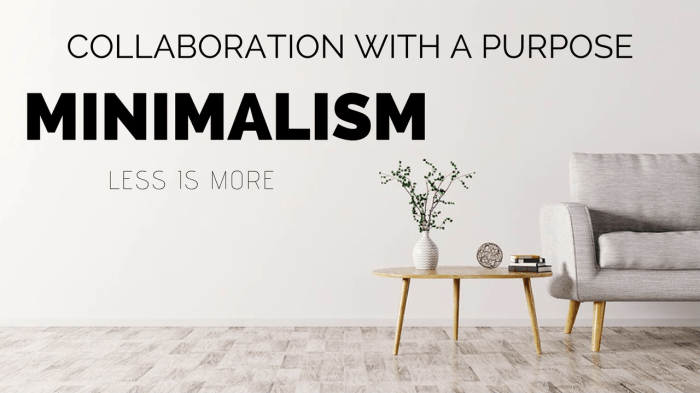
Here, you see a chair. A vase with some flowers. A bunch of books on a table. And one piece of art. And nothing else…because you don’t need anything else if you’re sitting down to read, providing you have enough light to read by in the first place.
See, anything else just distracts you from reading. And what is the point of that?
As for other possessions, I don’t really understand why folks feel like they need to “keep up with the Joneses” and the like. Because there’s truly no point in it.
See, a fancy car doesn’t advance your life goals much. Nor does having the latest high-tech gadget.
What will advance your life goals, then? And why does embracing minimalism or, its stronger cousin, non-materialism, do anything to give you the idea that you’re coming closer to them?
I can’t tell you what your own life goals are; only you can do that. But I can tell you that most of us want a few of the same things. To be loved for who we are. To be appreciated for who we are. And to be understood for who we are.
What you do for a living isn’t as important as those three things.
Now, we aren’t all alike, of course. But most of us do share those three things as among the highest aspirations we have. And none of them — none — have anything to do with materialism.
Minimalism forces you to realize what you need, and what you can live without.
And being a non-materialist forces you to realize that what truly matters are people, not things. Our minds, hearts, and spirits are far more important than anything else. And once you understand that, you can embrace the fact that possessions, for the most part, do not matter.
I believe strongly in this month’s topic, in short, and hope you will take the time to visit all of my fellow Collaboration with a Purpose authors (though you don’t have to do it all in the same day, of course!), as they all have different takes on the subject of minimalism. (Though I don’t know how many, if any at all, will discuss non-materialism, I’m sure their posts will be extremely valuable in their own right. They always are.) Links will be added as their posts go up, so do come back in a few days for the full and entire list of posts.
Nicolle K. (Intro post) – “Alert: A Collaboration for Minimalism”
Nicolle K. (regular post) – “Three Ways I’m Applying Minimalism as a Highly Sensitive Introvert”
Jane Love – “Mind Minimalism: Life Doesn’t Get Better With Worry”
Sadaf Siddiqi – “Value of Minimalism”
Ipuna Black – “Minimalism: What Gives You Meaning in Life?”
Gelyka Dumaraos – “Being More With Less: Embracing a Simple Life By Being Zero-Waste”
Mylene C. Orillo – “How Grief Taught Me to Keep My Life Simple”
Sonyo Estavillo – “Minimalism for Success: Why Little Wins Count”
Divyang Shah
Swati Kadam
Do check them out, OK?
Why I Love Baseball
Ever since I was a child, I have loved baseball. There’s something about how the game is played, including the managerial moves (pitching substitutions in particular), that has captivated me, and made me want to learn more and more about it.
Early on, I read the biographies of Jackie Robinson, Hank Aaron, and several other ballplayers. Most of the players I read about had struggled to get the big leagues; Jackie Robinson, in particular, had a very rough go of it as he was the first black player to break the “color line” (that is, the lily white major leagues). And whether it was race, poverty, or race and poverty, most of the players I read about found a way out of their bad situations, and made decent livings for themselves as ballplayers.
Because back then, ballplayers — even huge stars like Robinson and Aaron — were not paid extravagantly, as they are now. There were no millionaires in the major leagues until after Curt Flood challenged the reserve clause (and gave the baseball world free agency, and thus shifted salaries rapidly upward), though perhaps a few people came close to making a hundred thousand dollars now and again. And except for the really big stars, most players had to work in the off-season at regular jobs. Car salesmen, say, or at the post office, or maybe at the grocery store.
So if they weren’t making big money, why did most of them play? I think they did it because they enjoyed it. It’s a fun game, baseball; there are lots of different things to watch, from the pitching, the hitting, the defense, the managerial substitutions…a good manager can take a ho-hum game and make it dramatic, if he has the right team and makes the right moves at the right time.
Of course, sometimes, you don’t need a manager for the dramatics to occur naturally.
My favorite team, the Milwaukee Brewers, have had many interesting things happen over the years. The Brewers have had position players pitching in blowout losses; they’ve had inside-the-park home runs (one memorable one was Prince Fielder’s, several year back; Fielder was not exactly svelte compared to most other players, so seeing how fast he could scamper around the bases was a particular delight); they’ve had players do nearly everything, except win a World Series. (One of these years, perhaps that will happen, too.)
But around baseball, there are dozens of things that happen a night that are interesting, and usually there’s at least one truly different and unique happening every week or so. Pablo Sandoval, San Francisco Giants third baseman and all-around good, beefy guy, pitched a stellar ninth inning in a blowout loss just last week, and amidst the hysterical laughter by all the relief pitchers in the ballpark (home and away), there were some genuine compliments. Especially as Sandoval was the one “pitcher” who managed to get through an inning without giving up any runs for the Giants in the entire ballgame, these compliments seemed warranted.
And again, I turn back to my team, the Brewers, for a novelty. They were in a game earlier this year where the first two batters (from the opposing team) hit back-to-back home runs, which is not novel in and of itself…however, the fact that the Brewers, at the very end of the game, hit back-to-back home runs to end it was the first time that feat had ever occurred in the modern history of major league baseball.
Yeah. The first two guys hit solo homers. And the last two guys also hit solo homers.
Now, that’s entertainment!
Anyway, I love baseball. It can be thrilling. It can also, occasionally, be downright boring (I’m looking at my Brewers again, here, as they mounted almost no offense during last week’s series against the Cubs — must I say, again, that two runs over four games does not make an offense?). But even the boring moments usually have a silver lining, if you look hard enough…and hey, on nights like that, I can catch up on my reading.
So it’s always a win/win, as far as I’m concerned.
 Barb Caffrey's Blog