Archive for the ‘Books’ Category
Just Reviewed Aaron Lazar’s “Spirit Me Away” at SBR
Before I forget, I wanted to let my readers know that I just reviewed Aaron Lazar’s SPIRIT ME AWAY over at Shiny Book Review (SBR for short, as always), which is a new mystery in his long-running Gus LeGarde series. SPIRIT ME AWAY is set in 1969 and is a prequel to many of his mysteries featuring Gus.
In SPIRIT ME AWAY, Gus married his young bride, Elsbeth, a few months before the start of this novel; they’re music students living in Boston. When a young woman who’s lost her memory shows up nearby, they take her in and try to find out who she is. But there are some bad people out there who want her for nefarious purposes . . .it’s not a “cozy mystery” as are many in the LeGarde series, being rather a mystery with a great deal of romantic suspense. But it’s very, very good, and I enjoyed it thoroughly.
Also, I reviewed Aaron’s LADY BLUES over at SBR a couple of weeks ago. This, too, is a novel featuring Gus LeGarde, but is in the present-day and deals with the mystery of an old man in a nursing home who’s struggling to recover his memories with the aid of a new and experimental drug. But then the drug’s formulation is changed . . . slowly the old man loses his memories again. And then a friendly nurse goes missing, then the old man himself seemingly wanders away . . . Gus must get to the bottom of whatever is going on and, if possible, reunite the old man with his long-lost lover in the process before the man’s memories are gone for good.
I enjoyed LADY BLUES. It’s a warm, comforting mystery with a lot of musical ambiance and tons of food references. Gus and his family and friends are vital people who enjoy life and live it to the fullest, and they seem like people you know (or at least should know) . . . anyway, go take a gander at these reviews, and let me know what you think of ’em.
Stop the Presses! Jeffrey Getzin’s “King of Bryanae” is Out . . .
I’m pleased to report that Jeffrey Getzin’s newest novel, KING OF BRYANAE, is now available. This is the fourth book in his series revolving around the Kingdom of Bryanae, and is an interesting and captivating read.
But why am I announcing this novel release here? Well, it’s simple. I’ve known Jeff for quite a few years. I’ve also edited his last several novellas, including SHARA AND THE HAUNTED VILLAGE and A LESSON FOR THE CYCLOPS, and was fortunate enough to edit KING OF BRYANAE as well.
So trust me when I tell you that this story, which is all about Willow the Elf, swordswoman and Captain of the King’s Guard (also the protagonist of his first novel, PRINCE OF BRYANAE), and her encounter with a man who may — or may not — be the King of Bryanae, who’s reappeared after a long and mysterious disturbance — is unlike anything you’ve ever read in the sword and sorcery genre. And somehow, Getzin’s iconic swordsman, D’Arbignal, will also play a role . . . (note that because I don’t want to completely ruin your reader’s experience, that’s all I’m going to say).
With Jeff’s kind permission, here are two short chapters to whet your appetite for KING OF BRYANAE:
Chapter 1
The elf Willow feared no one. No matter how outnumbered, she had yet to meet her match in battle—which was largely why they had made her the Captain of the Guard in the first place. She did more than carry a weapon; she was one. She was efficient, deadly, and unbreakable.
No, danger did not worry her; what concerned Willow was boredom. She’d seen and done so many things over the many, many years that her life had become monotonous. Sometimes, she felt like she was living in a dream.
Take now, for instance: she crouched in the rough vee between two gnarled branches of a large pinterac tree, spying on an old, dilapidated farmhouse. She knew three of the five suspected kidnappers she hunted were holed up in there. She expected the other two to arrive shortly with the stolen infant. The Runjuns had been hiding elsewhere, some place Willow hadn’t yet discovered. But instead of waiting for information, she’d decided instead to smoke them out of hiding. If she couldn’t go to the Runjuns, the Runjuns would have to come to her. She knew about their family farm, which was why she was out here, observing the farmhouse, and waiting for the last two Runjuns to show up.
The farmhouse had once belonged to Meriema Runjun, an extremely wicked woman who’d died a long time ago. The contemporary Runjuns all knew of the place; it had served as a hideout on numerous occasions. Willow had leaked false information that the Runjuns’ lair had been located, but that the kidnappers themselves had not been identified. She knew they’d hear that a raid from the King’s Guard was imminent. She had bet that they’d flee to their family farm again … and so far, that bet looked to be paying off.
Within a few hours, she would enter that dilapidated farmhouse, kill some people, retrieve the child, and return him to his family as per the Chancellor’s orders. Which meant that within a few hours, she would be fighting for her life.
But she felt nothing.
No nerves, not even a trace of the pre-battle excitement that used to make her hands shake.
She did not worry about anything. She knew she’d recover the child—probably alive—and she certainly did not fear the Runjuns.
She felt … nothing.
Actually, that wasn’t entirely true. She felt boredom. Willow’s mad worship of that thankless bitch goddess Discipline kept her moving and fighting, but where she moved or whom she fought was largely immaterial. She had no drive other than to carry out her duties with clinical efficiency.
Come to think of it, how long had it been since she last genuinely smiled? Years?
Life had become dull: dull, joyless, and tedious. And oh, so predictable.
Willow had been Captain of the Guard for more than a hundred and fifty years. She had fought in battles waged first with enormous two-handed swords and heavy plate armor, and then later with rapiers and leather. She had seen royalty come and go. She had seen kingdoms rise and fall, the bizarre technical innovations of the Szun spreading like a disease from Panineth in the north, and the deaths of countless men and women.
Right now, she just did not care about any of it. And she hadn’t for a long, long time.
But she still had her duty.
Tonight there would be five kidnappers here, all brothers, and two wives. Willow predicted that by sunrise, she would kill at least three of the Runjun brothers and one of the wives. She was largely certain she would be able to recover the Snyde infant alive.
But none of that really mattered to her. She didn’t care about the kidnappers. She didn’t care about their wives. She didn’t care about the anxious family awaiting word and she didn’t even care about the damned baby.
She would fulfill her duty to the letter as always, and it would be easy. Easy, predictable, and oh, so boring.
| * | * | * |
The sky was nearly black, and sheets of midnight blue clouds muted the stars. The rain had started an hour ago: dull, fat droplets that splattered on the tree limb and plunked on the cowl of her dark wool cloak. A cold wind blew from the west, chilling her. She wrapped the cloak tightly around her body for warmth.
The activity touched the wisp of a memory, and despite herself, Willow shivered. She had been in a similar position once before—shivering in a tree, frozen and wet—but the details eluded her. Memories leaked from Willow like from a weathered keg, little rivers of her past trickling away.
She heard the ghostly wail of a crying baby. She shuddered for a moment before realizing the sound came from nearby, and not from her past. Ah yes, that would be Dillis Runjun and his wife Mara with the stolen Snyde child.
The hours sitting nearly motionless in the tree had left Willow stiff. She began to loosen up her body, starting with small shoulder rolls. She felt more than heard the little pops her body made as it prepared once more to kill.
Her keen elvish eyes discerned two figures moving furtively through the dark. There was precious little light on this dismal evening, yet the two remained vigilant and dashed from the cover of one tree to another.
Dillis was the larger of the pair, and was the leader of this little coterie of criminals. He was strong, and while he wasn’t especially bright, he possessed a raw cunning that often caught his adversaries by surprise. He was skilled with the club and the dagger, but he preferred the silent lethality of the stiletto. He was a low-level thug with aspirations for more. Those aspirations often involved breaking bones for local enforcers, and as of now, kidnapping.
Willow had been aware of Dillis for years, of course. She’d known that he’d eventually try something stupid enough that she’d have to find him. Kidnapping the Snyde child certainly qualified.
Mara followed a few steps behind. She was a shrewd and vicious little harpy who seemed almost as devoid of emotion as Willow herself. She had managed to keep her hands clean as far as the law was concerned, but multiple informants had told Willow that Mara was the brains behind her evil little family.
Willow watched as they crossed the field to the small, two-story farmhouse. Two sentries, most likely El and Elgy Runjun, eased from the mudroom’s doorway and spoke with them at length. One of them held a lantern at arm’s length, looking into the night.
Idiot. The lantern made him visible but would make it all but impossible for him to see anything outside the radius of its light.
Willow hated dealing with stupid criminals; if she had to be sent out here at all, couldn’t she at least be sent up against someone who might prove to be a challenge?
It was indeed Elgy; his bearded and pockmarked face was unmistakable, even at this distance. El lacked the intelligence to commit any crimes on his own, but he often went along with whatever schemes Dillis and Mara hatched.
The sentries stood aside to let Dillis and his wife enter. Once the couple had disappeared within, Willow climbed down from the tree. She collected the various items for the next stage of her plan, including the sharpened branch she had whittled while she had watched the house.
She circled along the tree line toward the back of the house. She moved slowly and silently over the moist ground, which was covered with twigs and leaves. The damp cold clung to her skin and seeped through any gaps in her clothing. The wind whipped against the hem of her cloak.
When she was directly behind the farmhouse, she sprinted toward the back door across a weed-filled field. When she reached the house, she pressed against its outer wall. Its boards were beginning to rot, and she felt the slime along her back as she moved. She was careful not to lean too hard against the wall for fear it might crack and give her away. She thought that if she pushed hard enough, the whole house might cave in.
She fit together the pieces she had brought—the stick, the cord, and so on—and set the assembly in place near the back door. Then she reversed her path, and returned to her tree. She climbed up to a thick branch and reached down for her bow and quiver, which she strung, then hung across her back. She adjusted the quiver several times until she could draw from it quickly.
She paused. She observed.
The wind whispered through the trees. Leaves blew along the ground. The sentries were stationary; the one on the left leaned against the doorjamb, smoking a pipe; the one on the right sat on a barrel, trying to get his own pipe lit.
Willow gauged the speed and strength of the wind. She drew an arrow and nocked it to the bow. She sighted Elgin on the left and held her breath, adjusting her aim to compensate for the wind and distance. As she exhaled, she let the motion of her breath bring the sight line lower. She released the arrow halfway through her exhale.
Before that speeding arrow reached its target, she loosed a barrage of arrows at El on the right. Her first shot pierced Elgin’s throat; in the two seconds it took El to realize what had happened, four arrows hit him in the face, shoulder, chest, and abdomen.
Elgin died within moments. El was not so fortunate. He tried to say something, perhaps even to yell, but all Willow heard was a wet gurgling sound, and that only because she had been listening for it. It was unlikely that those in the house had heard a thing.
Now that she had silenced El, she lined up another, careful shot and loosed the arrow just to be certain. It pierced the struggling man’s eye socket, and he fell to the ground dead.
So much for the sentries.
Willow removed the quiver from her back and hung it upon a convenient branch. She unstrung her bow, lowered it carefully to the ground, and climbed down.
She checked that her rapier was loose in its sheath and then drew her knife from her belt. Crouching once more, she zigzagged across the field toward the front door. When she reached it, she verified that both sentries were dead. (They were. Very.) Neither had been particularly smart, nor remotely honest; the world would not miss them.
* * *
Chapter 2
Willow squatted beneath the boarded-up window adjacent to the mudroom, and listened for several minutes. She heard nothing.
Good.
Next, she examined the ramshackle door, which appeared to have been repaired many times with mismatched boards. She inspected the gap between the door and its frame, verifying that the door was not barred from within. If it had been, of course, she could just kick through the door; it looked like it would be hard-pressed to keep out a strong sneeze, let alone a determined soldier. However, the less warning she gave the Runjuns, the better chance the Snydes had of getting their child back alive.
She placed the tip of her index finger upon the door handle. She exerted a minute amount of pressure, increasing the pressure gradually until the handle began to move. She remained patient, easing the handle until the latch had cleared the mortise notched in the rotting frame.
Willow placed her ear to the door one more time, verified that the entryway was clear, and eased the door open. The hinges started to squeak when the door was only a third of the way open, but that space was sufficient.
She slid her lean body through the gap in the doorway and into the mudroom. The room was empty and smelled of rot and mildew. It was dark save for the lamplight flickering in the adjacent room. She heard the baby crying and the Runjuns talking in that nearly unintelligible dialect of theirs. They seemed agitated and at odds, which served her purposes since it kept them distracted.
Using the shiny surface of her knife’s blade as a mirror, she reflected the lamplight within the room, allowing her to spy and map out its occupants in her head.
Kel Runjun was closest, leaning against the wall by the door, and seemed indifferent to the squabbling. His wife Sil stood a few feet away from him, her arms crossed, arguing vigorously with Dillis and Mara. Willow could only understand snippets of what they were saying.
“… killt de cholde now a’fer the Gerd comma finddit ‘im,” Sil was demanding.
Willow arched an eyebrow, grimly amused. The “Gerd” had already “finddit” them, and the child was the only thing keeping them alive. If they killed him, they might as well just cut their own throats and be done with it.
“Ain’t se s-s-sure …” Dillis said, wavering. Anxiety tinged his voice. Willow often wondered if the reason he was so vicious was to compensate in some way for his stutter. “Hiz f-f-adder iz loads with d-d-de gold an—”
“Notting done!” snapped Mara. Her voice contained a note of exasperation, as if she had had this same argument many times before. She held the bundled child at her bosom, her dark eyes bearing down first on her husband Dillis and then on Sil. “Weze fer the money an de cholde iz needs fer the money. Haf yer ballacks falled off, Dillis? Are nit ye a man?”
“Ye dern unnerstand.” Sil said. “I herd theyz sending the elf beech.”
That line almost brought a grim smile to her face. The reason they had heard that was because she had deliberately leaked that information. Idiots.
An ominous silence filled the room, interrupted only by the gurgling of the Snyde infant.
“That ain’t be true,” Mara said, but there was no conviction in her voice. “An if she a-come, we’d take her.”
“Sh-she ther one’s a-kilt Eryon,” Dillis said, his voice almost a whine. The man was spineless … and he was their leader?
Willow tried to recall which one Eryon was. She couldn’t remember. She had killed so many people during her career, it would be impossible to recollect all of them.
Willow risked a quick peek into the room. Sil had a knife in her hand and seemed to be working up her nerve to kill the child. Her husband Kel had likewise drawn a knife. His misaligned teeth were set in a humorless grin.
Willow sighed quietly. Yes, this was pretty much going the way she had expected. Might as well get started.
She took a deep breath, picturing the positions of the Runjuns in the room. She planned her attack and took a deep breath.
Then she moved. Fast.
She shouldered through the door and rounded the corner low. She cut a deep gash across Kel’s thigh, severing the artery. He howled and stooped to strike at Willow with his knife. She grabbed his knife hand at the wrist and yanked him down into an induced somersault. Willow yanked his hand upward as he fell, stabbing him in his groin with his own knife.
The two Runjun women shrieked. Mara fumbled with the blanket-wrapped child. Willow stood and flipped the knife in her hand, holding it by the blade.
Sil watched as Kel bled out and died. She exhaled puffs of rage through flared nostrils. Her lips were pressed tightly together.
“Ye merd’ring beech,” she said. She fixed her eyes on the child in Mara’s arms and took a step toward her, raising a dagger.
Willow threw her knife. It whizzed through the air and landed in the side of Sil’s neck. Willow grimaced; she had been aiming for the carotid artery, but had missed her target by less than an inch. She needed more practice.
“Give me the child,” Willow said to Mara, drawing her rapier.
Dillis’s face had turned as white as bleached parchment. A wet stain spread on his crotch. He slowly removed a stiletto from his boot and tossed it out of reach. Then he dropped to his knees and raised his hands in supplication.
Wise choice.
Sil yanked the knife from her neck and howled in pain. Doing so, she managed to sever the artery Willow had missed. Blood jetted from her neck. Her eyes rolled up to the whites. She collapsed into a crimson pool on the floor, not three feet from her dead husband.
Amateurs, Willow thought. It scarcely constituted a fight when going up against idiots of this magnitude.
Willow took two running strides toward Mara and dropped into a feet-first slide. She scissored her legs, buckling Mara’s knees in with one and kicking her ankles out with the other.
Mara toppled forward, with the Snyde infant perilously close to following. Willow was preparing to catch the child, but then Dillis unexpectedly reached up and steadied his wife so she didn’t fall. Instead, she righted herself, grabbed the infant even tighter, and fled to the back of the farmhouse.
Dammit. It was supposed to be Dillis running, not Mara.
Willow climbed to her feet. She stomped Dillis’s face with the bottom of her boot. He fell back, blood gushing from his nose. She pointed her rapier at him while calling after his wife: “I’m not here for you, Mara! I just want the child. Give him to me, and you get to live.”
Mara didn’t slow.
Dillis looked like he wanted to get up, so Willow discouraged him with a solid kick to the knee. His howls turned to sobs and pleas, but she had no time for him. Instead, she sprinted after Mara. The baby in Mara’s arms wailed in distress. Once more, Willow felt her chest tighten. Goosebumps rose on her arms, and for a moment, Willow had a sense of impending doom.
She shook it off and yelled again, “Don’t run, Mara! Just give me the child. You and your husband will both live.”
Too late. Mara had reached the back door and yanked it open.
The cord Willow had secured to the door yanked free of the chock restraining the bent branch. The branch straightened, and the sharpened stick plunged into Mara’s thigh. Mara shrieked as the baby flew from her arms and into the night.
Willow hurdled over Mara into the darkness, trying to locate the child. Its ghostly wails echoed in the cold night.
She dropped to her hands and knees and crawled through the freezing mud. The cold wetness seeped through her breeches and sleeves. The unearthly cries guided her until at last, her hands closed upon the infant’s pudgy leg. She gathered him into her arms. The screaming child grasped at Willow’s neck. She ran toward the lamplight leaking from the open farmhouse door.
Of course, he was covered in mud; Willow used her shirttail to wipe as much off as she could. A raw scrape along his chubby cheek made him look almost demonic in the flickering light. However, he was alive and healthy.
Objective achieved.
Willow wrapped the child in her cloak and walked back into the farmhouse. Mara was still transfixed by Willow’s trap, but she started wriggling, trying desperately to break free and escape Willow’s vengeance.
Only Willow had no vengeance. She hadn’t been lying when she said she was only here for the child. She really didn’t care about Mara or Dillis, but for their sake, they had better not ever cross her path again.
The two of them would survive if they just were sensible. Mara’s wound looked severe, but if she kept her head, she had every chance of surviving. Dillis’s nose would never be straight again, but he certainly would recover. Of course, Willow would barely have noticed such minor discomfort as a broken nose, but the amateur kidnapper clutched his hand to his face, howling in pain and misery.
Earlier in the day, Willow had considered torturing one or both of them to ask if that monsters Four Fingers had somehow been behind this kidnapping plot. Now that she had the child, though, she decided that it was best to get him back to his family as soon as possible. The last thing she needed was for the child to catch a chill and die on the way back.
She stepped over Mara as if she were going for a casual stroll. She walked through the room, pausing only to tell the dumbfounded Dillis: “Apply pressure to the wound in her leg and get her to a healer. She might live.”
Then she walked past him, too, and out through the front door. She stepped calmly past the two dead brothers and headed for the field and her tree, where she collected her bow and quiver.
The child wailed in Willow’s arms, but she assiduously ignored it.
* * * End of Excerpt * * *
Now, if you want to find out what happened to the little baby, much less what else happens to Willow and the man who may — or may not — be the King of Bryanae, head to this link (which will take you straight to Amazon). Or if you’d prefer the Nook version, go here instead.
Hours of reading enjoyment await!
Just Reviewed Stephanie Osborn’s “A Case of Spontaneous Combustion” at SBR
Folks, it’s Romance Saturday. And long-time readers of my blog know what that means . . .
Yes, it’s true. I reviewed another romance again at Shiny Book Review (SBR for short, as always). This time, I reviewed Stephanie Osborn’s A CASE OF SPONTANEOUS COMBUSTION, book 5 in her Displaced Detective series.
A quick after-action report for y’all:
I enjoyed Stephanie’s latest very, very much. I thought the romance was stellar, and I agreed that something like this could very easily happen (though I have to admit that I took all the high-tech devices for metaphors).
Why?
Well, without giving too much of the plot away, a miscommunication between newlyweds Sherlock Holmes and Skye Chadwick-Holmes has caused major trouble in both their personal and professional lives. And while the failure of high-tech devices to work as operated is part of it (though there is an operator behind this failure; further reviewer sayeth not), the biggest problem between them is one that any newlywed couple can have.
“What’s that?” you ask.
Simple: it’s the problem of expectations.
While Sherlock Holmes is a fictional example (in both Arthur Conan Doyle’s version and Stephanie Osborn’s), the fact of the matter is that most newlyweds don’t see one another as real, live human beings with real, live failings. Someone like Sherlock or Skye has fewer failings than the average person, but both of them still have failings.
Instead, most newlyweds wear rose-colored glasses and want to believe their spouses are the absolute best person who ever walked the face of the Earth (save, perhaps, for Jesus Christ Himself, or Gautama Buddha, or maybe Confucius).
This is both a strength and a weakness, and it can be exploited by someone malicious, as Sherlock and Skye found . . . but if you can get past this, and see your partner as a human being with flaws and challenges, just like every other human being, it deepens and broadens your love considerably.
Look. My husband Michael was the most wonderful person I have ever met, bar none. But he was still a human being. He had flaws. (Not many, but he had a few.)
Did we have a newlywed blow-up? Not one as bad as Skye’s and Sherlock’s, no. But we did have a couple of misunderstandings, mostly because we were learning how to live with one another, and sometimes even with the best of intentions, you’re not going to be able to communicate with one another.
(Yes. Even two writers cannot always communicate with each other. Go figure.)
We worked around that. We found what worked for us. And that’s why our marriage worked.
In short, we met each other as real, live human beings with real, live failings. So we entered into our marriage with a more realistic expectation — granted, it wasn’t a first marriage for either one of us, so that possibly made a difference as well. (I’d say “probably,” but who knows? Not me.)
That doesn’t mean you don’t think the other person is wonderful. Believe you me, I did — and I still do.
But it means you see him as human and mortal. Not as a demigod. And that allows you to meet him on a field of equality, where you both have something to bring to the table.
Anyway, that’s why I enjoyed A CASE OF SPONTANEOUS COMBUSTION so much as a romance. (I already discussed the mystery and hard SF elements in-depth in my review, but figured the actual romantic elements warranted a wee bit more discussion.)
You will, too, if you love honest romance with heart between two intelligent, passionate, hard-working individuals; if you love Sherlock Holmes stories (as brought to the modern-day); if you love hard SF along with your romantic mysteries; or if you love just-plain-good writing.
A Guest Blog from Stephanie Osborn: The Differences in Writing British and American English (and How to Write Both)
Folks, Stephanie Osborn is no stranger to the Elfyverse (or my blog, either, though sometimes they seem to be one and the same). She’s previously written a few guest blogs (here and here), and as her latest book in her popular Displaced Detective series featuring Sherlock Holmes and his wife, hyperspatial physicist Skye Chadwick, has finally arrived — this being A CASE OF SPONTANTEOUS COMBUSTION, it seemed like a good time for Stephanie to write another one.
So without further ado, please welcome writer extraordinaire Stephanie Osborn back to the Elfyverse!
******
A note from Stephanie Osborn: It is my great pleasure to make another guest appearance in the Elfyverse. Barb is an amazing writer and editor, and I am so happy to have made her acquaintance through her review of several of my novels; she has become a special friend. We’ve been able to help lift each other up at times when things were down, and that’s so much better than trying to haul oneself up by one’s own bootstraps! I hope you enjoy my little cameo.
American English and British English, and Learning to Write Both
By Stephanie Osborn
I’m sure you’ve all seen it.
We in America would say, “I don’t recognize this caller ID on my cellphone; I thought this app specialized in emphasizing identification. Could you wake me up at seven in the morning? Everything has been taken care of, but I have to run over and see Mom before the announcement is publicly known.”
But a Brit would say the same thing like this: “I don’t recognise this caller ID on my mobile; I thought this app specialised in emphasising identification. Would you knock me up at seven in the morning? It’s all sorted, but I have to pop over and see me Mum before the announcement is publically known.”
It’s the difference between the American version of English, and the British version of the same language. Sometimes people who travel back and forth between the two countries — the US and the UK — have been known to remark, “We speak the same language, but we don’t.”
And the difference encompasses terminology, slang, and even spelling.
Did you know that J.K. Rowling was made to change the name of the very first book in the Harry Potter series before it could be published in the USA? The original title, the title you’ll find on bookstore shelves in London, is Harry Potter and the Philosopher’s Stone. But publishers felt that Americans might not recognize the alchemical reference, and so it was changed to Harry Potter and the Sorcerer’s Stone. And you may, or may not, be familiar with the use of “trainers” to mean athletic shoes, or “jumper” to refer to a pullover sweater. Cell phones are “mobiles” and refrigerators, regardless of brand, are “Frigidaires.” (I suppose this is analogous to our referring to all disposable facial tissues as “Kleenex” and cotton swabs as “Q-Tips.”)
Americans may call it a plow, but Britons call it a plough — that was even a major clue that Holmes found in one of the original adventures, denoting the suspect wasn’t British as he claimed. There is, it seems, and has been for something like a century and a half at the least, a tendency for Americans to eliminate so-called silent letters and spell more phonetically than our British counterparts. But at least Sir Arthur Conan Doyle only had to write in one version thereof.
When I started writing the Displaced Detective series, which has been described as, “Sherlock Holmes meets The X-Files,” I made a deliberate decision: If the speaker was American, dialogue (and later, thoughts and even scenes from that character’s point of view) would be written in American English. If the speaker (thinker, observer) was from the United Kingdom, dialogue etc. would be written in British English. This has held true right down to the book currently being released, A Case of Spontaneous Combustion, book 5 in the series (with at least 3 more in work, and more in the planning stages).
The series itself traces the exploits of Sherlock Holmes — or one version of Holmes, at least — when he is inadvertently yanked from an alternate reality in which he exists in Victorian Europe, into modern, 21st Century America. Because in his particular alternate reality, he and Professor Moriarty were BOTH supposed to die at Reichenbach, if he is returned, he must die. So he wisely opts to stay put and come up to speed on the modern world. Working with Dr. Skye Chadwick, her continuum’s equivalent to Holmes and the Chief Scientist of Project Tesseract (the program responsible for his accidental transition), Holmes ends up being asked to investigate unusual and occasionally outré situations.
 In his latest foray, after an entire English village is wiped out in an apparent case of mass spontaneous combustion, London contacts The Holmes Agency to investigate. Holmes goes undercover to find a terror ring. In Colorado, Skye battles raging wildfires and mustangs, believing Holmes has abandoned her. Holmes must discover what caused the horror in Stonegrange and try to stop the terrorists before they unleash their bizarre weapon again, all the while wondering if he still has a home in Colorado.
And the cast of characters includes an American FBI agent, several members of the US military, two entire units of MI-5, and more. All of whom have to be rendered in their appropriate version of English.
Simple, you say? Just set Word to use the British English dictionary.
Right. Except then Skye, Agent Smith, Colonel Jones, and the other Americans would then be speaking Brit.
“So set both dictionaries operational,” you suggest.
Great idea. I’d love to. But Word doesn’t have that option — the two dictionaries would conflict. And even if it could use both, how would it know whether an American or an Englishman were speaking? More, one of those characters — Holmes himself — actually uses a somewhat archaic form of British English, in that he is a man of the Victorian era, and speaks in such fashion. So I am really using three different forms of English.
Well, the end result is simply that I have to make sure I read back through the manuscript very carefully, looking for places where either I’ve slipped up, or autocorrect replaced the British with the American equivalent (which it does every chance it gets). I’m also pleased that my publisher has assigned me a regular editor who is quite familiar with the British version of English, to include the euphemisms, exclamations, and general slang. She’s been amazingly helpful, and I do my best to stay up to speed on the latest version of slang in both the US and the UK.
So what has been the response?
Well, I’ve had one or two Amazon reviews refer to “misspellings,” and there’s one venerated author (of whom I like to refer as one of the “Grand Old Men of Science Fiction”) who is currently reading the first couple of books in the series and is amazed that I even attempted to pull such a thing off, let alone that I’m doing it.
But other than that, it’s rather strange; not one reader has volunteered the observation that I am writing in two different forms of the English language. Yet the sense among fans of the series is that I have captured Doyle’s tone and style, despite the fact that I do not use a first-person Watson narrative, despite the fact that we see what Holmes is thinking, at least to a point.
I believe the reason is because, subconsciously, readers are picking up on the fact that Holmes speaks, thinks, and observes in proper, Victorian, British English. And even when referring to more modern conveniences, maintains a solid British presence. Consistently. Throughout.
And that’s precisely what I intended, from the very beginning.
I love it when a plan comes together.
* * * * *
And that concludes Stephanie Osborn’s latest guest blog! (Insert another hearty round of applause here.) Thank you again, Stephanie . . . as always, I enjoyed your guest blog heartily.
For the rest of you, please do yourselves a favor, and go check out Stephanie’s intelligent novels of Sherlock Holmes as brought to the modern-day by hyperspatial physicist Skye Chadwick — and who later marries him, becoming akin to Dr. Watson in the process. They are truly SF novels, contain solid science and world building and characterization, and yet even with all this somewhat “heavy” subject matter are gripping and full of suspense.
That’s tough to pull off. But if you’re like me, you won’t recognize this in the heat of finding out just how Sherlock and Skye are going to solve the case this time . . .
PJ Media’s “Book Plug Friday” Plugs AN ELFY ON THE LOOSE…and My Editing
Folks, not long after my book AN ELFY ON THE LOOSE came out, I asked the authors of PJ Media’s “Book Plug Friday” column, Sarah A. Hoyt and Charlie Martin, if my book could be plugged as I need all the help I can get.
You see, they’re known for such things. Mrs. Hoyt, in particular, has been very friendly to indie and small-press writers, and as such, I didn’t feel too uncomfortable approaching them.
But I didn’t get exactly what I asked for.
Nope — I got better than what I asked for instead. And as that was so unexpected, I figured I’d better come and write my own blog post about it right away, just to share the good news.
Yes, Ms. Hoyt and Mr. Martin plugged my book, as I’d asked. But they also plugged my editing, on the basis of Dora Machado’s guest blog that discussed her experiences with me as an editor.
This is completely unprecedented. I’m beyond astonished that both my novel, AN ELFY ON THE LOOSE, and my editing skills were plugged at the same time.
Here’s the bit from this week’s “Book Plug Friday” column about my editing, as written by Mrs. Hoyt:
Then there is Barb Caffrey who has a testimonial from one of her clients. I’ve never worked with Barb, so I can’t personally recommend her.
Still, Ms. Hoyt told the world I edit, and told the world about Dora Machado’s guest blog — so I am extremely happy about that.
For those of you who aren’t familiar with my editing, but do know about my writing, here’s what I do: conceptual editing, continuity reading, copy-editing, and proofreading.
Or, as I put it, “the whole enchilada.”
Prices are variable. I charge a lot more for conceptual editing than I do for a combination copy-edit and continuity read, and I charge a lot less for simple proofreading. I tend to charge “per project” rates, and am known to be quite reasonable as far as fees go . . . as far as my professional competence goes, in addition to Ms. Machado’s testimonial (as Mrs. Hoyt put it), I am currently on the editorial board of Twilight Times Books.
Please take a good look at this week’s “Book Plug Friday” column. They definitely helped me, and in more than one way . . . and as I truly wasn’t expecting the plug for my editing, of all things, I continue to be very, very well pleased.
Be sure to keep PJ Media’s “Book Plug Friday” column in mind if you’re an author, editor, proofreader, or graphic designer, among others. Mrs. Hoyt and Mr. Martin are very willing to spread the word about whatever you’re doing that’s publishing-related, providing you follow their guidelines.
Two More Guest Blogs Up Promoting My Writing and “An Elfy on the Loose”
Folks, I’m pleased to report that two more new guest blogs are up and available for reading.**
First, Aaron Lazar over at Murder By Four accepted a guest blog from me called “Changing Voices and Heroes,” which is about the differences between writing military science fiction and comic fantasy on the one hand, and the differences between two very good heroes — space Navy Lieutenant Joey Maverick, who was my late husband Michael B. Caffrey’s character, and my hero Bruno the magically talented Elfy.
Here’s a bit from that:
Now, how did I tailor my own writing to fit these two wildly disparate genres?
When I’m writing milSF, I try to get right to the point. And I write a more action-oriented story, too – because the action often makes or breaks the story.
But when I’m writing comic fantasy, I allow my stories to spin out any way that works. There’s more time to fine-tune characterization; there’s more time to do some nifty things with word choices and puns . . . even limericks, if the story calls for it. And fully setting up my characters also allows me to better get at the humor of whatever is going on.
Clear as mud, no?
Anyway, today’s second guest blog is up over at Stephanie Osborn’s blog site Comet Tales. This discusses exactly how I came to write my novel AN ELFY ON THE LOOSE . . . and exactly what my late husband Michael did to help me along the way.
Here’s a bit from that guest blog:
When a character appears, fully formed, it’s best to listen to what he has to say. But all I knew, when I started writing, were three things: Bruno liked to wear black – when his race, the Elfys, mostly loved bright colors. He was the equivalent of a teenager. And he did not like to rhyme, even if all the other Elfys did.
Even so, that was enough for me to start writing what I then called “The Elfy Story.” I wrote the first six parts or so – less than chapters, about a thousand words per part – alone. Michael took a hand when I got to the seventh part because I had some sort of problem I couldn’t immediately solve, and he got intrigued. Then he figured this story had legs, and he wanted to help me figure out where it went.
. . .
With this huge, complex plot, I could’ve easily gotten lost. Fortunately for me, Michael was there every step of the way. He told me when I’d get frustrated, “Don’t worry. The story will come.” Or he’d tell me jokes in a similar way Bruno tries to do with Sarah from time to time in AN ELFY ON THE LOOSE (where do you think I got that from, hm?). Or he’d help me draw diagrams when I tried to figure out why the Elfy High Council did anything at all…plus, he edited what I wrote, gave me excellent advice, and heavily edited nearly all of Dennis the Dark Elf’s dialogue to make it even nastier and more hissable.
What more could anyone ever ask from her spouse than that?
Granted, if you’ve read my blog from its inception — or even in the past year or two — you’ve probably gathered that my husband Michael was the biggest influence on my writing. I’d simply not be the same writer without his help and guidance; there’s no ifs, ands, or buts about it.
And really, with AN ELFY ON THE LOOSE finally available for purchase, I want people to know how much he did.
I’m very pleased that Stephanie Osborn was willing to share my story of how the Elfyverse came to be on her blog.
Anyway, I hope you will enjoy these guest blogs. Please let me know what you think in the comments . . . and do, please, let people know about AN ELFY ON THE LOOSE as well as the Joey Maverick stories.
Because I need all the help I can get right now in order to let people know these stories exist — much less are fun stories that people should actually enjoy if they just give ’em a chance to work their magic.
———-
**
Mind, you might be wondering why I have three, count ’em, three guest blogs up in two days. This is because my fellow writer-friends are trying to help me raise my visibility, so perhaps I might be able to sell a few more books.
Besides, writing three different blogs — one about the virtues of quiet heroism, the next about the differences between the quiet Joey Maverick and the exuberant Bruno the Elfy, and the third about how I came to write AN ELFY ON THE LOOSE at all — was an intellectual challenge.
So how could I refuse?
Guest Blog about the Virtues of Quiet Heroism is Up at Chris Nuttall’s “Chrishanger”
Folks, when writer Chris Nuttall agreed to allow me to write a guest blog for him on the virtues of quiet heroism, I was extremely happy.
You see, my late husband Michael’s character Joey Maverick is a quiet hero. He’s a military man who sees what needs to be done, and does it. (As I put it in the blog, “No muss, no fuss.”) And it seems to me that people don’t get to read nearly enough about characters like Joey, which is why I have done my best to keep Michael’s writing alive.
The third story about Joey Maverick (currently in progress, and as yet untitled) is set on the planet Bubastis. There’s a famine going on, caused by a terrible drought, and the people of that planet — which are both human and Kiral, a feline-derived race — are suffering. The rural Kiral, in particular, are in desperate shape because they will not use food synthesizers under any circumstances, and yet most of the relief supplies aren’t getting to them. People will die unless Joey and his team can put an end to it . . . but there’s a lot going on underneath the surface. I still have to rough out some characters among the rural Kiral, and have I mentioned the complexity of the black market that’s cropped up on Bubastis yet?
But I’m getting there. Truly. And it’s wonderful to know that Chris enjoyed Joey’s first two adventures (available here and here), because sometimes it just seems like I’m shouting into a wind tunnel for all the good my writing’s doing. (Maybe all writers feel this way?)
At any rate, I hope you’ll enjoy my take on “The Virtues of Quiet Heroism,” which includes more of the story about Michael’s premise behind the Joey Maverick stories and why I cannot let Michael’s work or universe die out.
And do, please, stop by Chris’s blog “The Chrishanger” often. He talks about his writing, world events, politics, has contests . . . it’s a fun site, and he always does his best to keep it lively. And goodness knows, with all of his books (the most recent being SCHOOLED IN MAGIC from Twilight Times Books and THE NELSON TOUCH, book two of the Ark Royal series, which was put out independently), there’s always something new for Chris to discuss.
Book Discussion: “Schooled in Magic,” “Kindred Rites,” and More
What makes a book interesting enough that you want to pick it up immediately and start reading? Or, for those of you who exclusively read e-books, what makes you willing to sit down and read the sample pages?
While no one’s quite sure of the answers to the above questions, one thing’s for certain: Books aren’t written in a vacuum, and it’s hard for them to gain traction if no one knows about them.
Even if you’re an author with a following, as is the case with Christopher G. “Chris” Nuttall, Katharine Eliska Kimbriel, and Rosemary Edghill, it’s unclear what makes someone decide to read one of your books as opposed to another. Sure, there’s genre preference and all — some people just enjoy reading, say, fantasy-romances, and if your book falls into that category, you’re more likely to be read. But a book that’s so good that people are willing to fall all over themselves recommending it is rare . . . unless you’re a regular book reviewer, as I am.
Then, perhaps, it’s not so rare.
 At any rate, Chris Nuttall’s newest novel is SCHOOLED IN MAGIC, the first in a series about Emily, a girl from our Earth who’s transported to another world and finds she can do magic . . . but only if she can get away from the necromancer who transported her there, first.
I’ve read SCHOOLED IN MAGIC and found it to be an interesting take on the old “fish out of water” tale . . . what Emily does in this brand-new world is often life-affirming, but she can’t help but make mistake after mistake due to being unfamiliar with this world and its environs. (Note that this new world is never named; it’s simply “the world.” That’s done for a reason, as the people of this world are decidedly backward by Earthly standards, being roughly at a feudal level.)
A sample chapter is available here for your perusal . . . if you like what you see, please follow the links from that page (there are many) and get yourself your own copy (’cause I’m not sharing mine).
I recently reviewed two of Rosemary Edghill’s books over at Shiny Book Review, IDEALITY: VENGEANCE OF MASKS and FAILURE OF MOONLIGHT. The former is a dark fantasy with elements of SF and horror (tough to quantify, very interesting to read, and extremely thought provoking), while the latter is a series of short stories about Ms. Edghill’s popular character Bast, a Wiccan detective who has only her wits and her faith to help her solve crimes. Bast is extremely intelligent, makes many witty asides, and can be exceedingly trenchant in her opinions . . . which is one of the reasons I enjoy reading about her so much.
 FAILURE OF MOONLIGHT is one of those books that you just can’t stop thinking about once you’ve finished reading it. While the one-liners are great and well worth the price of admission, it’s Bast’s mind, thoughts and opinions that call me back again and again. Bast is moral, ethical, and principled, and while she mostly walks apart from others due to her Wiccan faith being profoundly misunderstood (even by other NeoPagans), she’s someone many people would want to befriend if they ever met someone like her outside of a story.
Best of all, if you enjoy these stories, there are three excellent novels about Bast available in BELL, BOOK AND MURDER. These, too, are well worth reading, and are books I return to again and again as I ponder various thoughts and wonder just how Bast managed to come up with the answers this time . . .
Finally, what can I say about the incomparable Katharine Eliska Kimbriel that I haven’t said before? Her work in both hard science fiction with her Chronicles of Nuala series and now in dark fantasy/frontier fantasy with her Night Calls series is outstanding; best of all, she’s currently working on the third book of the latter series even as I write this.
Her most recent release is KINDRED RITES, book two in the Night Calls series; I reviewed it over at SBR back in January. It features Alfreda “Allie” Sorensson. Allie is now thirteen, a burgeoning magician with unusually strong powers, and is studying with her Aunt Marta as she must learn self-control. Fortunately, Allie is a good-hearted young lady who has no wish to coerce others; she only wishes to live her life unmolested, and help others as need be.
In other hands, Allie could easily have turned into a Mary Sue-type of character. Instead, Ms. Kimbriel wisely shows Allie struggling with the things any young girl struggles with — boys. How other girls treat boys. Puberty (or at least the fact of it, as inexorable as the sun coming up in the morning). Learning her craft, which includes birthing babies, digging for herbs in foul weather, and many other unpleasant things . . . and dealing with the effects of magical “hangovers” when too much magic is expended, no doubt. (This is more sketched than shown, but is there nonetheless.)
And, of course, because Allie is so powerful, other people want to steal her away before she can fully come into her own, magical birthright.
In other words, there’s many practical elements to both of Allie’s stories, NIGHT CALLS and KINDRED RITES, plus many speculative elements, and both add immeasurably to the richness of these tales. Allie’s innate goodness is refreshing, while her natural curiosity and wisdom also appeal . . . in short, if you’re looking for YA fantasy done right, look no further than Katharine Eliska Kimbriel.
So there you have it — three fine works of fiction by three disparate writers, all different, each with something interesting and special to offer. I consider all of them “comfort books” for different reasons, and enjoyed them all immensely.
Your next assignment, Dear Reader, is to figure out which one you want to devour first . . . then have at.
Let’s Talk: Three New Titles from TTB
Folks, it’s not every day I can come up with an alliterative title like the one above . . . nor would I wish to, excepting the fact that three new young adult titles by Heather McLaren, Dina von Lowencraft and Scott Eder have been released by Twilight Times Books (TTB for short).
 The first, MYTHOS, is a debut urban fantasy by Illinois writer Heather McLaren (pictured at right). David Conley goes to the Bahamas and falls in love with Faren Sands, all the while thinking she’s a normal, nonmagical woman. However, she’s a mermaid from secretive Atlantis, which still exists. When she tells him who and what she is — and he gets over the shock — many, many consequences befall them.
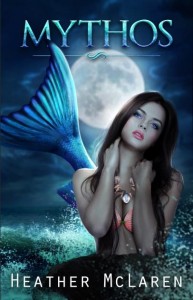 MYTHOS features a great cover (as you see) and an interesting way to bring the myth of Atlantis to modern-day readers. Further, it has the age-old conflict that two lovers must face once they truly know each other: Will they stay together despite it all, or will they end up apart?
I’ve had several e-mail discussions with Ms. McLaren, which has led me to discover that she — like me — believes in the power of persistence. When I asked her what caused the plotline of MYTHOS to come to mind, she said this: “(I started) writing the outline for Mythos and Beyond Legend (due to) boredom in creative writing class during my tenth grade year.” Further questioning elicited the response that MYTHOS has been in development in one fashion or another for twenty years. (More power to her!)
I also asked what kept her going during this whole process. She said, “It was a way to escape from stress. The more I wrote, the more I wanted to finish it.”
Isn’t that a sensible motivation? (I think so, anyway.)
I look forward to reading more of Ms. McLaren’s work because I’m a sucker for updated tales of Atlantis, especially if they’re done well and sensitively. And while so far all I’ve read is a sample chapter (available here), her book looks quite promising!
 The next novel up is Belgian writer Dina von Lowenkraft’s debut novel, DRAGON FIRE. (Ms. von Lowenkraft is pictured at left.) This is a cross-cultural tale set in Norway about a dragon shapeshifter, Rakan, and the woman who loves him, Anna. Both have been told various things about other cultures and other races that may or may not be true . . . will they be able to get past this long enough to express their feelings for one another? And even if they do, will they be able to stay together with everything that stands against them?
 An updated take on dragons that just so happens to have a clash of cultures inherent along with a romance? And one that takes a few jabs at the whole Twilight phenomenon as well?
No wonder Publishers Weekly was intrigued.
More to the point, there’s a reason DRAGON FIRE is next on my reading list for pleasure reading (as alas, I cannot review it at SBR due to our conflict-of-interest policy). I’m always intrigued by cross-cultural tales, especially when they deal with two young lovers who’ve been systematically lied to during most of their short lives. (Sound familiar? It should, considering that’s a big part of ELFY‘s premise. Not that I’m the first person in the history of the world to have come up with that one, as it’s been around since time immemorial.)
BTW, A sample chapter of DRAGON FIRE is available here.
 Finally, Florida writer Scott Eder’s debut novel KNIGHT OF FLAME is also available (he’s pictured at right). I haven’t had a great deal of interaction with Mr. Eder (though I have had some on Facebook), which makes it a little more difficult to discuss what’s going on with his book — but I shall give it my best anyway!
KNIGHT OF FLAME stars Develor Quinteele, a normal-seeming guy from Tampa, Florida. Unknown to most, he’s also known as the sixth Knight of Flame, and has an important task: he must keep the world safe from the Gray Lord, a horrible person who revels in the evil he does . . . and unfortunately has many descendants to help him carry out his horrific plans.
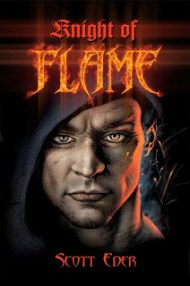 Develor’s control over his powers has never been the world’s best, and he’s turned to the easiest expedient possible — channeling his rage — in order to wield them. But this backfires spectacularly after Develor is falsely accused after a tragedy.
Stripped of his powers, will Develor regain control of himself well enough to get the other Knights to restore his power before it’s too late?
A few sample chapters of KNIGHT OF FLAME are available here. I read them, and was intrigued; there’s a swift writing style here and some excellent worldbuilding. The evil characters are hissable, and the good ones conflicted . . . I can see why Library Journal enjoyed this novel (even if I can’t seem to come up with a link to back it up, Eder’s blog points out the positive review).
At any rate, here are the three newest authors in the Twilight Times Books stable . . . please check them out, and see if their work interests you.
But in case you still need more motivation to check out TTB, take a gander at Maria de Vivo‘s THE COAL ELF. I edited this novel, and can tell you that Ms. de Vivo’s take on Santa Claus, Elves, and their comportment and demeanor is excellent. Witty and sarcastic by turns, heroine Ember leaves the safety of home and hearth to become, of all things, a coal Elf — those who are entrusted with digging out the coal that ends up in the stockings of bad children everywhere. And as you might expect, her job isn’t exactly coveted . . . especially when you consider that there’s never before been a female coal Elf of any sort.
Ember’s journey from rebellious teen Elf to a responsible, albeit still delightfully sarcastic, Elf fully in charge of herself is well worth the reading.
But don’t just take my word for it. Read this sample chapter . . . then come back and tell me if you don’t think Ember’s story is just the antidote to all the sappy Christmas songs you’ve been hearing on the radio lately.
Now, let’s get to reading and enjoying some books, shall we?
 Barb Caffrey's Blog