Archive for the ‘Books’ Category
Where Have You Gone, Judith A. Lansdowne?
Folks, it is no secret that I’m partial to romance novels.
As such, I’ve been asked often what I like about them. Because these are often the oldest stories in the world — boy meets girl, boy either takes to girl right away or can’t stand her (or vice versa), and in the end the couple walks off into the sunset.
This is the case in ninety percent of traditional romances, whether set in a historical period like England’s Regency, or in the current day.
But some romance authors add more. They add wit, charm, style, a certain zing — it’s hard to quantify, but it’s very easy to spot.
Judith A. Lansdowne has this extra ability. From her very first novel, AMELIA’S INTRIGUE (which I recently read via Inter-Library Loan) to her latest, JUST IMPOSSIBLE, Ms. Lansdowne found a way to weave in suspense, intrigue, humor, genuine pathos, and anything else anyone could ever want in a story.
Ms. Lansdowne hasn’t been active as a novelist since 2004. I’ve heard rumors that her husband was not well, or that there was some sort of family health crisis that took her away from her writing.
I have to assume that this is the only reason why her books haven’t re-emerged as e-books in the intervening eleven years. Because these are truly excellent books; they make you laugh, they make you think, they make you wish that every romance had this much charm.
In my own case, I often look at these romances between difficult women — too intelligent, maybe, or too forthright (as they used to put it in the Regency Era, “not quite in the common way”) — and prickly, dangerous, or a bit off-center men and find bits of myself and my late husband in there.
Even in the more “tame” romances, such as MUTINY AT ALMACK’S or JUST IN TIME, there’s always something different, something intriguing, to hold my interest.
Anyway, I don’t know where Ms. Lansdowne is. I’ve never met her. I do know that she, like myself, is an alumna of the University of Wisconsin-Parkside. (She was class of ’75, while I was class of ’94.) And because I know that at least some of my readership consists of Parkside graduates, my hope is that this little blog post will find her.
Because she may be thinking, at this late date, that no one wants to read her writing. And that’s just not true.
Or that her writing didn’t matter, which isn’t true, either.
One, final thought: Over this past week, when I had many disappointments — including the realization that I must push back the release of CHANGING FACES as despite my efforts, it is far from complete — Ms. Lansdowne’s words have given me hope, and have reminded me of what’s important in life.
My husband Michael believed in me, and believed in my writing. Just because I have a lot on my plate right now, that doesn’t at all mean I can’t get it done…I just have to believe in myself, and keep going.
And for the moment, Ms. Lansdowne’s work is helping me stay focused and centered.
So, wherever you are, Ms. Lansdowne, know that you’ve got a new fan in me…eleven years after your latest book came out.
Just Reviewed “Ty Cobb: A Terrible Beauty” at SBR
Folks, I wanted to point your attention toward my latest book review of Charles Leerhsen’s TY COBB: A Terrible Beauty, which is up right now over at Shiny Book Review (SBR for short, as always).
Now, why am I so proud of this review?
I think it has to do with two things. One, Mr. Leerhsen’s baseball scholarship is superb. And two, I was pleased to realize, after reading Leerhsen’s book, that Cobb was not at all the virulent racist he’d been portrayed to be.
See, all of the stuff I thought I knew about Cobb was wrong — well, except for the actual baseball facts. (I knew Cobb hit .367 as a lifetime batting average, for example, and was the all-time hits leader until Pete Rose moved past him in the mid-1980s.)
Basically, Ty Cobb, since his death in 1961, has been the victim of a shoddy narrative. Apparently his “biographer” Al Stump was no such thing; instead, Stump invented the wildest flights of fancy about Cobb, figuring that as there was almost no film or still pictures or even radio accounts of Cobb’s play, Stump could do as he liked and no one would be the wiser.
Besides, monsters sell. So Stump made Cobb a monster.
Leerhsen proved just how fallacious Stump’s account actually was by going back and reading all of the various newspaper reports, which were readily available in the archives. (Thank goodness for archives, eh?) Stump made so many erroneous assumptions that it’s hard to believe Stump didn’t know what he was writing was dead wrong; in fact, Cobb himself was in the midst of a lawsuit at the time of his death, because he’d gotten wind of what Stump was about to do to him in the guise of Cobb’s “autobiography” (which was ghost-written by Stump), and wanted no part of it.
The most egregious fallacy of Stump’s was to paint Cobb as a racist. Cobb was anything but — in fact, according to Leerhsen, Cobb used to sit in the dugout with players like Josh Gibson and Satchel Paige during Negro League games, and famously remarked that “The Negro (ballplayer) should be accepted, and not grudgingly but wholeheartedly.” And Cobb was a big fan of Roy Campanella’s, plus he enjoyed Willie Mays and Jackie Robinson.
And as far as being a mean, nasty, vicious old cuss — well, how mean, vicious and nasty could Ty Cobb have been if he was willing to help the young Joe DiMaggio out when Joe D. signed with the Yankees? (Cobb understood baseball contracts, and young Joe didn’t.) How mean was Cobb when he helped Campanella and his family out after “Campy” became paralyzed? And how vicious was Cobb when, after his playing days were over and he had nothing at all to gain by it, he and Babe Ruth became fast friends?
Leerhsen has dozens of stories about Cobb, and very few of them depict anything close to the man Stump portrayed (and Tommy Lee Jones later masterfully acted in the movie version, Cobb).
While Cobb was a difficult man to know — he was prickly, quick to anger, and settled things with his fists more than once — he was not a monster.
Instead, Cobb appears to be the victim of one of the worst narrative frames in the history of all narrative-framing.
So do, please, read my review of Charles Leerhsen’s book TY COBB: A Terrible Beauty. Then please, if you have any interest whatsoever in early 1900s to the “Roaring Twenties” Americana, baseball history, or just want to find out what’s actually the truth about Ty Cobb, go read his masterful book for yourself.
Time for a July #MFRWhooks Blog Hop, Atlantean Union-Style!
OK, OK…WordPress did something weird here, and posted this a full day earlier than I scheduled it.
I’m still very happy to do the #MFRWhooks Blog Hop for this novella, set in my late husband’s Atlantean Union milieu.
Now, back to my original post.
Folks, I am a proud member of the Marketing for Romance Writers organization. They do a lot of good for authors, most particularly small press and indies…and they’ve given me many tips that I’ve found quite useful.
 One of the other things they do is on every Wednesday, they open up something called “BookHooks.” It’s an opportunity to “hook” new readers, something no writer can do without.
As I have two new releases out — and as I’ve already done a paranormal blog hop or two in previous weeks for Michael’s “Columba and the Cat” novella — I figured I’d rather take part this week with my new military science fiction novella, “To Survive the Maelstrom.” (My late husband is credited, because I wouldn’t have written this story at all without the two thousand words he left behind.)
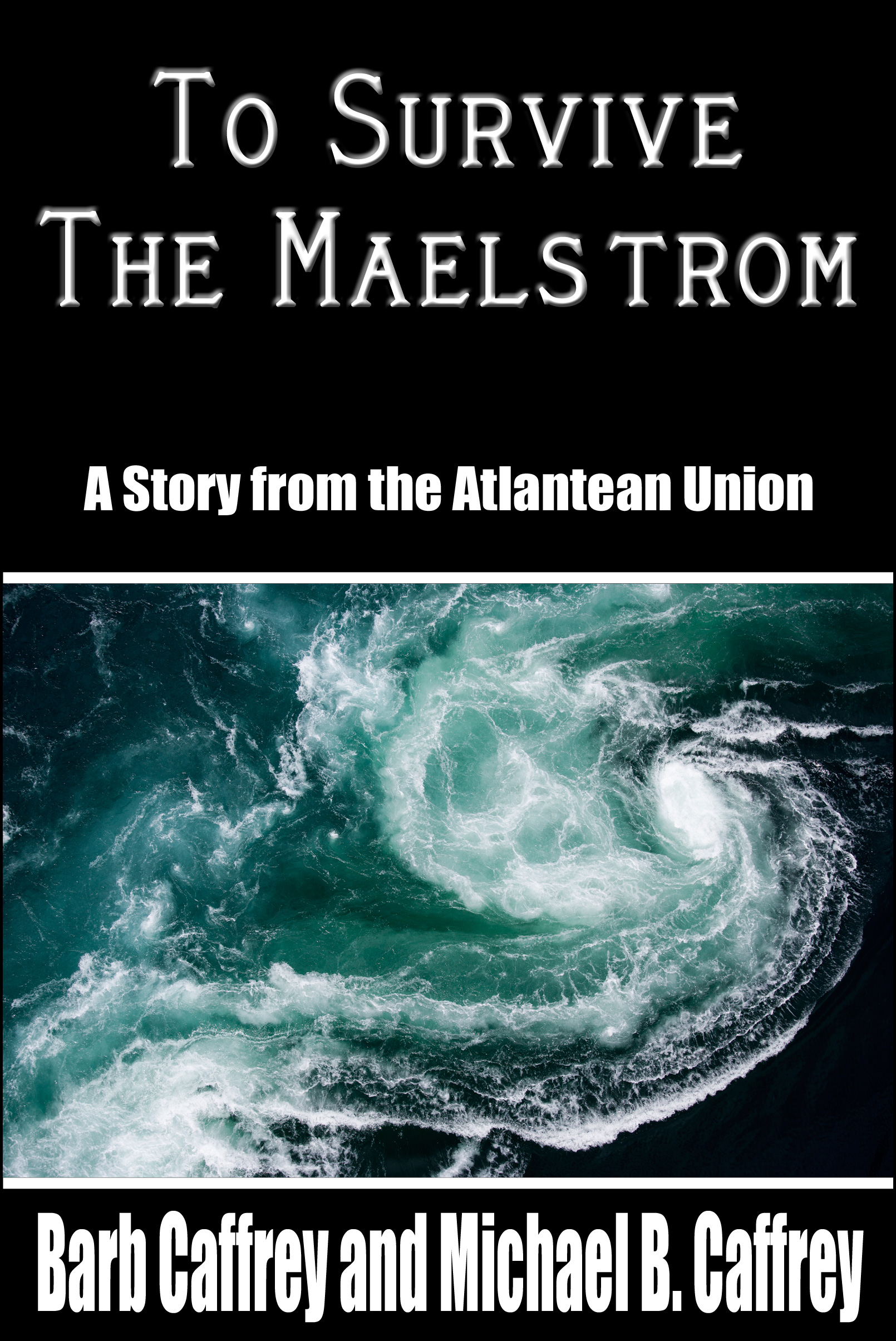 Here’s the blurb:
Command Sergeant-Major Sir Peter Welmsley of the Atlantean Union has lost everything he holds dear. He wonders why he lived, when so many others died at Hunin — including his fiancée, Lydia, and his best friend Chet.
Into his life comes Grasshunter’s Cub, an empathic, sentient creature known to those on Heligoland as a “weremouse.”
Weremice are known for their ability to help their bond-mates. But how can this young weremouse find a way to bring Peter back from the brink of despair and start living again?
And now, a few sentences from “To Survive the Maelstrom” that explain exactly what Peter’s emotional state is before he meets up with his destined weremouse:
How long had it been since he’d smiled? Three months, perhaps? Surely the six months he’d spent in a medically induced coma while his skin regrew didn’t count . . . did it?
Even the pleasant heat of the spring couldn’t keep him away from his thoughts any longer. Why hadn’t the damned pirates left Hunin the Hell alone? Nine times out of ten, they ran; the tenth time, like Hunin, they stood and fought. And this time, they’d landed a lucky shot on HMS Niobe, where Peter had served as a platoon sergeant. Peter had quickly assumed command in the emergency as the senior NCO, considering all of the officers were dead or incapacitated.
But it hadn’t been enough.
Why was he alive, when so many good people were dead?
Now, in case you were intrigued by this sample, go to Amazon forthwith and get yourself a copy. (Right now, Amazon is the only place that has it, though in 90 days I hope to get “To Survive the Maelstrom” up at Barnes and Noble and Smashwords as well.)
And do check out the other participants in this week’s blog hop, will you? They’re all wonderful authors, and you might just find yourself a new favorite if you only give ’em half a chance.
Time for a Paranormal Blog-Hop Wednesday, Elfy-style!
Folks, I’m proud to take part in Paranormal Love Wednesdays’ Blog Hop. I found out about this because I’m a member of Marketing for Romance Writers…as a writer of humorous YA urban fantasy/romance (with ghosts), I thought AN ELFY ON THE LOOSE might find some new readers this way.
And that’s important, especially as A LITTLE ELFY IN BIG TROUBLE is coming soon…
 Let’s see what a bit from AN ELFY ON THE LOOSE, chapter 18, can do, hm?**
Drum roll, please:
“Trust me.” He winked. Bruno was gratified to see Sarah smile at him. It was a small smile, but he wasn’t picky. He’d take any smile he could get.
He walked away from Sarah. The spirit followed him. Bruno almost felt as if he could sense the spirit wondering what he was doing, walking away from Sarah like this. He asked once, “Sarah? Do you feel anything?”
“No, should I?”
“Hmmm,” he said. He decided that since leading the spirit wasn’t doing any good, and trying to contact it directly hadn’t done any good either, he might as well ask it what it was doing there. He walked directly toward it. This time, it stayed put. Bruno felt a sense of astonishment from the shape before he addressed it. “I mean you no harm; neither does Sarah. Can you help us?”
Bruno expected the spirit to do something, but he didn’t really expect what came next. The spirit darted this way and that all over the third floor. Bruno and Sarah were led on a merry chase for a few moments, until it vanished into a wall. The very wall he had been examining when the spirit had appeared.
“Now what?” Sarah asked.
*** END EXCERPT***
Want to know more? First, here’s a blurb for you:
Bruno the Elfy believes he’s very young, has no power, cannot see or talk with spirits, and has no enemies.
He’s wrong.
Quickly sent to our Earth (the Human Realm) and told to watch for magic, Bruno must unravel the lies, keep his mentor from being tortured, and—oh, yeah—figure out why he’s so strongly attracted to young, Human Sarah.
Because his life depends on it.
Now that you’ve read a bit more about AN ELFY ON THE LOOSE, perhaps you’d like to read the five sample chapters? (If so, here they are.)
Or maybe — just maybe — something here intrigued you. If that’s the case, here are my buy links:
Amazon (US): http://amzn.to/1p6xvQj
Amazon (UK): http://goo.gl/dDoBnd
Barnes and Noble: http://tinyurl.com/m8o49ad
And do, please, check out the following authors…they’re all taking part in the Paranormal Love Wednesdays Hop, just as I am:
| 1. | Margo Bond Collins | 6. | Megan Morgan | 11. | Andrea R. Cooper | |||
| 2. | Bokerah | 7. | Dena Garson | 12. | Barb Caffrey | |||
| 3. | Carrie L Wells | 8. | Jo Grafford | 13. | Jodi Hale | |||
| 4. | JoAnne’s Blog | 9. | Helen Henderson |
|
||||
| 5. | Connie Bowen | 10. | J.J. DiBenedetto |
|
————————
**Note that the Paranormal Love Wednesdays’ Blog-Hop asks for only four paragraphs, and I put up six. (Yes, I can count.) I couldn’t figure out how to do it in only four paragraphs…so please forgive me the two extra paragraphs.
Deborah J. Ross Interviewed Me About My Story in “Gifts of Darkover”…and It’s Up!
Folks, I’m absolutely ecstatic that author and editor Deborah J. Ross interviewed me regarding my story, “A Problem of Punishment,” which is included in GIFTS OF DARKOVER. This is my second-ever story in the Darkover universe, and I was very happy to talk about it with Ms. Ross.
Note that my first was in STARS OF DARKOVER, and explains just how and why the first-ever Renunciate judge, Fiona n’ha Gorsali (introduced as a very minor player in THE SHATTERED CHAIN by Darkover series originator Marion Zimmer Bradley), was appointed to the powerful Courts of Arbitration in the first place.
Here’s a bit from my interview with Ms. Ross about my second story:
What inspired my story in Gifts Of Darkover was this: how did Fiona’s parents meet? What was her father Dominic, who I already knew had been a judge before her, really like? And what had made Gorsali fall in love with him, and he with her? A romantic story of a smart man and an accomplished woman against the background of the Hellers appealed to me, especially since they fell in love prior to the Terranan returning to Darkover and didn’t have many role models that would’ve helped them out.
I think you’ll enjoy “A Problem of Punishment” in GIFTS OF DARKOVER. It’s a romantic adventure about a Darkovan judge and the Renunciate he must help rescue. I wrote it because they’re the parents of Fiona n’ha Gorsali, and I wanted to know how they’d fallen in love and created her.
Note that I’m not yet done with Fiona’s life and career. I hope to write another story about her soon, this one about her childhood — because her father, the judge, is why she became a judge…there’s a story there, and I want to tell it!
GIFTS OF DARKOVER is out today…tell your friends, and enjoy the book!
What’s Good About Science Fiction and Fantasy?
Folks, for the past several days I have been wired for sound over this SF&F contretemps (which I referenced here a few days ago).
But I can only handle so much stress. (And make no mistake about it: watching people I respect and admire savage each other is not my idea of a good time.) Which is why when Mary Robinette Kowal put up a post a few days ago asking people to talk with her about being a fan of SF&F, it got me thinking.
What is good about science fiction and/or fantasy? What do I like about it?
At its best, science fiction and fantasy can lift you out of yourself, because both genres are about ideas. And ideas have power, and value, and can inspire…
There are so many wonderful authors out there, and so many great books. They’re full of ideas. And ideas can inspire, entertain, lift you out of yourself, maybe give you a new slant on an old problem…you never know where an idea might lead you, in short.
So what’s good about science fiction and fantasy? Plenty.
Try to remember that, amidst this current controversy. And concentrate on the stories, because it’s the stories that all made us want to be SF&F fans in the first place.
A Quick Monday Update
Folks, I’ve been editing up a storm the past week. Though I still have a lot more work to do, at least I’ve been able to come up for air a little bit so I can write a little blog-let.
But what should I write about today? Hm…good question.
One of these days, I intend to discuss the different types of editing I do, including developmental (also known as content editing), copy-editing, proofreading, and continuity reading.
In other words, there are levels within levels of editing…that’s the main point I’m trying to get at. Developmental editing takes the longest; copy-editing plus a continuity read takes the second-longest; proofreading is the easiest and takes the shortest amount of time, though it’s still not exactly short if you want to do a good job.
Clear as mud, no? (That’s what happens when a huge edit gets finished, and I get short on sleep.)
Anyway, I do have a few interesting things happening this week, including another edit (for myself, this time), a story that I’m working on (currently vexing me, but I hope I’ll have it straightened out soon) that’s due in on March 1, and a guest blog/swap this upcoming Wednesday with author N.N. Light, author of the Christian inspirational fantasy PRINCESS OF THE LIGHT — I’ll be interviewed at her blog, while she’ll have a guest post here at my blog on the same day.
As for reviews, I remain behind. Right now, there are two or three SF&F books in the queue along with two shorter works by Cherylynn Dyess (those may be reviewed together, but are probably still a week off due to my workload) — the books I’m probably going to review next over at Shiny Book Review are Ann Leckie’s ANCILLARY SWORD and Emily St. John Mandel’s STATION ELEVEN, though it’s possible I may review Victoria Alexander’s latest for Romance Saturday instead. (All depends on workload.)
Oh, yes — and did I mention that I have a concert to play with the Racine Concert Band this week, too? That’s this Thursday evening over at Horlick High School, if you live nearby and are interested in coming…I’m playing the alto saxophone for this concert.
Anyway, this is a high workload week. (I’m already exhausted just thinking about it!) But somehow, I’m going to get it done, get my book edited, get the story written, and along the way I’ll definitely have that guest blog exchange with N.N. Light on Wednesday.
One, final thing — since the Milwaukee Brewers Spring Training is officially underway (at least as far as the pitchers and catchers go), I’m definitely thinking about baseball. (So could another story about my baseball-loving psychic, Madame Arletta, and her werewolf husband Fergus be in the offing?)
Stay tuned.
Two New Reviews up at Shiny Book Review (SBR)
Folks, it took me longer than I’d have liked to review two new books over at Shiny Book Review (SBR for short, as always). One was nonfiction, the other was fiction. Both were outstanding.
The first, UNBROKEN CIRCLES FOR SCHOOLS by Ken Johnson, is a nonfiction book about what schools can do to help juvenile offenders. (This is a vast oversimplification, of course.) Mr. Johnson discusses the differences between retributive and restorative justice (the latter is much better, but isn’t often used by our criminal justice system), and how schools can help. Go read my review, then check out this outstanding book.
The second, DEVIL’S LAKE, is a romantic suspense novel by Aaron Paul Lazar. It’s an outstanding novel in every respect, and I was pleased to review it on Valentine’s Day for our Romance Saturday at SBR promotion.
So if you’re looking for something new to read in either nonfiction or fiction, head on over to SBR and take a look at these two reviews.
#MFRWAuthor RT Day is Tomorrow…and Other Stuff
Folks, tomorrow is Marketing for Romance Writers’ monthly ReTweet event. As I’m a member of MarketingforRomanceWriters.org (which you can find on Twitter as @MFRW_ORG), I’ve signed up to take part in something called a “Thunderclap,” which causes many Tweets and Facebook messages to go out at once as I understand it. (I’ve never taken part in a Thunderclap before, so that’s all I can tell you regarding this particular promotion.)

Mind, I always support #MFRWAuthor RT Day — the hashtag works out to “Marketing for Romance Writers Author” and of course “RT” means ReTweet — because I find the Marketing for Romance Writers group to be quite beneficial. They help you to understand marketing, for one (as I’m sure you’d expect, considering their name and all), as they are fellow writers who’ve all walked — or who are now walking — the same path you are. MarketingforRomanceWriters.org tends to help indie or small press authors the most, as we need the most help because we don’t have major publishers behind us. But it’s a group that will help any writer if he or she is willing to acknowledge what they do in return…do check them out (they have both a website and a blog as well as a Yahoo Group), as they are an invaluable resource.
Aside from that, I’ve been editing, doing a spot of writing, and editing some more, as per usual.
I do have some semi-bad news to report as my newest short story was rejected by the Writers of the Future contest. I call this “semi-bad” only because I am happy I wrote the story; while I’d have appreciated it if WOTF had loved it the way I do, it’s OK that they didn’t. (You wouldn’t believe how many thousands of stories they get during each quarter.)
Aside from that, Jason Cordova has been mentioned as a possible choice for the John W. Campbell Award. I know Jason quite well, as I’ve worked with him over at Shiny Book Review for years (yes, I intend to write a review this week; why did you ask?), and I’ve read most of his output. His first novel, CORRUPTOR, came out in 2010, but didn’t sell enough to be considered a first, qualifying pro story — which means he’s still eligible to win the Campbell Award.
“But Barb,” you say. “Aren’t you eligible, too? AN ELFY ON THE LOOSE came out last April, so you should qualify…right?”
Well, therein lies a tale. I sold my first story, a co-written affair with my late husband Michael, to the BEDLAM’S EDGE anthology back in 2004 (edited by Mercedes Lackey and the inestimable Rosemary Edghill). That was definitely a qualifying pro sale under the rules, albeit a qualifying half-sale (as Michael receives credit for the other half, which made perfect sense to me at the time and still does).
My second pro-qualifying sale, I believe, was made last year after I sold a story to STARS OF DARKOVER (edited by Deborah J. Ross and Elisabeth Waters). (I say “I believe” because I can’t remember when SFWA raised their rates for a pro-qualifying story from .05/word to .06/word. Under the new SFWA guidelines, this story would not count.)
And that’s it as far as pro-qualifying sales go. Everything else I’ve written to date, including AN ELFY ON THE LOOSE, leaves me eligible for the Writers of the Future Contest, meaning I’m largely unknown. (Something I’ve said all along, mind.) But because of my one, early half-sale, I believe I am ineligible for the John W. Campbell Award.
Even if I were eligible, I’d be astonished if anyone nominated me.
Why? I’m not known. (Neither is my late husband Michael, despite my efforts to the contrary — and his while he was still here.)
Anyway, Jason’s much better-known than I am. He also has more short stories and novels (some co-written with Eric S. Brown) to his credit than I do, and has more on the way. He definitely deserves to be considered for the Campbell Award as he remains eligible, and I’d love to see him win it.
EDITED TO ADD: My friend Katharine Eliska Kimbriel’s novel SPIRAL PATH is eligible for the World Fantasy Award, the Andre Norton Award, the Nebula, the Hugo Award for Best Novel, and even the Newbery Medal. I reviewed SPIRAL PATH at SBR last September; I’d anxiously awaited it for over a year, and I was not disappointed. So please, do not forget about her and her excellent work…you could not ask for a better writer. (Or a better person, though awards do not measure that, usually.)
Back to my original post, already in progress…
Aside from that, to answer a few questions — Yes, my hand is better. (Thank goodness.) And yes, I’m definitely looking forward to Spring Training. (Go, Brewers, Go!)
If you have any questions for me, go ahead and ask in the comments…I’ll do my best to answer, as always.
 Barb Caffrey's Blog