Archive for the ‘milsf’ Category
Jason Cordova’s “Wraithkin” — and Music?
Folks, it seems to be my week for stories, so let me tell you another one.
Years ago — I’m not sure how many, now — my late husband Michael told me, “Barb, I swear, you think in music, not words.” It was Michael’s contention that every time I wrote something, I was automatically translating it from the music I heard in my head.
I don’t know if that’s true or not, mind. But it was a poetic conceit he enjoyed, and as such, I appreciated it.
For some reason, that came to mind when I recently read an advance reader copy of Jason Cordova’s WRAITHKIN. Something about this book reminds me of a musical suite, and as I’m both a musician and a writer, I thought I’d use that to my advantage to try to explain why I like this book so much.
As I’m having no luck today uploading the cover, here’s the blurb instead:
How far would a man go to protect those he loved? For Gabriel Espinoza, the answer was simple: to the ends of the universe.
When a failed genetic test ruins his life, Gabriel and his fiancée prepare to run to a world where the laws aren’t as strict. There they could remain, in peace, for the remainder of their days, their love unspoiled by the strict regime which controls the Dominion of Man.
But Fate is a cruel, fickle mistress.
Torn from the only woman he had ever loved, Gabriel is prepared to burn the galaxy to get her back.
How far would a man go to protect the empire he was sworn to uphold? For Andrew Espinoza, the answer was a bit more complicated.
Torn between family loyalty and his duty to his country, Andrew must infiltrate a rich and powerful clan to determine if they are plotting against the Dominion of Man, but while undercover he discovers something far darker and more dangerous is lurking in the shadows, and he is the only man who can stop it.
But Fate is a cruel, fickle mistress.
How far will Andrew go to ensure the success of his mission?
One brother must save himself; the other must save the universe. But can either survive long enough to achieve their goal?
Now, here are my musically-related thoughts:
To my mind, WRAITHKIN is like a symphony in four parts. First, we have a slower, quieter, more intense first movement, where all the major themes are laid out. We meet Gabe and Sophie, see their love for one another, see it dashed after Gabe fails a genetic test (technically, he’s supposed to be sterilized right away, but his family is wealthy and powerful and keeps that from happening), and then they attempt to run away.
But Sophie has to pretend to be angry, and leaves her world in feigned grief and despair, meaning she goes out to a lightly defended colony world all but undefended. And when Gabe finds out that world has been attacked, and Sophie is missing, he vows revenge.
Then we have the second movement, which is more about Gabe’s brother, Andrew. Andrew is a spy, pure and simple, or if you’d rather, he’s a chameleon/mole. He has been trained to do what he does, but because of that, he submerges himself in other people’s roles — or, as this is my blog, the music of other people’s thoughts. So while the second movement moves faster, and hints at much, it uses similar themes as the first, but reversed and in retrograde…as befits a symphony, where many things must come together to make a greater whole.
The third movement is about how Gabe meets up with a bunch of guys in his position — they all have failed genetic tests, so are considered expendables, the lowest of the low. But they all want to serve…something. Or at least blow up stuff. So there’s training involved, and a bunch of gadgetry to use, and all the military SF trappings that are required are there for the use…almost as if there’s a template for the third movement.
Still, there are touches of humor. Pathos. Genuine characterization. Friendship, all unlooked for, and camaraderie, too…proving, as if there was any doubt whatsoever, that new music can be reminiscent of older music, but still pack a walloping punch.
Then comes the fourth movement. Andrew and Gabe must somehow complete their joint missions. Will they manage to do this, or won’t they? And what will be the consequences either way?
This fourth movement ties up all the themes of the book nicely, and lays hints for books to come…kind of like how if you’ve heard one symphony by Haydn or Brahms or Mozart, you want to go hear another one if you’re smart. They all have things in common, sure, but they’re all a little different and they all have much to teach you, much for you to appreciate, and much to savor, time after time…
Anyway, I liked Jason’s book quite a bit, in case you couldn’t tell. I think it has a little bit of everything. Slam-bang action. Romance. Family. Friendship. A big canvas, with a dystopian government to be alternately fought and defended…Jason’s writing keeps getting better and better, and this is a story to immerse yourself in fully.
That’s why I compared it to music, and I hope you’ll understand why, once you read it.
(And do go read it, will you? If you like milSF, you will love this book. And even if you don’t, but like big novels full of life and vigor, you will still love this book…)
#MilitarySFSunday: A Guest Post by Martin D. Hall
Folks, a while back I wrote a guest post for Chris the Story-Reading Ape’s busy blog that I re-blogged here called “What is Military Science Fiction, Anyway?” I enjoyed writing that, and thought it might spark a conversation…and, fortunately, it has.
Writer Martin D. Hall (who often writes as M.D. Hall) wrote me a lovely essay, and sent it to me…so, for your Sunday delectation, here it is. Enjoy!
I read an interesting guest post here, entitled: “What is Military Science Fiction, Anyway?” As I explored its message, I thought about the nature of military science fiction. It occurred to me that most sci fi falls into “military”, regardless of whether the writer intends it. This can happen even when, at first sight, it isn’t a prime element, for example: “The Time Machine”, where our traveller ultimately encounters a military force of sorts. “2001” is set against a cold war backdrop. Our intrepid explorers are sent out, ostensibly, to seek contact with a sentient race, but isn’t it likely that those funding the expedition were seeking a military advantage? Once David Bowman metamorphoses into the ‘Star Child’, he returns to Earth, detonates an orbiting warhead, thereby de-escalating a global conflict; we’ll visit “3001” shortly.
In pondering the invasiveness of military elements throughout science fiction, I was like an archaeologist who unearths a first century Roman pot, I brushed away more loose soil, and there it was: the remains of a bronze age dagger. No, it wasn’t a real dagger, but my imagery might be apposite … I uncovered another question: what place does violence occupy in science fiction?
While I’m sure you will find examples of non-military science fiction, it’s hard to find non-violent science fiction … Not impossible, but rare. Invariably, the use of violence, or force, if you will, underpins most the genre, with some modern day readers demanding a quick hit, before their attention wanders. In the case of “2001” they get it when a sure sign of our hairy ancestor’s accelerated evolution – courtesy of the monolith – is to crush another hominid’s head with a club.
How is the violence most easily exploited? In a military scenario, of course. Naturally, for balance, there needs to be political intrigue, and character development within the military arc: the hardening of some characters and the softening of others; the blurring of lines demarcating good and evil; above all humour, but weaving through it all is the use, threat, or fear of violence.
Why is this? Perhaps it’s because, from the comfort of our computer chair/armchair/wheelchair/deckchair, we crave excitement from a safe distance. Like watching contact sports, we can enjoy them without personal risk. Unlike contact sports we can witness the destruction of starships, planetary systems, galaxies and even universes, before taking a break for a cup of coffee (or something a little stronger).
Is this a bad thing? Of course it isn’t and, unlike other genres, it’s highly unlikely that truth will mirror fiction – I know, Captain Kirk used a flip-top mobile phone, and yes, inconsiderate use of said phones leads to anger and, occasionally, violence, but give me a break!
I promised I would return to “3001”. Arthur C. Clarke had charted David Bowman’s rapid evolution into the ‘Star Child’ in “2001”. Yet, at the very end of this book, it’s the human remnant of this not-quite omnipotent being, together with the closer-to-human Hal who will form the bulwark against …? Surprise, surprise: the genocidal, albeit coldly reasoned, aggression of the deity-like beings who started the chain of events on an African plain three million years before. Even these farmers-of-the-Universe, portrayed as benign in “2001”, will ultimately resort to violence at some point beyond the end of this book.
What does all this say about us? It isn’t that we are bored by non-violence, merely that in certain genres, and science fiction is one, we expect violence. Going back to “Star Trek”, Roddenberry didn’t send his creations out to wreak havoc, but even when Kirk, et al, managed to avoid shooting or hitting anyone, a guest protagonist usually did – you can’t even exclude Tribbles because of the threat they posed if unrestrained.
Let me close with another imagining: an alternative reality version of Star Wars, Episode VI. In our reality, we have the ultimate villain – Palpatine – who comes to a violent end. Perhaps we needed to temper this by witnessing the redemption of throat-crusher Darth Vader, but only after we have observed him in the act of crushing throats, or Obi squishing.
The scene is set: over the course of the two earlier films, no one has died, no planets have been destroyed, and Vader hasn’t remodelled anyone’s windpipe. We are on the not-really Death Star for the final confrontation between Luke and Palpatine (with a non-violent Vader looking on):
Vader yawns and tries to scratch his head, but is non-aggressively frustrated by the helmet needed to: a) help him breathe, and b) provide that gloriously rich baritone … The helmet lends no visual aspect of dread, because it is coloured in a non-threatening pastel shade – I leave it to you to decide which shade.
Palpatine: “What do you suggest, young Jedi?”
Luke: “Perhaps we can chat about it over a cup of tea?”
Palpatine: “Earl Grey?”
Luke: “Of course, I’ll even throw in a slice of lemon.”
Palpatine: In an impeccable English accent touched with a soft Scottish burr, following a not-so-sinister chuckle: “No one, who is anyone, drinks Earl Grey with lemon.”
The two laugh, good-humouredly, while Vader pours the tea, and the credits roll to John Williams’ stirring theme.
Did that do it for you?
I didn’t think so.
Nope, that definitely wouldn’t have worked for me. And I can’t imagine audiences watching the two other movies, either, no matter how good the acting or how good the storytelling, if there was no action-adventure, considering the venue. Great post, Martin! Hope to have you back here, soon.
Why I Wrote “Bringer of Chaos: The Origin of Pietas” — a Guest Blog by Kayelle Allen
Folks, do I have a treat for you today!
A few months ago, I edited Kayelle Allen’s BRINGER OF CHAOS: The Origin of Pietas, and couldn’t wait to tell you all about it. Pietas is a strong character, someone who starts out dark, forbidding, and almost impossible to like…but somehow, with Kayelle’s insight, Pietas becomes much more than that. BRINGER OF CHAOS is a science fiction novel of cultural clashes, personal growth, friendship, sacrifice, and much, much more. It’s beautifully written, in some spots deeply moving, and a book I hope everyone will check out right away.
Now, on to Kayelle’s excellent guest blog, already in progress…
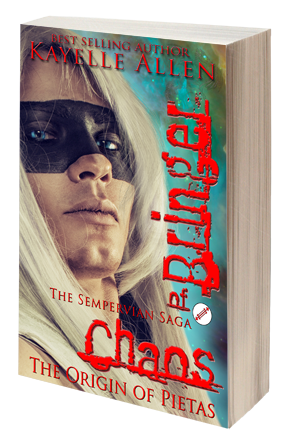 When I wrote Bringer of Chaos: the Origin of Pietas, I was creating the background and origin story for the most notorious villain in my scifi universe. In a series of books based in the Tarthian Empire, I had gone to great lengths to instill a sense of awe and fear in readers regarding the immortal king. Honestly, Pietas scared me, and I created him! I knew the depth of his cruelty because I’d created him to be the baddie all the other baddies feared. In the universe of those stories, he was known by many names: Impaler, Hammer of God, Marauder, Soul Ripper, Destroyer of Worlds, Slayer of Innocents, Hound of Hell, and more famously, the Bringer of Chaos. To reveal the reason he became such a terrifying person, I needed to delve into his head and get to know him better. *Gulp.*
I mentioned to my friend, author Houston Havens, that I didn’t know how to write an emotionless sociopath. First she laughed, then she took me to passages in my own books and showed me the emotions Pietas had displayed. Houston was right. Pietas was far from emotionless. Sociopath was as far from his reality as moonlight is from sunlight. One is cool and pale; the other hot and vibrant. I was trying to write him as a moon. Pietas was a sun.
Houston suggested that we “interview” him. She and I talk almost every day on Skype, so that was easy. I would “be” Pietas and answer on Skype as him. It would be an exercise in free association, and we would record it so I would have reference. Once we got started, it was surprisingly easy to get into his head. She asked him questions that were simple at first. Then she asked about his father, which made me delve into my own past as a child and parent. Mine was innocent and filled with love. My villainous hero, however, had a different bent.
When I was a child, the parent-child bond set my life on a certain path, and I believe no matter how old I get, I will always be the way I was molded to be from childhood. Pietas is immortal, and apparently, so is his love/hate-mostly-hate relationship with his father. Delving into that in detail will take more than one book. In fact, I’ve gone from wondering how I could possibly write a whole book about Pietas to planning another four.
Pietas now fascinates me. Getting to know this character helped me break past an episode of writer’s block that had lasted seven years. I had written, but was producing only non-fiction (Tarthian Empire Companion) and books about the characters (An Immortal’s Guide to Tarth). With Bringer of Chaos out of the way, I’m back where I belong — in the world of the Tarthian Empire. The galaxy of stories beyond that is, as Pietas would say, “ripe for the plucking.”
About Kayelle Allen
Kayelle Allen is a best selling American author. Her unstoppable heroes and heroines include contemporary every day folk, role-playing immortal gamers, futuristic covert agents, and warriors who purr.
Homeworld/Blog https://kayelleallen.com
Twitter https://twitter.com/kayelleallen
Facebook https://facebook.com/kayelleallen.author
About the Book
Bringer of Chaos: the Origin of Pietas
Author: Kayelle Allen
Publisher: Romance Lives Forever Books
Editor: Barb Caffrey
Heat level: PG13
Genre: YA (older young adult), action adventure, science fiction, space opera, military science fiction, space marine, genetic engineering
Wordcount: 52,492
Pages: 186
Two enemy warriors: one human, one immortal. Different in belief, alike in spirit, marooned together on an alien world.
Imprisoned and in isolation over a year without food or water, the immortal Pietas survives. Though broken in body, his intellect and will are intact, thanks to Six, the special ops warrior who captured him, but kept him sane. The warrior had no hand in his deprivation and, like Pietas, was betrayed by his own kind. When Pietas is abandoned on an alien world with nothing but his honor–and Six–he must find and rejoin other immortal exiles. After centuries of war, Pietas detests humans and kills them on sight, but he is too damaged to continue on his own. Though he despises needing help, he allows Six to nurture and restore him to full strength, and then accompany him. As they cross the planet together on foot, the immortal begins to wonder if he has found his first human friend, or if Six is loyal only because Pietas could keep the others from tearing him to shreds. This human will either be his closest living friend, or the one whose betrayal will trigger all-out vengeance by the most powerful immortal ever born.
Immortal. Warrior. Outcasts. Traitors took everything. Except their honor.
Read the first chapter https://kayelleallen.com/chaos-origin/
Amazon http://amzn.to/1R8DAbb
Amazon print http://amzn.to/1SSmueB
CreateSpace http://bit.ly/boc-origin-csp
—————
So, now that you’ve read all this, what are you waiting for? Go get Kayelle’s excellent novel right now. You will not regret it.
Two New Books from Friends to Share…
Folks, it’s Saturday. Time turns to reading, at least for me…sometimes to book reviewing, too (though I’m way behind on that, I do intend to get back to it sooner or later).
Today, I have two great books to share with you, especially if you enjoy military science fiction/adventure stories.
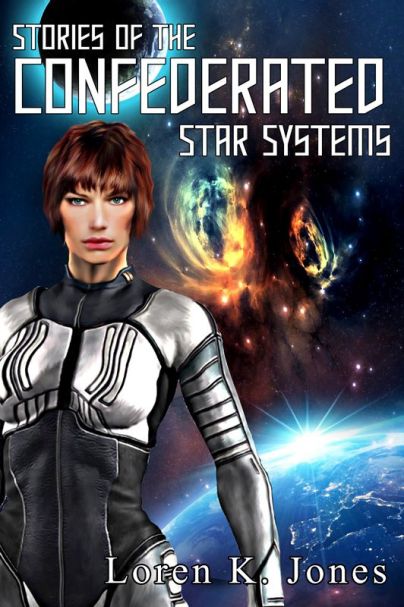 First, my friend Loren K. Jones’s second e-book from Twilight Times Books is out; it’s a short story collection called STORIES OF THE CONFEDERATED STAR SYSTEMS. I edited this book, and it’s a fun, fast read with a lot of great stories…right now, it’s only ninety-nine cents, too! (That won’t last long.) I grabbed my e-book copy right away, and hope you will, too.
Edited to add: If you want a copy from OmniLit, go here; if you want a copy from Barnes and Noble.com, go here. I now return you to your regularly scheduled blog post, already in progress…
“But Barb,” you protest. “I want to know what I’m getting into, before I buy this book, even for ninety-nine cents.”
Ah. Well, I have you covered…there is a free sample of Loren’s newest up right now at the Twilight Times Books website.
“So, who’s your other friend, Barb, that you’re ‘pimping’ today?”
Hmmm. I’d not use that word, quite…it’s more of an informative thing, really.
“Spit it out, Barb.”
OK, OK. My friends Jason Cordova and Chris Smith recently released KRAKEN MARE as an e-book. It’s about a disillusioned former Marine, who stumbles onto a mystery after taking a job on Titan’s moon. But it’s not a benign mystery; oh, no. (That would be too easy.) Instead, it’s a mystery that will “shock the foundations of the universe…something out of a nightmare,” as the book description says.
I don’t have a picture to add to this one…but I can tell you I’ve read several chapters already, and am enjoying it quite a bit. (No one does military SF/horror hybrids quite like Jason Cordova. And Chris Smith’s influence is felt in myriad ways…this book will not disappoint.)
Hope you enjoy them!
Now Available in E-Book: Loren K. Jones’s “Inadvertent Adventures”
Folks, it’s been a while since I was able to announce something fun for one of my friends, but I’m happy to do so tonight.
As some of you might know, Loren K. Jones has been a friend of mine for many years now; he knew my husband Michael well, though by long-distance, and Michael edited for Loren. (I have also edited books and stories for Loren since Michael’s passing.)
Now, Loren’s first novel for Twilight Times Books, INADVERTENT ADVENTURES — a funny military SF adventure — is now available for purchase at Amazon. And for a week or so as an introductory deal, it’ll be available for only ninety-nine cents. (Yes, I grabbed a copy right away. I have no shame.) It will also be available via OmniLit and Barnes and Noble within a day or so.
Loren’s a fine writer, and I’m glad to let you all know his latest novel is available…especially as many of his other works are currently out of print. (Don’t worry; I asked him about this recently, and he told me he’s working on bringing them back. And if INADVERTENT ADVENTURES does as well as I’m hoping, maybe that’ll be sooner rather than later.)
This is a big deal for Loren, and I’m very happy to support him and his efforts.
So, please do take a gander at Loren’s novel — hey, it’s only ninety-nine cents right now, so how could you go wrong? — and then come back and let me know what you think.
Check out #FSFNet’s Blockbuster End of the Year Sale!
Folks, please bookmark this page from now until December 31, 2015.
Why? Well, the Fantasy and Science Fiction Network — a group I’m proud to be a member of — has come together in order to offer a number of books for ninety-nine cents or less. All of these books will be on sale until the end of the year, too…so if you’ve been waiting for prices to come down in order to pick up a new book, now’s your chance.

Here are the five books/stories I contributed to this sale:
AN ELFY ON THE LOOSE, book 1 of the Elfy duology
“To Survive the Maelstrom,” a novella about Space Marine Peter Welmsley.
“Columba and the Cat” (my late husband’s story, which I edited and finished), a romantic fantasy novella.
and both extant novellas of Atlantean Union officer Joey T.Z. Maverick, “A Dark and Stormy Night” and “On Westmount Station.”
All are ninety-nine cents. And the latter four are all available on Kindle Unlimited, so if you are subscribed to that, you can read them for free right now.
There are many great authors in Fantasy and Science Fiction Network, mind; we all write books that are appropriate for ages thirteen on up, and keep to a PG-13 rating or less.
So do, please, take a note of this sale…and let me know what you think of it!
Marketing for Romance Writers’ Blog Features “To Survive the Maelstrom” as part of #Thursday13
Folks, I’d asked to be part of the meme known as #Thursday13 at Marketing for Romance Writers’ busy blog a while ago. I thought letting some folks know about “To Survive the Maelstrom” would be interesting. And all they wanted was for me to post up to thirteen lines of the manuscript…so what could be simpler?
 So if you’ve not read any of “To Survive the Maelstrom” yet, please go over there and read a bit about Command Sergeant-Major Peter Welmsley of the Atlantean Union. Peter was once my late husband Michael’s character, and I found his story so compelling, I wanted to know more.
That’s why I decided to write the story of how Peter meets his empathic companion, a sentient, sapient being known as a weremouse. I knew that someone who’d been so damaged as to need a complete epidermal regeneration must have a story to tell. And fortunately, I was able to figure out what, exactly, that story was.
Peter’s dilemma, you see, is one of many soldiers who come home, realizing the world around them has changed. Or at least the way they perceive the world around them has changed. They are ill in spirit, even if they might’ve been healed in body, and most of them aren’t fortunate enough to find something as accepting, loving and nurturing as a weremouse.
In fact, Peter’s struggles with his own family are alluded to, because they truly don’t seem to understand just how bad he feels. He’s lost nearly everyone he worked with; he lost his fiancée; he lost his best friend. And underneath it all, he feels guilty for surviving — and yet, if he didn’t survive, who would remember his friends? Who would remember Hunin? Who would remember to tell their stories as well as his own?
As a widow, I felt powerfully driven to write this story — not just to complete my late husband Michael’s work (which admittedly is a compelling motivation all on its own), but because I empathized with Peter.
No, I don’t have post-traumatic stress disorder, as Peter almost certainly does. No, I’ve never served in the military (though I was a military wife at one time, and they make enormous sacrifices that mostly go unnoticed). No, if Michael had lived, I probably wouldn’t have done more than edit for my husband, and talk with him about the possibilities here.
But as my life has changed profoundly due to being widowed too young, I understood where Peter was coming from. He’s a full adult. He had his life all planned out. He knew what he wanted, and he knew how to get it.
Then, in one day, everything changed. And he had to pick up the pieces.
Fortunately for Peter, a weremouse is about to change his life for the better. But that does not at all mean Peter doesn’t still have scars — many in places that do not show.
Anyway, I hope you will enjoy my story. (If you’re really sharp, you might even figure out what parts Michael wrote, and what parts I did. Though they’re not obvious…at least, I hope not.)
It’s available now at Amazon, and I hope in a few months’ time to have it up also at Smashwords and BN.com. Do let me know what you think of it.
Some Good News, Some Bad News…
Folks, I have the proverbial “good news, bad news” update to foist upon you today.
First, the good news. A LITTLE ELFY IN BIG TROUBLE will definitely be out in mid-September of 2015 — meaning a month from now — and a small blurb has been put up at the Twilight Times Books site reflecting what A LITTLE ELFY IN BIG TROUBLE is all about:
http://www.twilighttimesbooks.com/News.html#publishing_notes
As the blurb says:
Young Bruno the Elfy and Sarah, his mostly-human teenage girlfriend, are in deep trouble. Bruno’s Elfy mentor Roberto the Wise is about to be sacrificed by Dennis the Dark Elf, with Sarah’s parents’ help. Things look bleak, but Bruno and Sarah have a few allies no one could possibly expect – human, Elfy, and ghosts. Can young love and desperation win out despite it all?
And before you ask — no, I still don’t have cover art.
The bad news? Well, my second quarter story at the Writers of the Future contest, despite being out longer than any other story I’ve ever had, didn’t do anything. It came up with a flat rejection after 137 days.
This particular story is close to my heart in many ways; it is post-apocalyptic military SF with romance.
Now, there is a bit of interesting byplay here, in that I’m reasonably convinced I will be able to sell this elsewhere. (If not as a novella, as a novel.) So my efforts with this story haven’t been wasted…but of course I’m not happy that I’ve come up with yet another rejection at the WotF Contest.
Look. I’ve been trying submissions there for fourteen years now. (Does this mean I don’t know when to quit? I don’t know. It’s just how I am.) I’ve tried just about everything. I’ve tried magical realism. I’ve tried straight SF. I’ve tried fantasy. I’ve tried fantasy/romance. I’ve tried military SF — which is where my two honorable mentions come from — and now I’ve tried this one.
Which got me nowhere.
I do have a submission in already for Quarter 3. I can’t tell you what it is. I can tell you I’d be utterly astonished if this story does anything…not that it’s not a good story, because I think it is, but I don’t think it’s right for the market.
“So, Barb, why did you send it there, then?” you might be asking.
Because I like to submit something to the WotF Contest, just on the off-chance that lightning strikes. I need the boost to my career that the WotF Contest often provides. It seems to provide instant name recognition, which as a small press/indie author I need very badly…and it also gets your name in front of agents and bigger publishers. (Though even so, you still have to be very careful about whatever contracts you might sign. The reputable publishers will tell you that, but in case you’re not sure of the difference between a reputable pub and a disreputable pub, try either Writer Beware or Preditors and Editors. They’ll set you straight.)
Other than that, I wanted to mention that the Racine Concert Band’s free summer concert series at the Racine Zoo is coming to an end later tonight. Show starts at 7 p.m., and soloists this week are Greg and Kathy Berg (vocalists) and Nancy Quist, trumpet.
Hope to see you there!
Book Promotions Coming from July 23 to July 27, 2015
Before I forget — and I’ve got so much going on right now, that’s a real possibility! — I will have two book promotions going on starting on July 23 and ending on July 27, 2015.
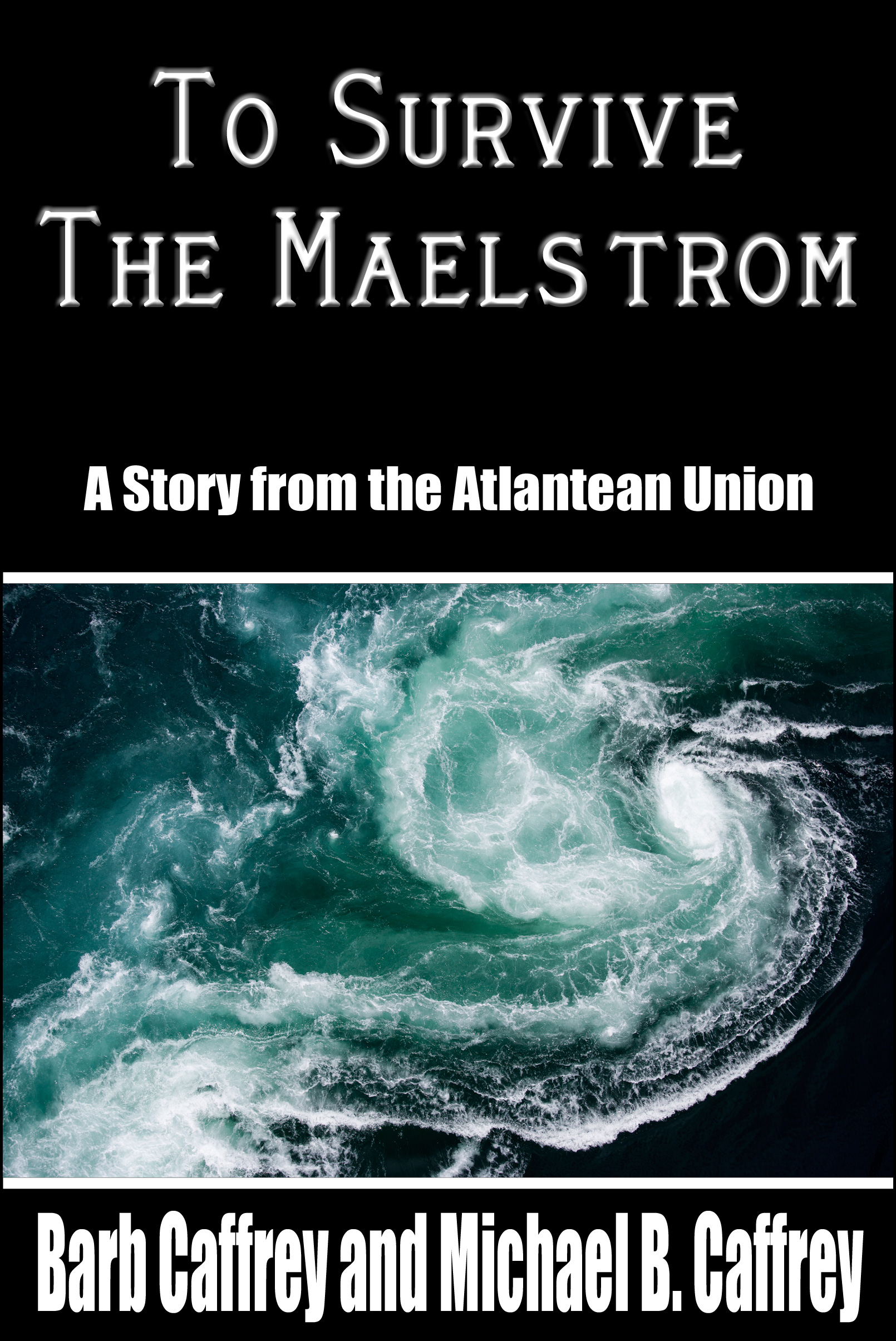 First, I’ve put my military SF story “To Survive the Maelstrom” on a ninety-nine cents deal. (It’s normally priced at $2.99.) It is set in my late husband Michael’s Atlantean Union universe, and thus he is credited second.
What is “To Survive the Maelstrom” about, you ask?
Here’s the blurb:
Command Sergeant-Major Sir Peter Welmsley of the Atlantean Union has lost everything he holds dear. He wonders why he lived, when so many others died at Hunin — including his fiancée, Lydia, and his best friend Chet.
Into his life comes Grasshunter’s Cub, an empathic, sentient creature known to those on Heligoland as a “weremouse.”
Weremice are known for their ability to help their bond-mates. But how can this young weremouse find a way to bring Peter back from the brink of despair and start living again?
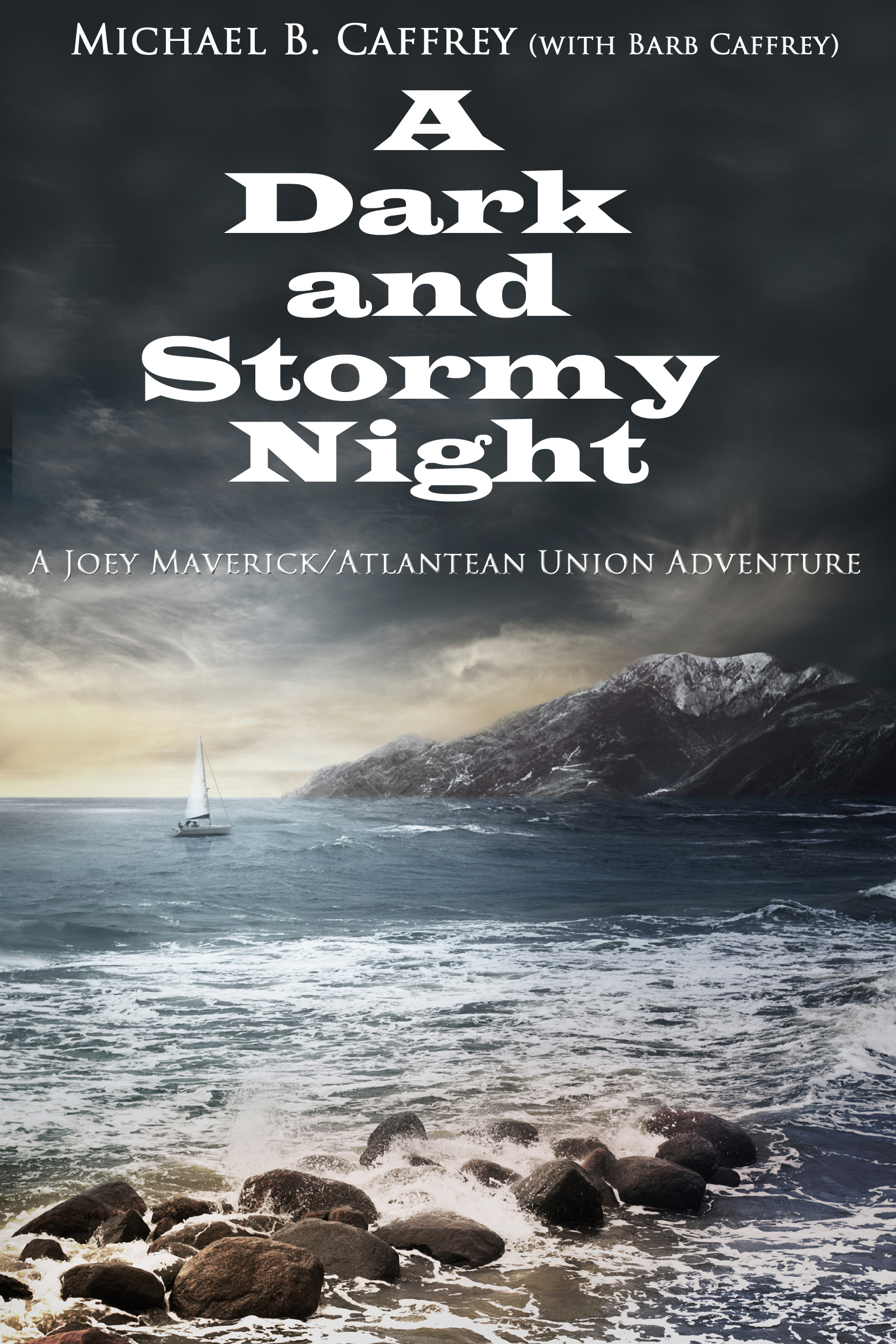
Next, I’ve decided to offer Michael’s “A Dark and Stormy Night” story for free during July 23 to July 27, 2015.
 What’s “A Dark and Stormy Night” about, you ask?
Here’s the blurb:
Joey Maverick, a young Ensign in the Atlantean Union, takes part in a low-tech sailing regatta right before he’s supposed to ship out for space. A storm hits, causing Maverick to take command of his ship and mount a rescue mission. Along the way he picks up stranded nurse Belinda Simpson, along with many others. Sparks fly while the tension mounts . . . what will be the outcome of this dark and stormy night?
Note that both are novellas. I added about a thousand, maybe 1500 words to finish off “A Dark and Stormy Night,” but it is substantially Michael’s story.
Anyway, I figured I’d give you all a heads-up about these book promotions — otherwise, why bother running them? — and now, I have.
Enjoy your Monday, folks!
 Barb Caffrey's Blog