Archive for the ‘Writing’ Category
More Books at the Fall Book Fair…
Folks, as promised, I’m here to let you know about some more books at Viviana MacKade’s Fall Book Fair online event…all of them are e-books priced at ninety-nine cents, and all are interesting reads. (I’ve read all the promos and have read a few of the books, and may be picking up a whole bunch of others. They just look that good.)
Along with my own AN ELFY ON THE LOOSE (which was featured today), my friend Kayelle Allen’s THE LAST VHALGENN was also featured. While I’ve often edited for Kayelle, this story predates me knowing her, much less editing for her — so I can tell you without any prejudice whatsoever that it’s a cracking good story.
 See, Kayelle’s character Raik is a type of supremely loyal woman we rarely see in any stories these days. She’s not perfect, no, but she’s sexy as Hell, smart, funny in her way, loyal to a fault, and because she is a Vhalgenn — a type of super-courtesan for the highest nobles in the land, and completely unable to have children (so no bastards can be sired upon her, meaning most noble wives would probably not mind her as much as they’d mind other mistresses), she has a unique role to play.
And when she’s placed in an impossible position, what will she choose to do? (Because I want you to go to Viviana’s page, I am going to stop right there with my plot summary.)
When I read THE LAST VHALGENN a few years ago, I sat up and went, “Wow. That’s my type of woman!”
And it’s one reason why, when I had the opportunity to talk about one of my friend Jason Cordova’s books earlier this year, I also talked about one of Kayelle’s — because there’s something there that I’ve seen from both of them that I don’t get in a lot of other places. The military detailing is exceptional, and the characterization is so good, the characters almost jump off the page. They are both Navy veterans, too, and I think that makes a big difference when it comes to authenticity. (The rest of us, who aren’t, have to work that much harder…but I digress.)
That’s why my hope was that folks who like Jason’s work but had never heard of Kayelle would go take a look at her books, most especially the two novels about Pietas (a man who you shouldn’t like, considering his violent and extremely difficult and sometimes distasteful attributes, but you can’t help but like anyway — and ultimately, come to admire). I saw a lot about BRINGER OF CHAOS: The Origin of Pietas that I thought Jason’s readers, especially those who adored the three Wraithkin books, would appreciate…maybe down the line more folks will make those cross-connections, but at least I have it out there that if you like one of these writers and their military-themed work (and yes, THE LAST VHALGENN has a military element, too, as she’s not just a courtesan; she’s also a fully trained fighter and tactician and military strategist), you will probably like the other.
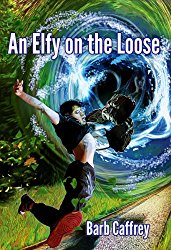 In addition to Kayelle’s excellent work, my own AN ELFY ON THE LOOSE is also featured today. It is a funny fantasy that Jason (in a quote given to me for promotional purposes) said was “quick and witty” and “straddles the line between absurdity and suspense.” (When he gave me that quote, I said, “Thank you!”) And Viviana MacKade saw that, made up a nifty little graphic with that quote, and credits Jason for it (as she should).
How did she know about this? Probably because she read the quotes I had for AN ELFY ON THE LOOSE either at my blog or at my Amazon page, and liked Jason’s the best…and as Jason’s own profile has risen in the last few years, it probably can’t hurt me any that she picked his quote. (I hope it helps. I’d like people to actually read what I’m writing, now and again. Gives me hope that they might want to see some sequels or prequels down the line, as I had a whole lot of ’em plotted out at one time.)
So, if you haven’t read AN ELFY ON THE LOOSE yet, please go take a look at it.
And of course keep an eye on Viviana MacKade’s book fair, as there’s still a few more days to go…lots of great e-books, all priced at just ninety-nine cents! (How can you go wrong?)
It’s Fall Book Fair Time…
Folks, over at Viviana Mackade’s blog this week, she’ll be featuring all sorts of books that are on sale right now (as e-books) for ninety-nine cents. And the first set of authors are up now — ten books, ten authors — so I figured I’d write a little bloglet and let you know this is going on.
Note that later this week, my booksAN ELFY ON THE LOOSE and CHANGING FACES will be part of the fair…so I will be promoting this book fair, and I hope you will check it out also.
Now, back to your regular programming, already in progress…
Yes, We Need Freedom of the Press
Folks, today is a day for action. As a writer, I feel it’s important to let you know that hundreds of newspapers have written and published editorials about the importance of the freedom of the press, due to constant verbal battering by President Donald J. Trump calling any news he dislikes “fake news.” (If you want to know more about it, take a look at the New York Times editorial from today, and then click on a few of the associated publications that are listed. And those aren’t all of them; those are just the ones the Times knows about, as far as I can tell.)
See, the 45th President of the United States complains that all news is fake. Or at least all news that he doesn’t like must be fake. And he constantly proclaims this from the highest mountaintop, letting everyone know he hates the press, he hates everything they say (unless they fawn over him, of course, as they often do on Fox News’ morning programs), and that supposedly the press is “the enemy of the people.”
Um, no, Mr. President. They aren’t.
As a writer, I want you to know where I stand on this.
We need the First Amendment to hold, and as such, we absolutely must have freedom of the press to operate as they will, to find out what they can, and to hold the powerful accountable. (Is that emphatic enough? Do I need to add emojis? GIFs? Frowny faces? Or will this do?)
(Moving on…)
I’ve written for a few newspapers in the past. (Two college papers, and freelance articles in a few other places, to be exact.) We took what we did seriously. We researched. We wrote. We edited. We checked our facts. And then we wrote and edited some more…yes, sometimes errors were still made, but we did our best to correct them. (Something President Trump doesn’t seem too worried about doing, if you ask me. But I digress.)
As today’s Kenosha News‘ editorial put it (this being the closest paper to me that’s taking part in the nationwide effort; my hometown paper, the Racine Journal-Times, did not, which shames me):
Presenting news that you disagree with is not “fake news.” We work hard to inform, serving as watchdogs of government and institutions, while also celebrating the good in the community. This has been going on for decades.
Absolutely correct. And without watchdogs, what would we learn except spin, spin, and more spin?
Here’s why we need the free press: They find stuff out everyone needs to know when the bigwigs in state, local, or federal government (or, perhaps, the very, very wealthy corporations) don’t want anyone to find out.
How would we have learned about big problems that led to the meltdown of Three Mile Island’s nuclear reactor without the press? (Wouldn’t the government have just spun everything, and said everything was fine?) How would we have learned about the Flint water crisis, and all the problems with the pipes, without the press? (Especially as the Governor of Michigan, Rick Snyder, did his best to obfuscate and “happy talk” the problems away until they got so big, they had to be dealt with publicly? Not that they’re over by any stretch, but at least we know about them now.) How would we have known at all about the problems of Senator Joseph McCarthy (who was from Wisconsin), if not for the press? (Wouldn’t Senator McCarthy have continued his reign of terror, accusing people of being Communists willy-nilly, and ruining even more people’s lives, reputations, and livelihoods thereby?)
And those are just three examples. There are many more. (For my conservative friends, think about how Bill Clinton’s affair with Monica Lewinsky would’ve been covered up if there were no journalists. Linda Tripp could’ve spoken until she was blue in the face, but if there was no one to publish what she had to say, other than the folks in her limited circle, who else would’ve known?)
This is why I urge you to please remember that the press is not the “enemy of the people,” no matter who says it, no matter how many times that person says it.
And start thinking about why someone who holds the highest office in the US of A keeps nattering on about “enemies of the people,” hm? Because shouldn’t he have bigger fish to fry, like North Korea? Or better yet, trying to make sure hackers don’t shut down our power grid in the middle of winter?
———–
P.S. And yes, dammit, the Russia investigation needs to be fully investigated, if for no other reason than to find out once and for all what happened. We need to know.
And if nothing happened, well, we need to know that, too. (I wait for facts. But the way this President has behaved, including his atrocious behavior in Helsinki alongside Russian President Vladimir Putin, makes me wonder just what he’s trying to hide. Surely I can’t be the only one?)
Thoughts on Forgiveness
It’s Sunday, so it’s time for another bit of reflection…enjoy.
The topic today is deceptively simple: How do you forgive, especially when you’ve been badly hurt by someone’s actions (or, perhaps, deliberate inaction)?
I’ve thought a lot about this over the years. Because when you refuse to forgive someone else, you’re potentially holding your hurts way too close to you. And those hurts can poison you, if you let them; at best, they hold you back and make you less than what you need to be.
The thing is, how do you forgive someone who either doesn’t ask, won’t ask, or can’t ask you for your forgiveness?
I don’t know the answer to this, and I wish I did.
My husband Michael told me any number of times that it’s impossible to fully forgive someone if you’ve not been asked for forgiveness. While I agreed with him at the time, and still mostly agree with his assertion now, I think it’s better to try — and, potentially, fail — to forgive someone, even if he can’t or won’t ask.
“Ah, but you didn’t say anything about someone who doesn’t ask!” you cry.
That’s because I am still working on that particular problem.
Someone who can’t ask, or won’t ask, is someone who fully realizes that problems have occurred between you, nine times out of ten. So there is an awareness there of wrongdoing, or at least of a significant disagreement that led to a major falling out. But someone who doesn’t ask may be willfully ignorant of what he or she has done, and that willful ignorance will get in the way of anything you try to do on the forgiveness front.
The reason Michael and I talked about this issue with regards to forgiveness is because we had some folks we knew who would make the same mistakes, over and over again, ask forgiveness, and then go out and make the same mistakes again and not care about hurting the same people. They felt they could ask for forgiveness over and over, and that they should automatically be granted forgiveness, without any work on their part, or any true remorse, or any acknowledgment of the pain and suffering they’d caused over the years.
That sort of person does not deserve forgiveness, at least until some hard thought goes into why this pattern repeats over and over again, and effort is made to reduce — or better yet, eliminate — that pattern by the person in question.
I do think most people realize that they will make mistakes. (I know I’ve made my share.) And that sometimes, those mistakes cannot be undone; even if forgiven, the hurt is there, and will always be there, unless both people work to eliminate that pain and figure out how to deal with each other on a more even footing.
So, forgiveness. It’s tough. Sometimes you can’t do it unless someone asks. And even then, you may be unready to forgive, or perhaps unwilling…sometimes, as I’ve said before in this blog (and elsewhere), all you can do is admit that you can’t forgive and leave it up to the Deity.
But I do think you should try, especially if asked. Because holding unnecessary pain inside will poison you, and no one needs that.
What are your thoughts on forgiveness? Share ’em in the comments, and let’s discuss!
Still Writing (A Brutally Honest Essay)
Sometimes — especially lately — I’ve wondered why I write.
Writing, like any creative pursuit, takes a lot of energy to do it well. And if you know anything about me, you know I take as an axiom “whatever’s worth doing is worth doing well.” (I didn’t say that first. Neither did Lois McMaster Bujold, though her character Cordelia Naismith Vorkosigan is famous for saying this. Nope, Philip Stanhope, Fourth Earl of Chesterfield, said it first as far as anyone can tell.)
This past year, I haven’t been able to devote as much time to my writing as I wanted. There were various reasons for this. But the upshot was that life got in the way of my writing, and because life was so all-pervasive, all-emcompassing, and extremely difficult, I lost my belief in myself for a while.
Now, I’m working on getting it back.
The easiest way to get back to work is open up an old MS that you believed in once, and still believe in now, if you can just figure out what else to do. If you open it back up, and don’t judge yourself as you fix a little here, and add a little there, before you know it, you’re back to writing every day.
Or at least every other day.
What complicates matters for me is that I thrive on audience participation. (Maybe that’s the musician in me, the musical training; I don’t know.) And for a writer, the only way for an audience to participate is to share your works-in-progress and talk it out with someone who’s as knowledgeable and as skilled as you are.
(Or at least is working on it and has a keen interest in doing so.)
There are a few ways for me to do this with stories that are further along than what I have, in various private forums I know about. But I haven’t felt confident enough to do just that. And as I always tended to work best alone, but with copious amounts of discussion between a trusted person (my husband, then my best friend, then a few other friends when they had time), I don’t want to put myself out there when I’m still building on the idea that it’s OK for me to put myself first, and my need for writing first as well, over what I’d been doing before.
In other words, I feel fragile. Almost as if what I’m doing won’t stand up, if I look at it too hard. Or that I am perhaps being too emotional about it all, as it means so much to me that it’s almost easier to bury it and leave it alone than get it out, face it, and move on with my creativity intact.
I’m not the only one who’s ever faced this. Most of us do, whether we realize it or not. But most don’t talk about it, because it feels like an illness, something to be hidden away, something shameful, maybe…something others won’t understand, unless they’re writers.
And they, my friends, figure they know what it is, so why talk about it?
I am working on it, and doing what I can to write my way, in my time, however I feel I must, and do what I have to do to feed my creativity. Because that’s undoubtedly where my soul resides; my husband knew it, my good friends have known it also over the years, and while they don’t say much about it, they know when I’m not writing, I’m not happy.
So that’s where I stand right now. Continuing onward, though the road seems dark and the scenery rather depressing. But the sun could come up tomorrow for me, and I want to wait it out, all the while scribbling madly (or typing, rather), to get down my impressions of where I am and where I hope to go.
That’s my strategy. But I would like to know what yours is, especially if you’ve dealt with disappointment, frustration, or “life, interrupted.” The floor is open…comments, anyone?
Why Friendship Is Important
Some days, it’s hard to get by. The world seems like it’s gone crazy. Politics make no sense. Current events show that people are overstressed, overstrained, and are getting into arguments–some deadly–seemingly at the drop of a hint.
It’s on days like that I definitely need the help of my friends. (Hey, it wasn’t just the Beatles who believed they’d get by, providing they had the help of their friends.)
Why? Well, they help keep me grounded, for one…for another, I value their perspectives, their voices, and themselves so much, it takes me out of my own head and makes me realize I’m not all alone in the world.
To me, being someone’s friend means more than “I care about you.” It means, “I care, so I’m going to tell you what I can. Show you what I can. Help you all I can.”
Anything less than that is not enough.
Now, are there different levels of friendships? Sure. You have folks you’re just getting to know, you have folks you’ve known a long time, and you have folks somewhere in between that continuum.
But with all of them, the point remains: if I care, I will do everything I possibly can do to show that I care. And that means if they have a problem, I listen and try to help. If they have a success, I rejoice with them. If they are frustrated, I let them vent; if they are buoyant, I allow myself to be lifted up by them, even if it’s been a horrible day on my end.
See, you have to try to see the other person’s viewpoint, or you’re not truly a friend.
Will my friends and I have differences of opinion? You’d better believe it. But we’ll at least try to agree to disagree because that is what friends do.
(No, they aren’t clones of you. If they are, you’re doing it wrong.)
Lately, I’ve been battling a great deal of frustration. My friends know this. They try to give me hope, or at least give commiseration, understanding, and support…they listen, they empathize, they care, and they make a huge difference thereby.
But I’ve also had to come to the realization — one I truly didn’t want to come to, mind — that there are some people in this world who will profess friendship, but honestly do not mean it. Or they maybe mean it some of the time, but not all of the time, and when the chips are down, they will not listen, they will not help, they will not empathize, and they will not understand.
There’s nothing I can do about people like that. The only thing I can do is remove myself from their consequences, and keep on going, with the friends who’ve proven true and trustworthy by my side.
So, on this Sunday morning, ask yourself the following question:
How can I be a better friend today? (I ask this question of myself all the time.)
Then, when you come up with an answer, go ahead and do whatever you need to do to be that better person.
Because you can choose to do better. You can be that better person, living up to the Golden Rule and treating people the way you, yourself, want to be treated.
And when you make mistakes, as you inevitably will?
Admit to them. (Even when it’s hard.) Apologize for them. (Even when it’s almost impossible.) And be determined to do better, and at least make different mistakes the next time.
That way, your friendship can go forward. And that way, your mistakes won’t weigh you down forever, either…so it’s a win/win.
Try, Try, Try Again
If I have a motto, it’s the above-titled one.
You see, I don’t believe in leaving well enough alone. I keep trying, even when all seems lost. Whether it’s with people, causes, books…while I may set something aside for a time, I don’t give up.
See, setting something aside when you’re tired, or ill, or have had enough, is the smart and sensible thing to do. Because those are times that you shouldn’t overtax yourself, if you can help it.
So, yeah, you can be persistent, but you also have to be smart about it. (I’m still learning about the latter, mind, and tend to learn best from The School of Hard Knocks (TM).) Pick your spots, maybe. And give yourself the leeway to rest, when you can…because as I’ve said before, if you don’t rest well, it’s much harder to access your creative faculties.
I know that to write well, or to compose music at all, I have to have rest. This past year or so, rest has been hard to find for a variety of reasons. But I continue to work hard at finding a way to rest…and finding a way to create, and be my best self, as well as the best person I can possibly be overall.
At any rate, that’s what I’m pondering, this hot July morning. What’s on your mind?
Oh, and for those who’ve asked: Yes, there will be a free concert at the Racine Zoo tonight at 7:30 by the Racine Concert Band, weather permitting of course. (Our first free concert of the year was rained out last week.) Hope you can stop in and hear some free music if you’re in the neighborhood…who knows? You might just enjoy yourself.
The Virtue of Dissent
Folks, there’s been a lot in the news lately about dissent, and about how it’s supposedly unpatriotic to disagree.
I beg to differ.
We need dissent. Or we can’t function as a democracy.
See, when people feel stifled from talking about anything, whether it’s something that is frustrating, unpleasant, difficult, annoying, or any other of a dozen other things that are incredibly hard to discuss, that causes a lot of trouble.
When you feel stifled, when you feel your voice isn’t being heard, that builds resentment. And at best, when you feel that much resentment, you aren’t likely to be looking for any sort of compromise; you’ve already been told compromise is not possible because your point of view is not important.
And yet, in a democracy, every voice is important. And we all get a say.
Being able to discuss problems in a rational manner without yelling at the top of your lungs or telling the other person (or party) that they’re a bunch of blithering idiots is mandatory. But right now, we don’t seem to have too many in the Congress who are willing to be adults and do the people’s work — i.e., compromise for the common good — because they are either blinded by the power or they are daunted by the responsibility.
Whenever we have one party solely in charge of the government — whether it was the Democrats from 2008-2010, or the Republicans from 2016-2018 — that makes it harder for dissenting voices to be heard. And when they aren’t heard, those voices usually become movements. And those movements become akin to steamrollers…witness what happened with the Tea Party in 2010, for example.
That’s what is supposed to happen in a democracy. Those who feel ignored have a right to talk, to assemble, to figure out what they’re going to do, and then they have a right to make their case to the public.
It is a virtue.
That we can see dissent as a virtue was, at one point, uniquely American.
But now, we have a man as President with authoritarian impulses (or at least a great deal of bloviating and authoritarian speech), and he definitely does not seem to think that dissent is valuable, or a virtue, or needed in a democracy.
He wants instead for everyone to follow him. Because he says so.
To my mind, that is not good enough. We have to have reasons for what we do. Logical reasons. And we have to have some basis and forethought and planning behind these logical reasons.
When government officials pop off and do things on the spur of the moment, we get bad law, bad policy, and a whole host of unintended consequences. That, in general, is why you want to have responsible public officials who are willing to call people — regardless of party or power or prestige — on the carpet when they do something that is harmful.
That’s why we need dissent.
We have had one-party rule with vigorous dissent in the past, looking back to WW II, for example. Harry S Truman, then a Senator, held hearings about war profiteering. Most of those he called before him were Democrats, but that didn’t stop him; right was right, and he did the right thing.
That is what brought him to FDR’s attention, and it’s why Truman became FDR’s Vice President in 1944. Without Truman dissenting vigorously, Truman never would’ve become VP, and thus never would’ve ascended to the Presidency after FDR’s passing.
Unfortunately, the Republicans in charge of the House and Senate have not dissented very much. Not with the travel ban. Not with the tariffs. Not with the immigration situation, whether it’s families being split up at the border, DACA, or anything else.
Nope. Instead, they’ve blindly — as a body — done the President’s work, which is not what the Constitution wanted. (We have separation of powers for a reason.)
Yes, individual Republicans, such as Bob Corker or John McCain or a few retiring House Reps, have stepped up and said they believe that the President needs to be checked now and again. That no one should have that much power. And that there’s a reason we have a deliberative body like the Congress…and that they should do their jobs, and uphold their Constitutional responsibilities.
I believe in the power of dissent. I believe it is constructive to dissent, to allow dissent, to understand dissent, and to appreciate dissent. I also believe that if we start to think that dissenting is “unpatriotic” or “anti-American,” we are ceding our rights of dissent and getting nothing back.
I am concerned that we have so many politicians that are (in George Will’s words as heard on MSNBC months ago), “supine” or “craven.” They do not express dissent because of these two horrible characteristics, and thus do not do the people’s business thereby.
My hope is that more people will understand that dissent is healthy, necessary, and essential.
But my fear is that too many people won’t realize what’s at stake, or what could be at stake if the current crop of supine and craven Republicans in the House and Senate continue to refuse to be a check on this President. And that we’ll go further down the garden path of authoritarianism, and lose our abilities to dissent freely and fairly.
What you need to do, if you live in the U.S., is this: Think hard about what you want out of your representatives and Senators. Do you want them to blindly trust anyone without doing their due diligence? Or do you want them to be like Harry Truman, and stand up for what’s right, whether it’s against their own party or not?
Happy Summer Solstice to All…
…and man, do we need it.
Folks, my hope for everyone is that the Summer Solstice (in the Northern Hemisphere) will bring about a positive change.
For me, this is when I start intensively thinking about my husband Michael. Because on this date in 2002, we’d taken out our marriage license. And we celebrated over the weekend as best we could, knowing we would marry on the 24th, which was also the night of a full moon as best I can recall.
We had the whole world to look forward to, then…love, happiness, spiritual fulfillment, the joy of creativity, the joy of emotional and physical and mental and spiritual harmony, and the fun of being around Michael — the funniest, most intelligent, most spiritual and most everything person I have ever known.
I wish our journey together had been longer than a bit over two years. But I will never regret marrying him. Marrying Michael was the best thing I have ever done, and I am very happy that I get to remember him in the ways that I do — at the height of his creative powers, and at his happiest and most content.
For us, the Summer Solstice of 2002 was extremely beneficial.
May your Summer Solstice of 2018 be equally generous.
Little Things Matter (in Relationships, Too)
In a way, this is part two of my last post about how little things matter. But it also stands on its own…enjoy!
Recently, I read something about what makes interpersonal relationships work, whether they’re friendships or something of a romantic nature. I’d expected something profound — yes, even me, someone who’s experienced a successful and happy marriage — but that’s not what the writer talked about.
Nope.
What this writer — whose name escapes me — said was that the way to predict whether a friendship or romantic relationship was going to work well was whether or not you shared the little, mundane, ordinary things with your friend or partner.
And my jaw dropped. (Seriously. It did.)
Maybe this idea, that all the little things — the petty annoyances, the grievances, the frustrations, not to mention the small victories (like remembering to pick up the milk when you’re dead tired, so your partner can have it for her cereal in the morning) — add up to something major may not strike you as earth-shattering.
But here’s the reason it struck me as exactly that.
We’re told all the time that little things like that don’t matter. That we’re supposed to talk about profound things instead. And that if we can’t or won’t talk about deeper issues, there’s no point to being there.
There’s a certain amount of truth to that last part, mind, insofar as you have to be able to talk over deep and difficult things, too. That shows you trust the other person, and without trust, you cannot have intimacy, whether it’s emotional, physical, or any other way there is.
But the reason the little things matter just as much, if not more, than the big revelations that we trust our friends and partners with, is because they show our vulnerability.
See, when we’re willing to talk about how much our feet hurt, or how the traffic on the road was, or any other thing that seems piddly on its face, it all adds up to something much more profound.
Talking about things like that, when taken in their totality, say, “I trust you” to the other person. And as I said before, trust is absolutely essential to any form of intimate, interpersonal contact.
So, when you share your vulnerabilities, you promote deeper connection between yourself and someone else you care about. And you do that not just by the ‘big reveals” of the stuff you don’t trot out on the first date (or even the fiftieth); you do that by showing every day who you are, why you care, and what on Earth you’re doing spending any of your time with your loved one (or friend).
That’s why the little things do matter, in relationships, just as they do in anything else.
What little things do you do to show your friends (and/or loved ones) that you care? And what little things did you never, ever, in a million years think would be important, but maybe actually are? Tell me about them in the comments!
 Barb Caffrey's Blog