Archive for the ‘Writing’ Category
When Creativity (Temporarily) Dries Up
As I’ve said for a few weeks now on my blog, I’ve been dealing with a family health issue that has pushed almost everything else to the back of the line. As that seems to be resolving, my creative life is re-emerging…and as such, I thought I’d write a blog about why I think my creativity (save my editing work) more or less dried up during the recent emergency.
You see, we all have so much energy. (I’ve heard this called “spoon theory” or even “so many f**ks to give,” so whatever terminology works for you.) And when most of it is going to manage an emergency of some sort, there’s just not a lot left.
As there are probably more people out there who have to deal with this sort of thing, or maybe have dealt with it in the past, I know I’m not alone in dealing with the lack of energy or utter exhaustion that dealing with a crisis (along with continuing to do as much of your own work as humanly possible without collapse). But it is difficult, while you’re in the midst of it, to remember that…you feel isolated, almost the loneliest person in the world, and your own needs go to the back burner while you take care of someone else.
This has been called “caregiver fatigue,” and is a known phenomenon.
What makes me feel like myself, more than anything, is to create, whether it’s words, music, or a combination of the two. (That’s how I saw my work on CHANGING FACES, at any rate. I still intend to cut a companion CD of some sort down the line, if I can raise the money for such and regain the energy and strength to play my clarinet at top form.) But I can’t create like this, or at least can’t create very much.
No one can.
You just don’t have enough spoons to play with, as creativity takes a lot of spoons — far more than it seems at the time.
I know, from past experience with traumatic events, that my creative impulses will come back online after I’ve regained strength, rest, and health again. (As dealing with the crisis, especially coming out of two full months of illness, wasn’t easy.) And I look forward to the day I can wake up with a story idea, happily write it down, and think hard about what I’m going to do next without exhausting myself even further.
However, I’m not there yet. And admitting that isn’t easy, because I want to be known as a strong person, someone who can do anything she puts her mind to…someone who writes ten thousand words a week, maybe, as I did while my late husband Michael was alive, and haven’t managed to do consistently ever since.
I think overall that the important thing to remember, if you’re in a situation like I’ve been, is that so long as you’re still alive, and so long as you are doing your best, your talents will re-emerge once there’s sufficient energy for them.
And as a persistent person (I’ve sometimes been called almost pathologically persistent, which I don’t think is exactly a compliment), it’s all I can do now to remember that, and trust — as my niece, Jenni, also a writer, told me — that my creativity isn’t absent. It’s just brooding, waiting, and will burst out of me again once the energy has been restored to allow it to flourish.
What have you done in similar situations to nurture your creativity? Tell me about it in the comments!
We Must Do Better and Insist on Better Health Care (A Collaboration with a Purpose Post)
Sorry ’bout the lengthy title there, folks…on with the show, er, I mean blog.

I am especially cognizant this year of World Health Day due to the myriad of health problems my family has suffered over the past year. Because of all the times we’ve been to the doctor, or in the hospital, or in the rehab center, I am more aware than ever about how we need better quality health care in the United States. (I can’t speak for the rest of the world, though my fellow bloggers have done so brilliantly. Links will follow at the end of this post.)
What I’ve seen shocks me. (And I thought I was unshockable.) A woman who needs hearing aids was in one of the rehab centers my family member dealt with this year, and can’t get them because she can’t afford them. She is over sixty-five, is retired, has Medicare–meaning, she does have state-sponsored insurance that’s subsidized by the federal government–and she still can’t afford hearing aids.
This affects her quality of life.
This affects how she can interact with her family, her grandchildren, and those working with her to help her heal up so she can go home.
There’s something wrong with a country that doesn’t find a way to help someone who needs hearing aids find a way to get them. (She is willing to pay, mind. Her daughter told me that. But it’s a matter of making it affordable so she can, and still eat, pay her bills, and afford her medications.)
Or how about this? I, myself, have dealt with a problem trying to get any help with my vision. I have Obamacare. I am eligible to be seen and get glasses, which would be subsidized (but not free)…yet every time I try to set up an appointment, and I’ve been trying now for over two years, I am told there are none.
So, I continue to wear glasses that are over two years old. My backup pair is over ten years old. My vision hasn’t changed much in all that time, but that doesn’t mean I shouldn’t have a checkup or get another pair of glasses that is perhaps a little bit more up-to-date than my backup pair.
How many other people are out there who can’t afford to pay full price for glasses, thus wait to be seen, and then never get an appointment because it’s supposedly always full?
Then, there’s the problem of paying for medication. My family members have radically different insurance. One has no help at all to pay for her prescriptions. Another has some help. But when your medicines can cost over $300 per month — yes, one of the cardiac meds my mother takes is at least that expensive — the co-pay is still plenty high. And when you’re on a fixed income, in retirement, coming up with that high co-pay is damned difficult.
Why is this considered acceptable?
Then, there’s the problem of getting doctor’s appointments when you’re sick. (I know first-hand about that one, too.) Getting your doctor’s office to even call you back is a pain in the buttinsky. And then, if you do get to talk with a nurse, they just send you to urgent care anyway, so why did you waste your time?
In short, there are major problems with health care.
Right now, we have a proliferation of forms, a proliferation of HMOs, PPOs, and all sorts of other alphabet-type agencies, that basically boil down to, “No, we’re not going to help you.” And that is utterly unacceptable.
Mind, there are wonderful people in health care. I’ve met more great nurses and doctors (much less PAs and CNAs) than I can shake a stick at. These people genuinely want to help, but they are overwhelmed by paperwork and there aren’t enough slots to see everyone who needs to be seen. And nothing at all seems to get done whatsoever about fixing these systemic problems.
The World Health Organization has done this World Health Day since 1948, to call attention to the need for better health care for as many people as possible. (Preferably, it would be for every single last one of us, and that is indeed their goal.) And this year, their slogan is called #HealthForAll.
I think we badly need to be reminded that health must be cultivated. We have to have enough resources to help people get hearing aids when they are on fixed incomes. Or afford expensive cardiac medicines when they are on fixed incomes. Or have access to doctors, nurses, and appropriate care, while being treated as the human beings we are rather than an inconvenience or worse, someone to be brushed off and ignored.
So I’m pleased that the Collaboration with a Purpose group wanted to talk about World Health Day this year. It is something that is close to my heart. And it is something we desperately need — better health care, for as many people as possible, in as many ways as possible, so we all can live better and happier lives.
Because if you don’t have your health, you don’t have anything.
Period.
Now, please go check out my fellow Collaboration with a Purpose group members, as they all have interesting takes on the subject. (Links will be added as their posts go up.)
- Jothish Joseph — “Are You Healthy?”
- Mylene Orillo — “The Truth About Getting Sick in the Philippines“
- Ipuna Black — “Health is a State of Balance: Mind, Body, Spirit“
- Sonyo Estavillo — “#WorldHealthDay & Why #MentalHealthMatters“
- Tajwarr Fatma — “World Health Day” (about mental illness/mental health)
- Nicolle K. — Intro post about World Health Day
- Nicolle’s regular post is up! — “Health for All — Self-Care“
- Jane Love — “Three Vital Components of a Healthy and Balanced Life“
- Gelyka Ruth Dumaraos — “How My Father’s Health Condition Made Me Shift to a Healthier Lifestyle“
- Divyang Shah — “World Health Day!“
- Sadaf Siddiqi — “Health is Wealth“
In Praise of Video Games
Folks, I am tired of video games being blamed for everything. Supposedly, video games are bad for you; they create addictions; they may even lead, some say, to school shootings, especially if you play the more violent games on a regular basis.
Banana mush. (This is my very polite way to say “BS.”)
Why is it, hm, that no one ever talks about the pluses of video games? How they help you test your reflexes, or maybe how they help you figure out unusual solutions to problems, or even that they give you something to do when you’re worrying about a problem and have no other way to get out of your own head?
Seems to me that those three reasons, right there, are good reasons to praise video games. Because problem solving, improving reflexes, and giving yourself a mental “out” when you truly need one and have no others (providing you do this in moderation), are all good things.
I know that I play a number of games, and have for years. From Space Invaders to Pitfall (OK, I’m “old school,” all right?), to Ms. Pac-Man to Tetris, to Castle Age to Candy Crush, I’ve probably played just about everything. (Including “Operation Wolf,” back in the day. And no, I didn’t turn into a gun-toting criminal, thank you.)
Why do I do this, when my life is busy and stressful? I think it’s because of needing that out, along with a need to test my reflexes and improve my problem-solving skills.
It gives me some serenity, to be able to zone out for an hour, playing cards online (yes, I do that, too), or at Club Pogo (yep, I’m a member, and I’m especially partial to the planet-zapping Space Hunt game), or at any number of other places. And this little “mental vacation” allows me to finish up all the other things I need to do…even though I can’t do it every day, the fact that I can do this on some days helps enormously.
At any rate, I wish we’d see more people talk about the positives of playing video games, rather than the negatives. Because there truly are positives…we just need to look at ’em in a different way. (Sometimes I wonder if that’s the case with many things in this world. But I digress…)
What video games do you play, or have you played? Which ones would you say have helped you most, as a person, or given you the most relief over time? Tell me about it in the comments!
Modern Living Has Its Advantages
With all the doom and gloom of the last few weeks, I thought it was time to write a blog about something I truly enjoy: Living in modern times.
You see, as children of the Twentieth (and now, Twenty-First) centuries, we have grown up with many creature comforts that our ancestors never had. And I’m not just talking about smartphones, the internet, or computing.
Think about it. We can get fresh produce in the off-season because of modern-day shipping practices. In the Midwest in winter, we often see produce from Chile, Mexico, Indonesia, and even Africa. These are luxuries that we almost never think about; they’re just there, in the grocery store, waiting to be bought.
(That some of it is more expensive than others, well…comes with the territory, I suppose. But I digress.)
In addition, the array of spices we have available for purchase is astonishing, too. If you go back several centuries, and you study history at all, you’ll realize that wars were fought over the spice trade. They were hard to get, and extremely difficult to keep in stock once traders had acquired them, because of their respective rarity.
And that’s not all.
Think about your modern carry-out dinner. In America, that’s probably pizza and wings; in the UK, it might be fish and chips. Either way, that food you just bought is better for you than what kings used to eat, and is far more quickly prepared, too. (The old-fashioned brick ovens, while pretty to look at and quite useful even now, do take far more time to use. And cauldrons over fires could only cook as fast as what a modern-day slow cooker could do, on average.)
And then, there’s the wide variety of alcoholic spirits. In the US, we can get tequila from Mexico, vodka from Russia, whiskey (from Scotland or Ireland), or any number of other types of alcohol. We are not limited to whatever brewmaster might be available at an alehouse. And while we still do have brewpubs and small-batch beer and the like, that’s now considered to be an optional luxury. Nice to have once in a while, but more pricey than other options.
Of course, to my mind, antibiotics are among the biggest perks of living in these contemporary times. While they aren’t a cure-all, and while there are issues with “superbugs” that are chemically resistant to them, antibiotics have been a lifesaver and a game-changer for many. (Including me.)
So, the next time you think about how frustrating your life is because you don’t have whatever the starlet of the month is hawking on Instagram or Twitter, remember all the things you do. If you live in the Western world in particular, even if you are not wealthy by any stretch of the imagination, you probably live far, far better than most of the kings and queens of yore.
And are far better-educated, too. (But that’s a separate post.)
What modern-day creature comforts can you not live without? Tell me about it in the comments!
Do All You Can…
…even when it doesn’t feel like it’ll be enough.
That is my motto, right now.
As I continue to struggle with my health, I have to remind myself that sometimes, doing all I can means to rest. Recover. Eat as much as I can (with a raw throat, that’s not easy, but it is again possible), and in as balanced a way as I can…take probiotics, to keep the antibiotics I’m on from destroying my gut bacteria…laugh, because it’s better than crying. (Or pulling my hair out.)
I continue to work on my plotting exercise (I talked about this yesterday), and will hope this will keep me from going stir-crazy.
I did write a thousand words today, though it was a different sort of exercise entirely, and was prompted by home internet problems. (I hate that, but it’s a very minor woe, all things considered. At least I can get out and use the internet elsewhere. So it adds a step when I am not at my best. So what?)
And I looked at the two edits in progress, figured out where I am, and have a good idea where I need to be starting tomorrow to finish them both up.
So, I’m staying on top of it as best I can. And am doing whatever I can, even though as I said above, it truly doesn’t feel like enough.
Thinking, Writing, and Illness
Most of us have to deal with illness, and somehow get things done. But when you’re sick (as I am right now), and you are an independent writer and editor, what are you supposed to do about it?
That sounds ridiculous to say, doesn’t it? Because we all struggle with illness. Very few people have charmed lives, and even they have to deal with the illnesses of beloved family and friends (or, sometimes, four-footed companions).
Still, when you’re in my position, and need your mind to do your work, but your mind isn’t at its best, and your body definitely isn’t either…what’s to do?
I’ve been trying to plot a book. This isn’t normally what I do, as I take an idea and run with it; I’m a pantser, not a plotter (that is, I sit down and write whatever it is, and then fix it on the fly). But plotting can’t hurt me, and thus, I’m trying to do that now and see where I get.
This is an exercise given to me by my friend Chris Nuttall (and if you don’t know Chris’s work already, go to Amazon and put his name in there; that’ll give you an idea). I often edit Chris’s work (my latest for him include THE ZERO EQUATION and THUNDER AND LIGHTNING, co-written by Leo Champion; I intend to talk more about both books in upcoming days, once I’ve regained a bit of my energy), and I know how he tends to work; he comes up with plots first, then writes, then tweaks (sometimes, if warranted), then sends to me (or another editor), then fixes, then I (or another editor) may see it one last time if the changes warrant it — otherwise, it goes up for sale. (This is for Chris’s independent work. The work he does through Twilight Times Books, Elsewhen Press, and 47North is a different story.)
I think his thought is interesting. And what I’m trying to do now is figure out who my characters are, what they’re doing, why they’re doing it, and just what’s going to happen along the way. (I also know, me being me, that some of this is subject to change. But it gives me a starting point, and it makes me feel a whole lot better to have work to do along with my editing. Which, by the way, I can still do — I just need a bit more time to do it right now, that’s all.)**
So, there’s thought behind this. Reasoning, purpose, function, and my hope is that it’ll flow into a form that is sensible, logical, and yet feels lifelike and real, like my “pantser” (seat of the pants, natch) novels do. (Or at least I hope they do.)
I’m glad to be able to continue to edit, though a bit slower than usual. I’m also glad that my friends, including Chris, came up with something for me to do of a writing nature so I wouldn’t feel stir-crazy while I’m not at my best. (Writing takes more out of me than editing, just as playing music takes more out of me, physically, than composing it. Though all of them require a goodly amount of mental and physical energy, some are easier to do while ill than others. I hope this makes some sense.)
Now for the big question: What do you do when you feel lousy, but are a creative person and need to express yourself? I’d appreciate hearing any tips you might have in the comments.
———-
**I suppose this is a good time to explain what I’m dealing with: exacerbation of asthma/bronchitis, an ear infection, plus a particularly wicked sinus infection. (I have two antibiotics, a steroid, and have to use my rescue inhaler four times a day until this is gone. When I get sick, I guess it’s go big, or go home. Except I am home…)
Welcome, 2018! New Year’s Resolutions, Anyone? (A Collaboration with a Purpose Post)
Folks, this is the first Collaboration with a Purpose post of 2018. And thus, our group of bloggers decided what would be better than New Year’s resolutions?
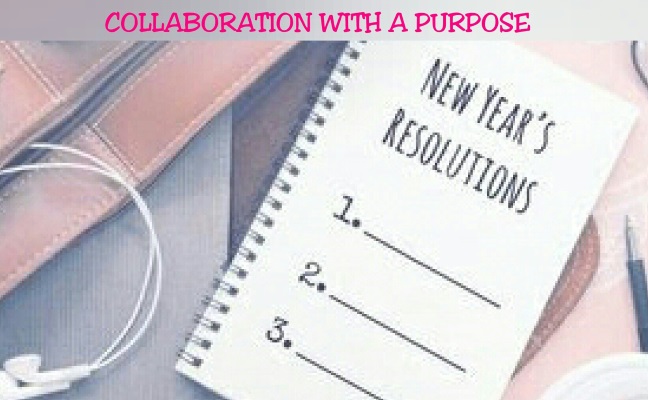
My view of resolutions, mind, is probably not like many of the other bloggers. I figure, you need to first change your attitude, and only then make a resolution to keep that change active. (This is directly opposite how most people approach this.)
Why do I take that tactic? Well, I’ve seen too many people crash and burn when they make a grandiose resolution (or two). Here’s a few resolutions I’ve seen others make that definitely have not worked out:
- Vowing to take more cold baths (I mean, who does this?)
- Exercising more (Too broad; what counts as exercise?)
- Eating less (Too broad; you can eat less, say, of veggies and more chocolate cake, and you’re still technically keeping this resolution)
- Taking up veganism (Nice idea, in theory, but very difficult in practice. Besides, it’s incredibly expensive for most people to do properly, and money is in short supply ’round here.)
- Becoming a vegetarian after being a lifelong meat eater (Again, nice idea. Hard to do. Easier than veganism depending on what type of vegetarian you want to become, providing it’s not vegan.)
Now, what resolutions do I think are possible, after the requisite change in attitude? Here we go:
- Trying to see the other person’s point of view once in a while, even if it’s difficult and seemingly makes no sense. (The mental exercise is good for you. Kind of like taking brisk medicine you really don’t want, granted…but still, good for you.)
- Eating one serving more of fruit or veggies a day. (Starting small is the best way for your change in attitude to work.)
- Finding an hour a day to spend either writing, meditating, or some combination of the two. (This is a good idea and again, it’s starting reasonably small. In my life, usually my paying job of editing takes over, or taking care of my family may take over, or perhaps my health will act up. But trying for one single hour is sensible, even though of course I want much more than that over time.)
- Spending ten minutes a day doing some sort of physical activity (probably walking; maybe if I’m lucky, swimming)
See? The last four resolutions are doable. They require a slight shift in attitude, and to try just a little bit harder. And aren’t flat-out impossible, which is what tends to stop too many people from keeping any of their New Year’s Resolutions in the first place.
Now, I know that some people swear by cold baths. (Seriously.) And yes, some swear by veganism. (Yeah. Really.) And some swear by both at the same time — which sounds a bit odd, but whatever floats their respective boats.
But that isn’t me. I believe in incremental change. I know I can make the effort if it’s small. And small things add up over time to big results, if we only believe those results are possible….and maybe that, ultimately, is what New Year’s resolutions are all about — reminding us that change is indeed possible, if we’re only willing to work for it.
Now, take a look at my fellow bloggers’ views on the subject! Here are links to their blogs…more specific links will be added later, once their posts are up:
- Ipuna Black
- Jane Love @ Harmonious Joy
- Mylene C. Orillo
- Sadaf Siddiqi
- Sonyo Estavillo @ ‘Lil Pick Me Up
- Nicolle K @ Stories of a Highly Sensitive Introvert
And do let me know what you think of this post…especially as we of the Collaboration are looking for more topics to discuss of an inspirational (or at least interesting) nature in 2018.
Dare to Risk (Even When it Hurts)
Folks, it’s been a while since I’ve written a post like this, but here goes:
The most important thing in life is this: You need to remember to dare to risk. Even when it hurts. And even when it doesn’t seem like the risk is worth the reward…do it anyway.
Why am I writing this?
Well, as a writer, every time I sit down to do something with a story, I’m risking the chance of failure.
But as a person, every time I open myself up and am vulnerable to someone, I’m risking the chance of being completely and totally misunderstood. Or unappreciated. Or just…nothing.
I know that. I am not a fool. And I choose to dare that risk, at least in part because it’s the only way, sometimes, to learn something…even if it’s something I’d rather not.
And there are other reasons to dare that risk, too.
Daring to risk is possibly the most important thing I can do, or any writer can do, or any creative person of any possible permutation can do, because it is the only way to express what needs to be expressed. And feeling the pain, sometimes, of risks that don’t work out is necessary, because none of us get through this life unscathed.
I’ve written before about the apocryphal Buddha story–the “search all around the world, daughter, and see if you can find anyone who does not suffer, then report back to me.” Buddha knew, in that story, that every single person had faced suffering of some sort or another, and that it was impossible to live a human life without it.
Now, being married to a Buddhist, I know that suffering is not to be avoided. It’s part of life, as obnoxious as it is to us, and yet thrusting it away causes bigger problems.
Why am I saying all this?
Simply this: I believe, very strongly in fact, that sometimes we have to be prepared to take our lumps. Daring to risk does not mean you’ll always succeed…and it certainly doesn’t mean at all that you will ever succeed, for that matter. But the risk is worth it for its own reward, that of knowing you did everything you possibly could, and then some, to make your dreams come true.
That sometimes there’s nothing you can do? Well, feeling that pain allows you to better inform the stories you write, and make them feel real.
(At least, so I’m telling myself right now. There has to be a reason for it, and that one is as good as any.)
Anyway, don’t let the bad days stop you from daring to risk it all for art, for love, for friendship, or for anything else you feel is worthwhile.
Because the moment you stop risking, that’s the moment you stop living. (Got it?)
———
By the way, folks…later today, I’ll be writing about two books I think you should keep an eye out for, Jason Cordova’s DEVASTATOR (out next week) and Kayelle Allen’s BRINGER OF CHAOS: FORGED IN FIRE. Both are second books in two very good series; both feature believable science and speculation, some darkness, some light, some romance, and are generally cracking good reads. So if you haven’t read Jason’s CORRUPTOR yet or Kayelle’s BRINGER OF CHAOS: THE ORIGINS OF PIETAS either, you really are missing out…can’t wait to tell you more about these two interesting stories. (No, I’m not always doom and gloom, or reminding you to take risks. But yes, do take that risk.)
Reflections on 2017: A Collaboration with a Purpose post
Folks, I am happy to write another blog for Collaboration with a Purpose, this time on the need for personal reflections. As I continue to struggle with a respiratory issue (though I am getting a wee bit better), I’m happy to discuss something that I hope won’t be too controversial…though in this day and age, where people seem to take offense at the drop of a hint, who knows?
So, here’s my take on 2017…ready?

First, let’s talk about the good parts of 2017.
- I’ve made some new friends, particularly among the bloggers who’ve taken part in the Collaboration with a Purpose group, and that’s a wonderful thing.
- CHANGING FACES was completed, at long last, and was published in February as an e-book.
- I realized, not without a lot of effort that I might not have had to put in were I not so hard-headed at times, that the heart can expand to fit wherever it’s needed. There’s always room for another friend, for example…the only trick, if there is one, is to let yourself feel and not censure yourself. (Not that all of your feelings will make sense; nope, that’s too easy. But knowing I can feel deeply again is a very, very good thing.)
- I edited at least fourteen books, most in the SF&F genre.
- My story “To Exist within Memory” was published by the Twilight Times e-zine in October, along with a reprint of my poem “Break the Dark Lens.”
- I played my first musical solo on alto saxophone in over ten years in July, the Isaac Albeniz Tango (with band accompaniment from the Racine Concert Band, of course).
The bad?
- United States politics was completely frustrating, incredibly vexing, sometimes stupefying, and always, always maddening. I just did not understand much of what the government did, nor why they did it, and wondered just how these people thought they should get paid for doing nothing. (Or in some cases, worse than nothing.)
- Roy Moore. (See my recent blog on the subject.)
- I suffered from self-doubt, especially after CHANGING FACES didn’t make much of a dent in the marketplace. I wondered, often, if anyone would ever read what I was writing aside from the occasional blog post, and if not, what my life purpose actually was?
So, it was kind of a mixed bag.
Mostly, though, I’m glad the year is almost over. The good parts of the year outweighed the bad, but 2017 is a year I’ll be happy to put in the rear-view mirror.
Now, go take a look at these other posts from my Collaboration with a Purpose buddies, as they’re all different, all interesting, and all memorable:
 Barb Caffrey's Blog