Archive for the ‘Writing’ Category
Time for a Paranormal Blog-Hop Wednesday, Elfy-style!
Folks, I’m proud to take part in Paranormal Love Wednesdays’ Blog Hop. I found out about this because I’m a member of Marketing for Romance Writers…as a writer of humorous YA urban fantasy/romance (with ghosts), I thought AN ELFY ON THE LOOSE might find some new readers this way.
And that’s important, especially as A LITTLE ELFY IN BIG TROUBLE is coming soon…
 Let’s see what a bit from AN ELFY ON THE LOOSE, chapter 18, can do, hm?**
Drum roll, please:
“Trust me.” He winked. Bruno was gratified to see Sarah smile at him. It was a small smile, but he wasn’t picky. He’d take any smile he could get.
He walked away from Sarah. The spirit followed him. Bruno almost felt as if he could sense the spirit wondering what he was doing, walking away from Sarah like this. He asked once, “Sarah? Do you feel anything?”
“No, should I?”
“Hmmm,” he said. He decided that since leading the spirit wasn’t doing any good, and trying to contact it directly hadn’t done any good either, he might as well ask it what it was doing there. He walked directly toward it. This time, it stayed put. Bruno felt a sense of astonishment from the shape before he addressed it. “I mean you no harm; neither does Sarah. Can you help us?”
Bruno expected the spirit to do something, but he didn’t really expect what came next. The spirit darted this way and that all over the third floor. Bruno and Sarah were led on a merry chase for a few moments, until it vanished into a wall. The very wall he had been examining when the spirit had appeared.
“Now what?” Sarah asked.
*** END EXCERPT***
Want to know more? First, here’s a blurb for you:
Bruno the Elfy believes he’s very young, has no power, cannot see or talk with spirits, and has no enemies.
He’s wrong.
Quickly sent to our Earth (the Human Realm) and told to watch for magic, Bruno must unravel the lies, keep his mentor from being tortured, and—oh, yeah—figure out why he’s so strongly attracted to young, Human Sarah.
Because his life depends on it.
Now that you’ve read a bit more about AN ELFY ON THE LOOSE, perhaps you’d like to read the five sample chapters? (If so, here they are.)
Or maybe — just maybe — something here intrigued you. If that’s the case, here are my buy links:
Amazon (US): http://amzn.to/1p6xvQj
Amazon (UK): http://goo.gl/dDoBnd
Barnes and Noble: http://tinyurl.com/m8o49ad
And do, please, check out the following authors…they’re all taking part in the Paranormal Love Wednesdays Hop, just as I am:
| 1. | Margo Bond Collins | 6. | Megan Morgan | 11. | Andrea R. Cooper | |||
| 2. | Bokerah | 7. | Dena Garson | 12. | Barb Caffrey | |||
| 3. | Carrie L Wells | 8. | Jo Grafford | 13. | Jodi Hale | |||
| 4. | JoAnne’s Blog | 9. | Helen Henderson |
|
||||
| 5. | Connie Bowen | 10. | J.J. DiBenedetto |
|
————————
**Note that the Paranormal Love Wednesdays’ Blog-Hop asks for only four paragraphs, and I put up six. (Yes, I can count.) I couldn’t figure out how to do it in only four paragraphs…so please forgive me the two extra paragraphs.
Friday Inspiration — Who Are Your Heroes?
Friday’s inspirational thought is this: Who are your heroes? And why are they important to you?
Why are heroes important? They give us reasons to keep trying.
Long before I ever knew I wanted to be a writer, I knew who my heroes were. Henry Aaron. Ernie Banks. Larry Doby. And Jackie Robinson. Men who broke the color line in major league baseball, who dealt with gratuitous insults with grace and dignity.
Oh, I had others, too. Helen Keller, for learning and thriving despite being both blind and deaf. Florence Nightingale, for being willing to nurse the sick and for preaching the importance of proper sanitation. Art Pepper for getting away from heroin and resuming his jazz career in his early fifties…and Benny Goodman, for proving that a strong jazz clarinetist could play Mozart with equal ease.
Those are just a few of my heroes.
So who are your heroes? Why do they matter to you?
And one additional question for my fellow writers out there: How have your heroes factored into your writing?
A Monday Editing Blog (AKA, “What’s the Deal with the Second Half of ELFY, Barb?”)
Folks, it’s been an interesting week around Chez Caffrey.
As most of you know, I’ve been struggling with my final edit for the second half of the ELFY duology, now titled A LITTLE ELFY IN BIG TROUBLE. (I like this title.) I haven’t discussed why I’ve been struggling so much, but there have been three things getting in my way.
Today seems like the time to discuss these things.
First, I’ve been doing a good amount of occupational therapy for my hands. They haven’t been good since I suffered a bad burn in February; that burn, which was to the left forefinger and left middle finger, set off a bad carpal tunnel flare-up. I went to the doctor, got treatment, and started doing exercises.
After almost two months of exercises, I’m now back to the point where I can type a good four or five hours every night. I still must needs take breaks, and of course I have to keep doing my exercises as well. But things have improved.
The second reason why I have been having trouble is because I wrote the book twelve-plus years ago. Times have changed. Some specific references needed to be updated. And because the book was split, I had to try to make the book appear like it could stand alone…though no matter what I do, it’s going to lean heavily on the first half of the book (AN ELFY ON THE LOOSE), as that’s by design.
(Clear as mud, right?)
My third reason for needing to take time with this? Well, you have to be in the right frame of mind to see what is actually in your own manuscript rather than what you think is there. This is the main reason most authors do not edit themselves; granted, I had an editor do the first pass for me, and I’m following what she said when I agree with it. But the editor didn’t read the first half of the novel, and that means some of what she said has to be taken with a huge grain of salt.
Now, I’m very fortunate in that I have two great mentors in my corner this time around: Stephanie Osborn and Katharine Eliska Kimbriel. They both have looked at my revised first chapter and have given me excellent advice. They also have been a strong sounding board, and have listened as I’ve wrestled with this final edit for the past several months.
What I try to do with the Elfyverse is to be consistent. I want to tell the best story I can. I’ve improved my actual writing mechanics a great deal since I originally wrote ELFY in 2002-3, and I want to reflect that…but I don’t want to take all the life out of the story, either.
It’s because I had this twelve-year break in the action that I can edit for myself at all.
And make no mistake about it: This is a full-on edit. It is not editorial changes, which is a much different animal. This is my own take on my own work, yes, but it’s also my older and wiser self editing my younger and more exuberant self, while trying to keep track of all the details — you may feel free to read “keep all the balls in the air” if you wish — at the same time.
So to answer the question I posed in my title…the deal with the second half of ELFY is that I’m working hard on it, and I hope to have it in to my long-suffering publisher very soon.
At that point, I’ll find out what the revised timetable is for publication, and I’ll be glad to trumpet that all over the Internet.
But until then, wish me well as I continue to recover from the worst carpal tunnel flare-up I’ve had in years. As I definitely need all the well-wishing I can get.
Whither Writing, or, How to Stop Getting in Your Own Way
Folks, I keep meaning to write this little bloglet about writing, and time keeps slipping away.
Why? Well, I’m still ensconced in my final edit of A LITTLE ELFY IN BIG TROUBLE. Were my hands a bit better — I’ve been dealing with a flare-up of my carpal tunnel syndrome for the past few months — it would’ve been done by now.
So I thought to myself today, “Why am I judging myself by other people’s standards?”
Writing is an individual pursuit. Anyone who writes knows this. We all have different styles of writing, different ways of writing, and different habits away from writing, all of which adds up to one thing: we are individuals, doing individual pursuits.
Before you say it…I know this is obvious. But sometimes, you must point out the obvious.
Especially when you tend to forget about it, as most of us do.
So here’s my thought: We are all individuals, right? So why do we try to judge our writing progress by anyone else’s standards?
I know, I know. There are some standards that seem irrefutable.
But if I try, say, to judge what I’m doing by what my friends are doing, I’m going to lose.
Then again, if they judge themselves by what I’m doing, they might lose, too. Especially as I don’t know what their standards are; only they do.
Look, folks. You have to judge yourself solely by what you do. And you have to allow yourself to be yourself: an individual voice doing individual things in an individual way.
That’s how you stop getting in your own way, as a writer or in life.
Think about it.
Deborah J. Ross Interviewed Me About My Story in “Gifts of Darkover”…and It’s Up!
Folks, I’m absolutely ecstatic that author and editor Deborah J. Ross interviewed me regarding my story, “A Problem of Punishment,” which is included in GIFTS OF DARKOVER. This is my second-ever story in the Darkover universe, and I was very happy to talk about it with Ms. Ross.
Note that my first was in STARS OF DARKOVER, and explains just how and why the first-ever Renunciate judge, Fiona n’ha Gorsali (introduced as a very minor player in THE SHATTERED CHAIN by Darkover series originator Marion Zimmer Bradley), was appointed to the powerful Courts of Arbitration in the first place.
Here’s a bit from my interview with Ms. Ross about my second story:
What inspired my story in Gifts Of Darkover was this: how did Fiona’s parents meet? What was her father Dominic, who I already knew had been a judge before her, really like? And what had made Gorsali fall in love with him, and he with her? A romantic story of a smart man and an accomplished woman against the background of the Hellers appealed to me, especially since they fell in love prior to the Terranan returning to Darkover and didn’t have many role models that would’ve helped them out.
I think you’ll enjoy “A Problem of Punishment” in GIFTS OF DARKOVER. It’s a romantic adventure about a Darkovan judge and the Renunciate he must help rescue. I wrote it because they’re the parents of Fiona n’ha Gorsali, and I wanted to know how they’d fallen in love and created her.
Note that I’m not yet done with Fiona’s life and career. I hope to write another story about her soon, this one about her childhood — because her father, the judge, is why she became a judge…there’s a story there, and I want to tell it!
GIFTS OF DARKOVER is out today…tell your friends, and enjoy the book!
Seven Things You May Not Know About My Writing
A few days ago, author Aaron Lazar tagged me on Facebook with a new type of blog challenge: Name seven things people probably don’t know about your writing, and link back to him.
As Aaron gave his list on Facebook, I can’t link properly to his list. (I can only link to his webpage instead.) But I can write down seven things people may not know about my writing…and here they are.
- I’ve been a writer since age ten. My first story was about a girl who wanted to be a ballboy at Milwaukee County Stadium. (There was no such thing as a “ballgirl” in the 1980s.) She was prepubescent and looked like the guys; her parents and the team were in on the deception, and gave her a room all to herself to change in. She was OK until she started a friendship with one of the other ballboys…and then I didn’t know what to do, so I ended the story. (Hey, I was only ten.)
- I started writing poetry and science fiction stories when I was a teenager; I started writing fantasy in my twenties.
- True story: In my high school creative writing class, the teacher asked everyone to grade themselves. (We had to come up with a grade for ourselves, and defend it.) I was the only person to go in and say, “I deserve an A.” (And I got my A, too.)
- My first-ever short fiction was a SF story about characters from the “Star Trek” lower decks. (Yes, this was long before Star Trek: The Next Generation came out, much less the episode with the low-ranking officers.) I got a note back with my rejection, but as I was only 19, I didn’t know that meant I was doing something right. So I put my writing aside for a time.
- I started writing nonfiction again around age 27, and worked as an opinion and arts and entertainment reporter for the Parkside Ranger News (the student newspaper of the University of Wisconsin-Parkside).
- Later, I was the only non-journalism Master’s candidate to ever write regularly for the Daily Nebraskan. (This is the student newspaper of the University of Nebraska-Lincoln. One of my regular “beats” was to let the arts and entertainment writers know what was available. Usually I wrote the stories myself, but occasionally someone else would be sent out to attend an opera or band performance.)
- The ELFY duology was not my first-ever attempt at a full-length fantasy. CHANGING FACES was my first attempt…but I couldn’t figure out how to end the story until I met my late husband Michael. And by that time, I’d started ELFY, so I put CHANGING FACES aside for a while.
Now for a few bonus facts:
- The first writers I remember reading in the SF&F genre were Poul Anderson (especially the Dominic Flandry series), Andre Norton, and Isaac Asimov.
- The comedic fantasy and SF writers I’ve enjoyed include Piers Anthony, Robert Asprin, Esther Friesner, Jody Lynn Nye, and Douglas Adams.
- My late husband Michael helped me come up with the Bilre language (used by the Elfys).
So how’s that for a few interesting factoids?
Now, as for some other writers to tag? How about Jason Cordova, Chris Nuttall, and Mrs. N.N.P. Light?
What’s Good About Science Fiction and Fantasy?
Folks, for the past several days I have been wired for sound over this SF&F contretemps (which I referenced here a few days ago).
But I can only handle so much stress. (And make no mistake about it: watching people I respect and admire savage each other is not my idea of a good time.) Which is why when Mary Robinette Kowal put up a post a few days ago asking people to talk with her about being a fan of SF&F, it got me thinking.
What is good about science fiction and/or fantasy? What do I like about it?
At its best, science fiction and fantasy can lift you out of yourself, because both genres are about ideas. And ideas have power, and value, and can inspire…
There are so many wonderful authors out there, and so many great books. They’re full of ideas. And ideas can inspire, entertain, lift you out of yourself, maybe give you a new slant on an old problem…you never know where an idea might lead you, in short.
So what’s good about science fiction and fantasy? Plenty.
Try to remember that, amidst this current controversy. And concentrate on the stories, because it’s the stories that all made us want to be SF&F fans in the first place.
Friendship, and the SF Controversy “du jour”
Folks, I continue to be consumed by my edit for A LITTLE ELFY IN BIG TROUBLE, which is the main reason I haven’t been online to blog in the past week-plus.
But there are other reasons.
One of them caused me to ponder what the meaning of the word “friendship” is all about. For when someone knows you for a long time, there is a presumption that if there’s a disagreement — regardless of what the disagreement is about — the other person will listen to you.
He or she may not agree with what you’ve said. But the other person will at least listen, and try to understand.
During this past week, I’ve seen more distress coming out of the community of science fiction and fantasy writers than I’ve ever seen before. I can’t really summarize this for people who don’t understand it, and it seems like “inside baseball” unless you’ve been caught in the crosshairs of this particular bit of internecine strife.
But the upshot of it is this: Writers are fighting other writers, mostly using words — something writers are very good at using, by definition. And rather than trying to find any common ground with one another, writers are continuing to duke it out with our words instead.
How does this have anything to do with friendship, you ask?
It’s simple. I have a friend, Jason Cordova, who got nominated for one of the most prestigious awards in SF&F — the John W. Campbell Award. He got nominated due to the auspices of a group that many other long-term SF&F writers do not like (this group being called the “Sad Puppies”). Jason was not the only writer to be nominated by the “Sad Puppies,” mind you, but he’s the one I know the best.
He is my friend. (You may have gathered this, yes?)
So when some long-term writers started saying that all the people who’d been nominated by the “Sad Puppies” were racists, or homophobic bigots, or the like, I protested. (Anyone who regularly reads my blog knows that I am not shy about such things.)
Jason is Hispanic. He has a sister who’s married to another woman. He is far from wealthy. He is an honored and honorable veteran of the military. And he’s written some lovely short stories along with his solo novel, CORRUPTOR, and several co-written novels with Eric S. Brown, most particularly KAIJU APOCALYPSE and MURDER WORLD.
I don’t think Jason in a million years thought that he’d ever be considered for the John W. Campbell Award, whether the “Sad Puppies” nominated him or not. But he was.
And, being a friend, I congratulated him. And then defended him, even though he probably did not need my defense, because that is what friends do.
To make things a bit more complex, one of the people who was upset was also my friend. This person saw my defense and became irate.
Instead of asking me what I was about, this person walked away. At this point, I don’t know if this person will ever return, either.
Now, there’s a whole lot I’m leaving out, partly by design. (As I said, it’s “inside baseball” for those who aren’t following it — lucky you.)
But the important thing is this: If you are my friend, I know we’re not always going to agree on everything.
(How boring would the world be if we did? But I digress.)
What I would hope we’d agree on is the fact that our friendship deserves at least a little care. A little understanding. A little bit of hope that maybe, just maybe, common ground can be re-established.
I don’t know how many times I’ve gotten upset with my friends, including Jason at times. I’m sure he’s gotten upset with me, too. We don’t agree in our political philosophy, we don’t always agree on other issues…but we are friends, and we work things out — sometimes by agreeing to disagree, sometimes by trying to meet each other halfway.
This is what friends do.
I wish that the SF&F community could try to do that now. Because SF&F writers have far more in common with each other than we do with anyone else…and it’s sad that instead of using our immense energy and creativity to create new worlds with, we’re instead savaging each other.
And as for my other friend? I will care about this person until the day I die. I owe this person a great deal, and I haven’t forgotten this.
But like Lillian Hellman, I will not cut my conscience to fit this year’s fashions.
******
Note: I thought long and hard before writing this. I am willing to discuss the issues of friendship and whether or not SF&F writers can somehow try to find common ground with one another again. Anything else will probably raise my blood pressure unduly; besides, there are many other places discussing these issues in far greater depth than I am.
I’ve taken a general course mostly because I wanted those who are just finding out about this issue to understand just how messy this nonsense is. I’ve already lost one friend over this because I chose to defend another friend I felt was being unjustly attacked.
I neither like nor dislike the “Sad Puppies.” I do respect many of them, most particularly Brad Torgersen and Amanda S. Green. (Before anyone asks, we’re not going to discuss the merits of the “Rabid Puppies” group right now. Or the lack thereof.) I feel they have a right to be heard, and under the rules, they did nothing objectionable. But to some, me saying that is like waving a red flag in front of a bull.
And I neither like nor dislike the vast majority of writers on the other side of this mess.
One thing I do know, though: No one should be threatening anyone else over this. Ever.
Anyway, the floor is open. I welcome comments, providing they are civil. Any that aren’t will be deleted. (You have been warned.)
Time for a February #MFRWHooks Blog!
It’s time for a Marketing for Romance Writers Book Hooks promotion! And as it’s a whole lot easier to write that as a hashtag (#MFRWHooks, for short), I think I’ll just do that for the remainder of this blog.
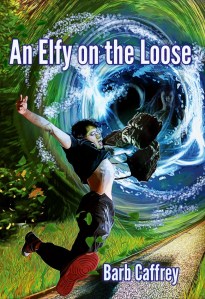 In combination with #MFRWAuthor ReTweet Day (which I discussed yesterday), I decided to take part in this week’s #MFRWHooks. I’ve done this before, as it’s an excellent way to let new readers know about my comic YA urban fantasy/romance novel, AN ELFY ON THE LOOSE (say that five times fast — I dare you!).
So without further ado…let the #MFRWHooks Blog Hop, February 11, 2015, edition, begin!

The rules of the #MFRWHooks blog hop are simple: You post six to eight lines of your novel plus a short blurb, and then you head to the next hop.
Ready? Here’s eight lines from the first chapter of AN ELFY ON THE LOOSE. Note that at this time, Bruno the Elfy’s name is still Jon…as to why? (You need to read the book to find out, though this brief excerpt is part of the answer.):
“While you’re pacing, will you please tell me your name?” Jon asked. “No one here has asked my name, and no one gave me their name in response, and, well, well—it’s just bad manners!”
“I think my parents are terrified the Elfy-Welfies, being so elusive, are that way because of the souls they’re supposed to have stolen,” the girl said softly. “Which the Elfys never could have done if names hadn’t been freely given—”
“What utter rubbish!” Jon interrupted.
I hope you enjoyed that little snippet. But perhaps you’d rather read a short blurb about what AN ELFY ON THE LOOSE is about instead?
Bruno the Elfy believes he’s very young, has no power, and has no enemies.
He’s wrong.
Quickly sent to our Earth (the Human Realm) and told to watch for magic, Bruno must unravel the lies, keep his mentor from being tortured, and—oh, yeah—figure out why he’s so strongly attracted to young, Human Sarah.
Because his life depends on it.
* * * * * End blurb * * * * *
Or maybe you’d just like to read more of the sample chapters? (If so, here they are.)
Or maybe — just maybe — something here intrigued you. If that’s the case, here are my buy links:
Amazon (US): http://amzn.to/1p6xvQj
Amazon (UK): http://goo.gl/dDoBnd
Barnes and Noble: http://tinyurl.com/m8o49ad
Now, go be fruitful and multiply — or at least make your way to the next blog in the hop by visiting http://mfrwbookhooks.blogspot.com, as that’s the easiest way to discover any number of other interesting books, all featuring at least a small hint of romance.
Enjoy!
#MFRWAuthor RT Day is Tomorrow…and Other Stuff
Folks, tomorrow is Marketing for Romance Writers’ monthly ReTweet event. As I’m a member of MarketingforRomanceWriters.org (which you can find on Twitter as @MFRW_ORG), I’ve signed up to take part in something called a “Thunderclap,” which causes many Tweets and Facebook messages to go out at once as I understand it. (I’ve never taken part in a Thunderclap before, so that’s all I can tell you regarding this particular promotion.)

Mind, I always support #MFRWAuthor RT Day — the hashtag works out to “Marketing for Romance Writers Author” and of course “RT” means ReTweet — because I find the Marketing for Romance Writers group to be quite beneficial. They help you to understand marketing, for one (as I’m sure you’d expect, considering their name and all), as they are fellow writers who’ve all walked — or who are now walking — the same path you are. MarketingforRomanceWriters.org tends to help indie or small press authors the most, as we need the most help because we don’t have major publishers behind us. But it’s a group that will help any writer if he or she is willing to acknowledge what they do in return…do check them out (they have both a website and a blog as well as a Yahoo Group), as they are an invaluable resource.
Aside from that, I’ve been editing, doing a spot of writing, and editing some more, as per usual.
I do have some semi-bad news to report as my newest short story was rejected by the Writers of the Future contest. I call this “semi-bad” only because I am happy I wrote the story; while I’d have appreciated it if WOTF had loved it the way I do, it’s OK that they didn’t. (You wouldn’t believe how many thousands of stories they get during each quarter.)
Aside from that, Jason Cordova has been mentioned as a possible choice for the John W. Campbell Award. I know Jason quite well, as I’ve worked with him over at Shiny Book Review for years (yes, I intend to write a review this week; why did you ask?), and I’ve read most of his output. His first novel, CORRUPTOR, came out in 2010, but didn’t sell enough to be considered a first, qualifying pro story — which means he’s still eligible to win the Campbell Award.
“But Barb,” you say. “Aren’t you eligible, too? AN ELFY ON THE LOOSE came out last April, so you should qualify…right?”
Well, therein lies a tale. I sold my first story, a co-written affair with my late husband Michael, to the BEDLAM’S EDGE anthology back in 2004 (edited by Mercedes Lackey and the inestimable Rosemary Edghill). That was definitely a qualifying pro sale under the rules, albeit a qualifying half-sale (as Michael receives credit for the other half, which made perfect sense to me at the time and still does).
My second pro-qualifying sale, I believe, was made last year after I sold a story to STARS OF DARKOVER (edited by Deborah J. Ross and Elisabeth Waters). (I say “I believe” because I can’t remember when SFWA raised their rates for a pro-qualifying story from .05/word to .06/word. Under the new SFWA guidelines, this story would not count.)
And that’s it as far as pro-qualifying sales go. Everything else I’ve written to date, including AN ELFY ON THE LOOSE, leaves me eligible for the Writers of the Future Contest, meaning I’m largely unknown. (Something I’ve said all along, mind.) But because of my one, early half-sale, I believe I am ineligible for the John W. Campbell Award.
Even if I were eligible, I’d be astonished if anyone nominated me.
Why? I’m not known. (Neither is my late husband Michael, despite my efforts to the contrary — and his while he was still here.)
Anyway, Jason’s much better-known than I am. He also has more short stories and novels (some co-written with Eric S. Brown) to his credit than I do, and has more on the way. He definitely deserves to be considered for the Campbell Award as he remains eligible, and I’d love to see him win it.
EDITED TO ADD: My friend Katharine Eliska Kimbriel’s novel SPIRAL PATH is eligible for the World Fantasy Award, the Andre Norton Award, the Nebula, the Hugo Award for Best Novel, and even the Newbery Medal. I reviewed SPIRAL PATH at SBR last September; I’d anxiously awaited it for over a year, and I was not disappointed. So please, do not forget about her and her excellent work…you could not ask for a better writer. (Or a better person, though awards do not measure that, usually.)
Back to my original post, already in progress…
Aside from that, to answer a few questions — Yes, my hand is better. (Thank goodness.) And yes, I’m definitely looking forward to Spring Training. (Go, Brewers, Go!)
If you have any questions for me, go ahead and ask in the comments…I’ll do my best to answer, as always.
 Barb Caffrey's Blog