A Meditation on Hope
This post may seem elliptical, even for me, but I hope it’ll make sense at the end. (You have been warned.)
Sometimes, I wonder about the feeling of hope. We need that, in our lives; we need to feel that whatever we’re doing will eventually succeed, or at least that whatever we’re doing will lead to ultimate success in whatever it is we’re trying to do.
And without hope, how could we get there? Especially as many things we try to do, such as write a book (or lengthy piece of music), require the devotion of many hours of hard and taxing work?
In the midst of such labors, maybe you’re like me and wonder if the feeling of hope makes any sense.
Is hope logical, in other words?
I don’t know if is. But I do know we couldn’t live without it.
Hoping for better tomorrows is one of the reasons the Founding Fathers of the United States drafted the Articles of Confederation, then the Constitution of the U.S. They thought long and hard about what they wanted — and didn’t want — in such documents, and realized that whatever they did (or didn’t) do, it wouldn’t be enough. Yet they had hope, and they persevered, and they eventually came up with those important, bedrock documents.
And in the Bible, many people lived in hope that God would show them the way, even if they didn’t necessarily always understand what that way was. (Many, many people did not recognize Jesus when he showed up, for example.)
Hope was the one thing in Pandora’s Box, too…the one, unstoppable thing that might make all the difference in the world.
When we’re at our lowest ebb, it’s hope that allows us to try again another day.
And it’s when all hope is gone that we slowly, surely, lose our place in this world, and wonder why we’re even here. And what good we’re even doing. And why we should bother to keep doing it.
But is hope ever truly gone? Isn’t there always something to hope for? Some reason to get up in the morning, and face the day, and smile?
I don’t have the answers to that question.
What I do have is the hope that I will find the answers to that question someday. (I know, I know; there’s that word again, in all its slipperiness.)
And sometimes, that has to be enough.
What do you think about the meaning of hope? Or about how elliptical my thought processes can sometimes be? Let me know in the comments!
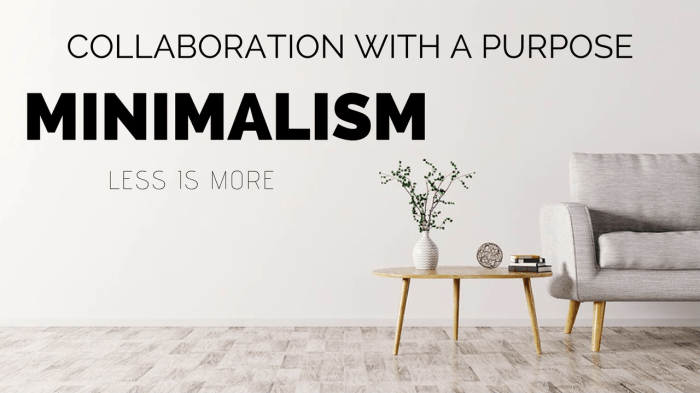
Why Minimalism is the First Step Toward Non-materialism — a Collaboration with a Purpose Post
Since I was in my mid-teens, I’ve believed in non-materialism. People, I thought (and still think) are far more important than any possessions. And while you need some things in this life (for me, these are a car, musical instruments, a computer, some clothes, books, etc.), you don’t need to go hog wild and buy everything in sight.
This feeling is now being expressed as minimalism. People who’ve never once thought about non-materialism are trying to become aware of how many needless possessions they have, and get rid of the ones that truly aren’t necessary.
It’s because of that viewpoint that the Collaboration with a Purpose group decided to discuss minimalism and its related elements this time around.

Jane Love put this picture together, along with the later one in this post, to give you an idea of what we’re talking about.
See, what we need is a place to call our own. We don’t need a whole lot of stuff around us that gets in our way and stifles us. (I know, I’m a fine one to talk. My room is cluttered with all sorts of things, though I blame some of that on not having enough space to do everything I need at the moment. Though it certainly has made me figure out what I do need, and why, living in a smaller space than I’d prefer…but as always, I digress.)
The point of minimalism is to identify what you do need, and use that. Appreciate that, yes. But don’t go overboard, and don’t clutter your life up with unnecessary things that serve no purpose other than to make you feel better for a brief moment about buying the latest hot gadget or late model car.
But I started off talking about non-materialism, didn’t I? So how does this relate?
There are grades of non-materialism, you see. Minimalism, I see as one of those shades along the non-materialist spectrum. And the two operate in much the same way: The goal is to give the irreplaceable — the people, furry friends, and true passions — the space and respect in your life they deserve, while minimizing the effect of everything else.
Take a look at the picture below (the second of Jane Love’s wonderful efforts this month) if you don’t believe me:
Here, you see a chair. A vase with some flowers. A bunch of books on a table. And one piece of art. And nothing else…because you don’t need anything else if you’re sitting down to read, providing you have enough light to read by in the first place.
See, anything else just distracts you from reading. And what is the point of that?
As for other possessions, I don’t really understand why folks feel like they need to “keep up with the Joneses” and the like. Because there’s truly no point in it.
See, a fancy car doesn’t advance your life goals much. Nor does having the latest high-tech gadget.
What will advance your life goals, then? And why does embracing minimalism or, its stronger cousin, non-materialism, do anything to give you the idea that you’re coming closer to them?
I can’t tell you what your own life goals are; only you can do that. But I can tell you that most of us want a few of the same things. To be loved for who we are. To be appreciated for who we are. And to be understood for who we are.
What you do for a living isn’t as important as those three things.
Now, we aren’t all alike, of course. But most of us do share those three things as among the highest aspirations we have. And none of them — none — have anything to do with materialism.
Minimalism forces you to realize what you need, and what you can live without.
And being a non-materialist forces you to realize that what truly matters are people, not things. Our minds, hearts, and spirits are far more important than anything else. And once you understand that, you can embrace the fact that possessions, for the most part, do not matter.
I believe strongly in this month’s topic, in short, and hope you will take the time to visit all of my fellow Collaboration with a Purpose authors (though you don’t have to do it all in the same day, of course!), as they all have different takes on the subject of minimalism. (Though I don’t know how many, if any at all, will discuss non-materialism, I’m sure their posts will be extremely valuable in their own right. They always are.) Links will be added as their posts go up, so do come back in a few days for the full and entire list of posts.
Nicolle K. (Intro post) – “Alert: A Collaboration for Minimalism”
Nicolle K. (regular post) – “Three Ways I’m Applying Minimalism as a Highly Sensitive Introvert”
Jane Love – “Mind Minimalism: Life Doesn’t Get Better With Worry”
Sadaf Siddiqi – “Value of Minimalism”
Ipuna Black – “Minimalism: What Gives You Meaning in Life?”
Gelyka Dumaraos – “Being More With Less: Embracing a Simple Life By Being Zero-Waste”
Mylene C. Orillo – “How Grief Taught Me to Keep My Life Simple”
Sonyo Estavillo – “Minimalism for Success: Why Little Wins Count”
Divyang Shah
Swati Kadam
Do check them out, OK?
Why I Love Baseball
Ever since I was a child, I have loved baseball. There’s something about how the game is played, including the managerial moves (pitching substitutions in particular), that has captivated me, and made me want to learn more and more about it.
Early on, I read the biographies of Jackie Robinson, Hank Aaron, and several other ballplayers. Most of the players I read about had struggled to get the big leagues; Jackie Robinson, in particular, had a very rough go of it as he was the first black player to break the “color line” (that is, the lily white major leagues). And whether it was race, poverty, or race and poverty, most of the players I read about found a way out of their bad situations, and made decent livings for themselves as ballplayers.
Because back then, ballplayers — even huge stars like Robinson and Aaron — were not paid extravagantly, as they are now. There were no millionaires in the major leagues until after Curt Flood challenged the reserve clause (and gave the baseball world free agency, and thus shifted salaries rapidly upward), though perhaps a few people came close to making a hundred thousand dollars now and again. And except for the really big stars, most players had to work in the off-season at regular jobs. Car salesmen, say, or at the post office, or maybe at the grocery store.
So if they weren’t making big money, why did most of them play? I think they did it because they enjoyed it. It’s a fun game, baseball; there are lots of different things to watch, from the pitching, the hitting, the defense, the managerial substitutions…a good manager can take a ho-hum game and make it dramatic, if he has the right team and makes the right moves at the right time.
Of course, sometimes, you don’t need a manager for the dramatics to occur naturally.
My favorite team, the Milwaukee Brewers, have had many interesting things happen over the years. The Brewers have had position players pitching in blowout losses; they’ve had inside-the-park home runs (one memorable one was Prince Fielder’s, several year back; Fielder was not exactly svelte compared to most other players, so seeing how fast he could scamper around the bases was a particular delight); they’ve had players do nearly everything, except win a World Series. (One of these years, perhaps that will happen, too.)
But around baseball, there are dozens of things that happen a night that are interesting, and usually there’s at least one truly different and unique happening every week or so. Pablo Sandoval, San Francisco Giants third baseman and all-around good, beefy guy, pitched a stellar ninth inning in a blowout loss just last week, and amidst the hysterical laughter by all the relief pitchers in the ballpark (home and away), there were some genuine compliments. Especially as Sandoval was the one “pitcher” who managed to get through an inning without giving up any runs for the Giants in the entire ballgame, these compliments seemed warranted.
And again, I turn back to my team, the Brewers, for a novelty. They were in a game earlier this year where the first two batters (from the opposing team) hit back-to-back home runs, which is not novel in and of itself…however, the fact that the Brewers, at the very end of the game, hit back-to-back home runs to end it was the first time that feat had ever occurred in the modern history of major league baseball.
Yeah. The first two guys hit solo homers. And the last two guys also hit solo homers.
Now, that’s entertainment!
Anyway, I love baseball. It can be thrilling. It can also, occasionally, be downright boring (I’m looking at my Brewers again, here, as they mounted almost no offense during last week’s series against the Cubs — must I say, again, that two runs over four games does not make an offense?). But even the boring moments usually have a silver lining, if you look hard enough…and hey, on nights like that, I can catch up on my reading.
So it’s always a win/win, as far as I’m concerned.
Why Perfection is a Trap
Have you ever heard from some well-meaning busybody, “Go back, and make it perfect?”
I know I have. And hearing those words didn’t help, because perfection — and the pursuit of it, perfectionism — is a trap.
See, nothing we human beings can do is perfect. Nothing whatsoever. We can only do our best. And try to make our best even better over time, of course…but that is not perfection, and it can’t be.
So, if you’re like me, and you are unwilling to admit that you can make errors — sometimes bad ones — that makes life difficult. Because perfection, as I said, is a trap; it makes you believe that nothing you do will ever matter, because you can’t be perfect, and yet you still must try.
Now, being excellent, striving for excellence, is indeed doable. And I urge you to do that very thing.
But trying for perfection? Um, no…not a good idea, because of what I’ve already said, and also because if for some reason you do hit someone else’s standard of what “perfect” actually means, you’ll end up never being able to satisfy that person again as no one can be at that high of a level all the time.
In my life, I’ve known a number of people who were incredibly encouraging and giving in spirit. None of them believed that you should try to be perfect.
Yet, partially because of my early training as a musician, I fear to make mistakes. (Even though I know I can make huge ones, as I said before.) I try over and over again to fix things that maybe don’t even need to be fixed; I try over and over again to explain myself, because I don’t think my initial explanation cut the mustard, even though it was perfectly understandable — and listening does take some energy, if you do it right, so me trying so hard to make myself understood is also a trap…hm.
At any rate, try to avoid the trap of perfectionism, or the will to be perfect all the time. Instead, accept that you will go for excellence instead — and that will be more than good enough.
Former Brewers Coach, Broadcaster Davey Nelson dies at 73
Earlier today, I found out that former Brewers coach and broadcaster Davey Nelson died on Sunday at age 73. And that made me feel awful.
Why?
Well, even though I never met Davey Nelson in person — and yes, he was always “Davey,” with the -y ending — he was an extremely positive person who lit up the room anywhere he went. And he could seemingly find the silver lining even to the worst game, even if it was just “no one got injured today.”
(That’s my quote, not his. Davey would’ve undoubtedly put it a much different way.)
There are some people who transcend sports because they have huge hearts and make a positive difference in as many ways as possible. Davey Nelson was one of those people without a shadow of a doubt. Adam McCalvy’s article (Brewers beat writer for MLB.com) quoted Brewers Chief Operations Officer Rick Schlesinger as saying, “Davey took every opportunity to turn a casual introduction into a lifelong relationship, and his legacy will live on in the positive impact he had on the lives of so many people. Davey’s love of life and commitment to helping those in need were second to none, and we are so grateful for the time that we had with him. Our thoughts and prayers are with his family and all of those who loved him.”
I wish I had met Davey Nelson in person, mind. He was known for encouraging people. And even when he must’ve suffered setbacks — as I seem to recall him saying once, during a rain delay years ago, that he wished he could’ve played longer (though he was happy with what he did while he was there — see his stats, and you’ll know why) — he found a way to make you feel better.
That was one of his main talents.
Player after player have made statements on Twitter and elsewhere stating how influential, positive, and just plain good a person Davey Nelson was. And how much he will be missed.
As have broadcasters. And well-known sportswriters.
Still, what I will remember about Davey Nelson was his very strong belief that people matter. Not just in baseball, either…people, period.
That’s why he got involved with Open Arms for Children in South Africa. And was friends with the director of that organization for over twenty-five years. And met numerous children, whom he inspired…and who helped to inspire him as well.
And at the end of his life, as Adam McCalvy pointed out in his article, Davey’s TV and baseball family stepped up.
That, too, is a wonderful tribute, though I’m sure all those folks don’t see it that way now — and may not, ever.
All I know is, I will miss Davey Nelson. He was a very good man. He made other people around him feel better, and encouraged them to be their best selves.
There aren’t many people like that in this world.
When Creativity (Temporarily) Dries Up
As I’ve said for a few weeks now on my blog, I’ve been dealing with a family health issue that has pushed almost everything else to the back of the line. As that seems to be resolving, my creative life is re-emerging…and as such, I thought I’d write a blog about why I think my creativity (save my editing work) more or less dried up during the recent emergency.
You see, we all have so much energy. (I’ve heard this called “spoon theory” or even “so many f**ks to give,” so whatever terminology works for you.) And when most of it is going to manage an emergency of some sort, there’s just not a lot left.
As there are probably more people out there who have to deal with this sort of thing, or maybe have dealt with it in the past, I know I’m not alone in dealing with the lack of energy or utter exhaustion that dealing with a crisis (along with continuing to do as much of your own work as humanly possible without collapse). But it is difficult, while you’re in the midst of it, to remember that…you feel isolated, almost the loneliest person in the world, and your own needs go to the back burner while you take care of someone else.
This has been called “caregiver fatigue,” and is a known phenomenon.
What makes me feel like myself, more than anything, is to create, whether it’s words, music, or a combination of the two. (That’s how I saw my work on CHANGING FACES, at any rate. I still intend to cut a companion CD of some sort down the line, if I can raise the money for such and regain the energy and strength to play my clarinet at top form.) But I can’t create like this, or at least can’t create very much.
No one can.
You just don’t have enough spoons to play with, as creativity takes a lot of spoons — far more than it seems at the time.
I know, from past experience with traumatic events, that my creative impulses will come back online after I’ve regained strength, rest, and health again. (As dealing with the crisis, especially coming out of two full months of illness, wasn’t easy.) And I look forward to the day I can wake up with a story idea, happily write it down, and think hard about what I’m going to do next without exhausting myself even further.
However, I’m not there yet. And admitting that isn’t easy, because I want to be known as a strong person, someone who can do anything she puts her mind to…someone who writes ten thousand words a week, maybe, as I did while my late husband Michael was alive, and haven’t managed to do consistently ever since.
I think overall that the important thing to remember, if you’re in a situation like I’ve been, is that so long as you’re still alive, and so long as you are doing your best, your talents will re-emerge once there’s sufficient energy for them.
And as a persistent person (I’ve sometimes been called almost pathologically persistent, which I don’t think is exactly a compliment), it’s all I can do now to remember that, and trust — as my niece, Jenni, also a writer, told me — that my creativity isn’t absent. It’s just brooding, waiting, and will burst out of me again once the energy has been restored to allow it to flourish.
What have you done in similar situations to nurture your creativity? Tell me about it in the comments!
Timing, and Jason Cordova’s DARKLING
I read Jason Cordova’s hotly awaited new novel, DARKLING, over the course of three weeks. (Normally I would’ve devoured it in one sitting, but the fact that I had a crisis going on with a family member’s health made me put it to the side for a time.) It is absorbing, intelligent, fast-paced, dark, depressing, menacing, and in its way a damned good read — but the timing of my life and reading this book were not fully aligned.

I submitted a review to Amazon, as per usual, but because I am much more scattered/distracted than usual, I didn’t make a copy of it before I left their page. (Edited to add: After waiting for nearly a full day, I gave up and reviewed the book at Goodreads.) Because of that, I can’t quote the review I’ve already written; all I can do is tell you to go read DARKLING, as it’s very good dark military SF with some absorbing political machinations. (Yes, you should read WRAITHKIN, the first book of Jason’s “Kin Wars” series, first. But you’ll easily understand DARKLING whether you do or not, providing you’ve read any military SF or dark SF at all.)
The rest of this blog is going to talk about aspects of the book that were tough for me to handle, due to the timing. If you don’t want your reading spoiled (though I will try to avoid the worst of spoilers), go do something else and return for the next blog, will you? (I won’t be offended. Promise.)
We have three brothers in DARKLING: Gabriel Espinoza, a Darkling soldier and second-class citizen dealing with dehumanizing treatment due to all soldiers of this type being recruited from the Imperfect class (meaning they could develop cancer, or have some other “genetic defect” that’s been rooted out by the galactic civilization they live in); Andrew Espinoza, a spy (a damned good one) who’s acted in many regards as a chameleon mole; Kevin Espinoza, a politician and born diplomat. Gabriel is a brooding hot mess from an emotional standpoint (it’s understandable, though; the love of his life is dead, he had to give up his daughter due to his line of work and because he didn’t want her tainted by the knowledge of his “imperfect” father, and he’s cut off from his family due to various considerations, even though his family wanted nothing of the sort. I can’t explain this fully because of spoilers, and also because much of it is explained at the very end of WRAITHKIN as I have written before, so I hope you can take this as read.) Andrew, as a chameleon mole, has other issues with trying to maintain his inner self, and also has been cut off from his family due to completely other concerns (again, his family certainly doesn’t want this, but with his job, there’s no other way). And finally, Kevin is a good guy, the only brother attuned to his emotions and fighting hard for the Imperfects as he views his society as closed-minded and hypocritical (and rightfully so). But he’s mostly there as a foil, to explain what the other two brothers should’ve been if not for the circumstances that led them to fight a war in their disparate ways…and that’s a conscious author’s decision that I can’t fault Jason for, as he needed that foil desperately due to the darkness of everything else.
Now, as to the circumstances of my life, and how it applies to how I saw DARKLING.
First, I was reading along, and enjoying the book immensely despite its darkness. (I knew what I was getting in for, as I read and enjoyed WRAITHKIN, and I really wanted to see what would happen next to the Espinoza clan.) Then, my family member’s health crisis arose, and suddenly the world stopped meaning much. I had to put DARKLING down, and deal with immediate realities; my blogs dried up for a bit (which I’ve already explained); I went to “work, sleep, go to hospital/rehab center” mode, rinse and repeat.
Finally, I was able to get back to DARKLING and realized two things; one, I hadn’t forgotten anything in the intervening time since I’d last been able to read and concentrate on anything. (This is the sign of a good writing and an absorbing read, that you don’t forget anything even in the midst of a crisis like this.) And two, the fact that these brothers are put through the emotional and physical wringer was all of a sudden more visceral, more immediate, than before, due to the circumstances of what was going on all around me.
See, writers are observers by nature. We have to be, or we can’t explain or show any of the stories we tell with any verisimilitude at all.
So, I was observing everything that happened around me, as per usual, whether I was picking up on that observation consciously or not. And all of that — all — hit me as I restarted my read of DARKLING. The injuries these men suffered were almost overpowering in their intensity, in this context, and it was difficult for me to keep reading despite the quality of the writing. (Jason keeps getting better and better, and tells a damned absorbing story, as I have said before.)
To my mind, DEVASTATOR is more my cup of tea (as I wrote here). I like Tori so much as a character, and her relationship with Dylan (the shy, almost innocent love she has for him) helps to enliven even the darkest of moments.
But DARKLING is quite good. Quite, quite good, in fact.
I just had a hard time reading it due to what’s been going on. So I tried to say that, without getting into personal details, in the review at Amazon (that still isn’t up as I type this, though if it does go up anytime soon I’ll add a link to the review so you can read it directly).
I do think Jason’s created a new genre, or at least fused a few, in DARKLING. I call this “grim-dark military SF.” (If you read it, you’ll understand why.) There is a palpable sense of menace in even its quieter moments; everyone is on edge, everyone is waiting for the next shoe to drop (or axe to fall, depending), and Gabriel in particular seems like a bomb waiting for a place to go off.
The writing is stellar, though, and if you know going in — as you should, providing you’ve read WRAITHKIN — that it’s going to be grim, you should be able to handle DARKLING just fine.
Just don’t read it before going to sleep if you have a weak stomach or are prone to nightmares. As this book will give you more than a few, else.
Easter Week Thoughts: Carrying Each Other’s Burdens
It’s Sunday, and this blog still says what I want even though it’s been a week since Easter came and went this year…take a good look, and think.

Is it possible for human beings to comprehend that other people have burdens, too?
Sure, we know our own burdens — the problems we carry mile after mile, day after day. They’ve become so much a part of us, it goes without saying…they’re just there, and we keep on shouldering them because we know no other way.
But we don’t always know what burdens the other person is carrying, just as the other person doesn’t know our burdens.
Yes, there’s a way around this problem. You can ask what’s going on. Maybe you can help shoulder the load for a while, if the other person allows it…if the other person lets you reach inside, so you can see them in the same way you see yourself.
Because it’s Easter Week, I’ve been thinking a lot about this. I know all sorts of people, and every one of them has problems…
View original post 370 more words
We Must Do Better and Insist on Better Health Care (A Collaboration with a Purpose Post)
Sorry ’bout the lengthy title there, folks…on with the show, er, I mean blog.

I am especially cognizant this year of World Health Day due to the myriad of health problems my family has suffered over the past year. Because of all the times we’ve been to the doctor, or in the hospital, or in the rehab center, I am more aware than ever about how we need better quality health care in the United States. (I can’t speak for the rest of the world, though my fellow bloggers have done so brilliantly. Links will follow at the end of this post.)
What I’ve seen shocks me. (And I thought I was unshockable.) A woman who needs hearing aids was in one of the rehab centers my family member dealt with this year, and can’t get them because she can’t afford them. She is over sixty-five, is retired, has Medicare–meaning, she does have state-sponsored insurance that’s subsidized by the federal government–and she still can’t afford hearing aids.
This affects her quality of life.
This affects how she can interact with her family, her grandchildren, and those working with her to help her heal up so she can go home.
There’s something wrong with a country that doesn’t find a way to help someone who needs hearing aids find a way to get them. (She is willing to pay, mind. Her daughter told me that. But it’s a matter of making it affordable so she can, and still eat, pay her bills, and afford her medications.)
Or how about this? I, myself, have dealt with a problem trying to get any help with my vision. I have Obamacare. I am eligible to be seen and get glasses, which would be subsidized (but not free)…yet every time I try to set up an appointment, and I’ve been trying now for over two years, I am told there are none.
So, I continue to wear glasses that are over two years old. My backup pair is over ten years old. My vision hasn’t changed much in all that time, but that doesn’t mean I shouldn’t have a checkup or get another pair of glasses that is perhaps a little bit more up-to-date than my backup pair.
How many other people are out there who can’t afford to pay full price for glasses, thus wait to be seen, and then never get an appointment because it’s supposedly always full?
Then, there’s the problem of paying for medication. My family members have radically different insurance. One has no help at all to pay for her prescriptions. Another has some help. But when your medicines can cost over $300 per month — yes, one of the cardiac meds my mother takes is at least that expensive — the co-pay is still plenty high. And when you’re on a fixed income, in retirement, coming up with that high co-pay is damned difficult.
Why is this considered acceptable?
Then, there’s the problem of getting doctor’s appointments when you’re sick. (I know first-hand about that one, too.) Getting your doctor’s office to even call you back is a pain in the buttinsky. And then, if you do get to talk with a nurse, they just send you to urgent care anyway, so why did you waste your time?
In short, there are major problems with health care.
Right now, we have a proliferation of forms, a proliferation of HMOs, PPOs, and all sorts of other alphabet-type agencies, that basically boil down to, “No, we’re not going to help you.” And that is utterly unacceptable.
Mind, there are wonderful people in health care. I’ve met more great nurses and doctors (much less PAs and CNAs) than I can shake a stick at. These people genuinely want to help, but they are overwhelmed by paperwork and there aren’t enough slots to see everyone who needs to be seen. And nothing at all seems to get done whatsoever about fixing these systemic problems.
The World Health Organization has done this World Health Day since 1948, to call attention to the need for better health care for as many people as possible. (Preferably, it would be for every single last one of us, and that is indeed their goal.) And this year, their slogan is called #HealthForAll.
I think we badly need to be reminded that health must be cultivated. We have to have enough resources to help people get hearing aids when they are on fixed incomes. Or afford expensive cardiac medicines when they are on fixed incomes. Or have access to doctors, nurses, and appropriate care, while being treated as the human beings we are rather than an inconvenience or worse, someone to be brushed off and ignored.
So I’m pleased that the Collaboration with a Purpose group wanted to talk about World Health Day this year. It is something that is close to my heart. And it is something we desperately need — better health care, for as many people as possible, in as many ways as possible, so we all can live better and happier lives.
Because if you don’t have your health, you don’t have anything.
Period.
Now, please go check out my fellow Collaboration with a Purpose group members, as they all have interesting takes on the subject. (Links will be added as their posts go up.)
- Jothish Joseph — “Are You Healthy?”
- Mylene Orillo — “The Truth About Getting Sick in the Philippines“
- Ipuna Black — “Health is a State of Balance: Mind, Body, Spirit“
- Sonyo Estavillo — “#WorldHealthDay & Why #MentalHealthMatters“
- Tajwarr Fatma — “World Health Day” (about mental illness/mental health)
- Nicolle K. — Intro post about World Health Day
- Nicolle’s regular post is up! — “Health for All — Self-Care“
- Jane Love — “Three Vital Components of a Healthy and Balanced Life“
- Gelyka Ruth Dumaraos — “How My Father’s Health Condition Made Me Shift to a Healthier Lifestyle“
- Divyang Shah — “World Health Day!“
- Sadaf Siddiqi — “Health is Wealth“
 Barb Caffrey's Blog