Book Promotions Coming from July 23 to July 27, 2015
Before I forget — and I’ve got so much going on right now, that’s a real possibility! — I will have two book promotions going on starting on July 23 and ending on July 27, 2015.
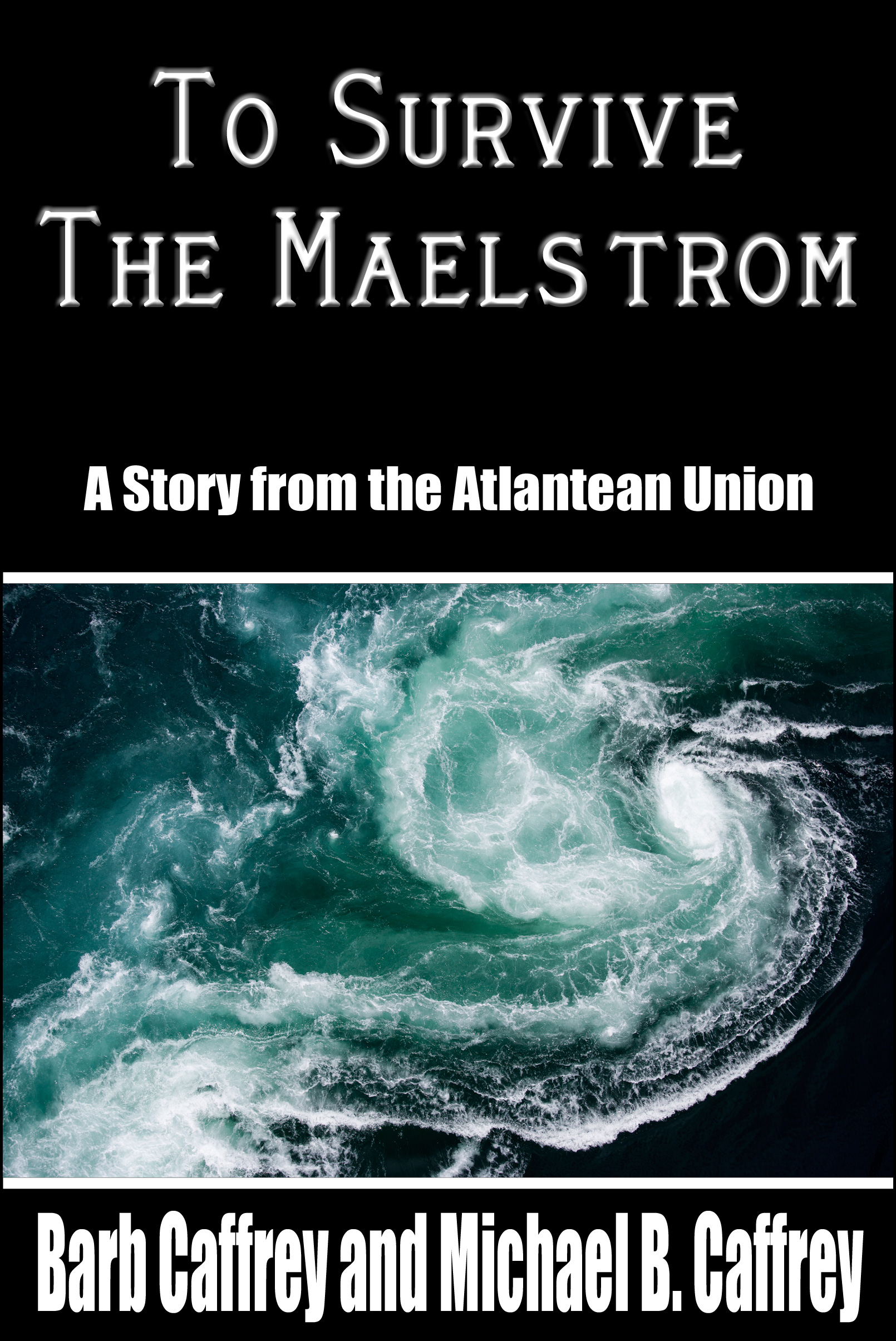 First, I’ve put my military SF story “To Survive the Maelstrom” on a ninety-nine cents deal. (It’s normally priced at $2.99.) It is set in my late husband Michael’s Atlantean Union universe, and thus he is credited second.
What is “To Survive the Maelstrom” about, you ask?
Here’s the blurb:
Command Sergeant-Major Sir Peter Welmsley of the Atlantean Union has lost everything he holds dear. He wonders why he lived, when so many others died at Hunin — including his fiancée, Lydia, and his best friend Chet.
Into his life comes Grasshunter’s Cub, an empathic, sentient creature known to those on Heligoland as a “weremouse.”
Weremice are known for their ability to help their bond-mates. But how can this young weremouse find a way to bring Peter back from the brink of despair and start living again?
Next, I’ve decided to offer Michael’s “A Dark and Stormy Night” story for free during July 23 to July 27, 2015.
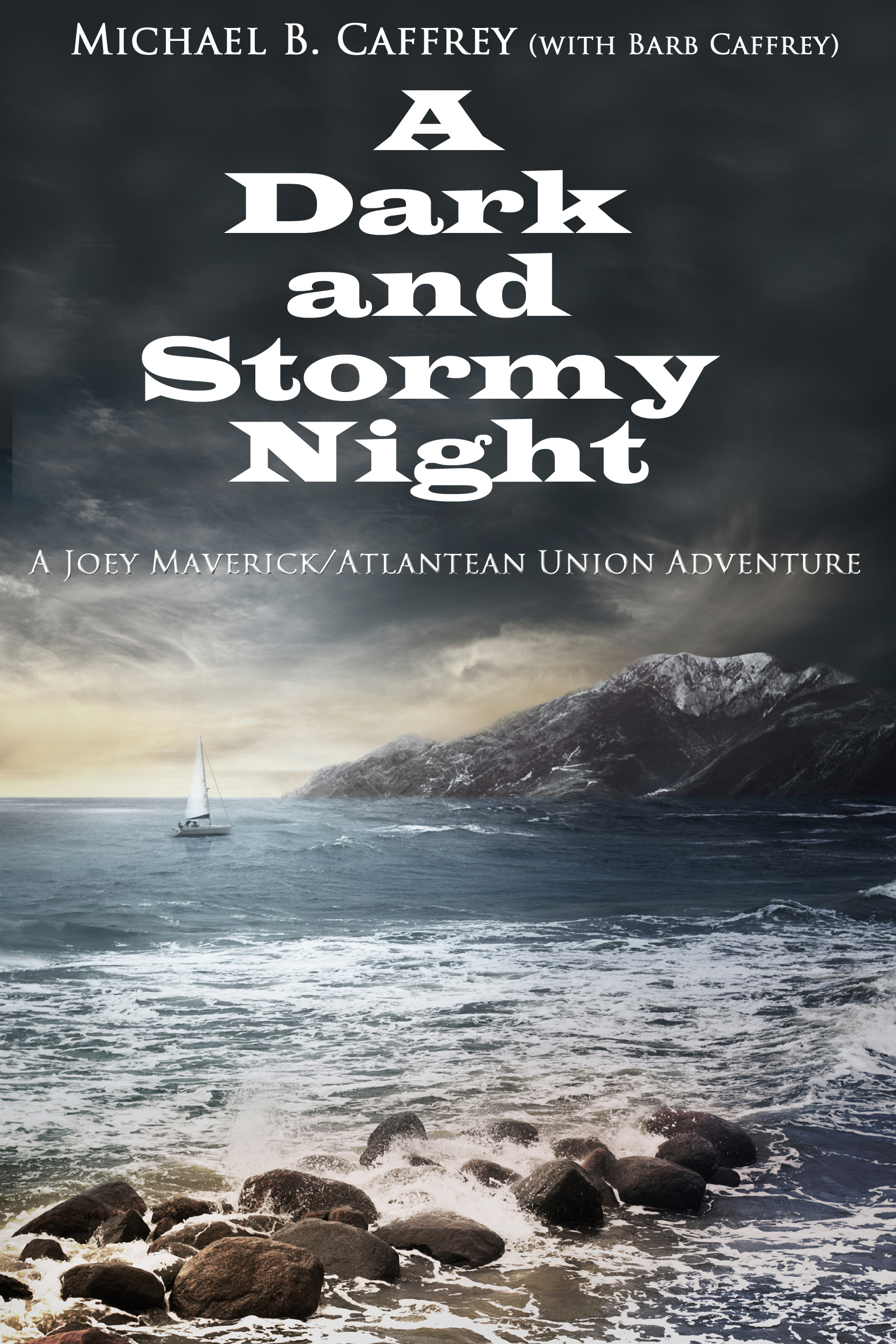 What’s “A Dark and Stormy Night” about, you ask?
Here’s the blurb:
Joey Maverick, a young Ensign in the Atlantean Union, takes part in a low-tech sailing regatta right before he’s supposed to ship out for space. A storm hits, causing Maverick to take command of his ship and mount a rescue mission. Along the way he picks up stranded nurse Belinda Simpson, along with many others. Sparks fly while the tension mounts . . . what will be the outcome of this dark and stormy night?
Note that both are novellas. I added about a thousand, maybe 1500 words to finish off “A Dark and Stormy Night,” but it is substantially Michael’s story.
Anyway, I figured I’d give you all a heads-up about these book promotions — otherwise, why bother running them? — and now, I have.
Enjoy your Monday, folks!
Just Reviewed “Ty Cobb: A Terrible Beauty” at SBR
Folks, I wanted to point your attention toward my latest book review of Charles Leerhsen’s TY COBB: A Terrible Beauty, which is up right now over at Shiny Book Review (SBR for short, as always).
Now, why am I so proud of this review?
I think it has to do with two things. One, Mr. Leerhsen’s baseball scholarship is superb. And two, I was pleased to realize, after reading Leerhsen’s book, that Cobb was not at all the virulent racist he’d been portrayed to be.
See, all of the stuff I thought I knew about Cobb was wrong — well, except for the actual baseball facts. (I knew Cobb hit .367 as a lifetime batting average, for example, and was the all-time hits leader until Pete Rose moved past him in the mid-1980s.)
Basically, Ty Cobb, since his death in 1961, has been the victim of a shoddy narrative. Apparently his “biographer” Al Stump was no such thing; instead, Stump invented the wildest flights of fancy about Cobb, figuring that as there was almost no film or still pictures or even radio accounts of Cobb’s play, Stump could do as he liked and no one would be the wiser.
Besides, monsters sell. So Stump made Cobb a monster.
Leerhsen proved just how fallacious Stump’s account actually was by going back and reading all of the various newspaper reports, which were readily available in the archives. (Thank goodness for archives, eh?) Stump made so many erroneous assumptions that it’s hard to believe Stump didn’t know what he was writing was dead wrong; in fact, Cobb himself was in the midst of a lawsuit at the time of his death, because he’d gotten wind of what Stump was about to do to him in the guise of Cobb’s “autobiography” (which was ghost-written by Stump), and wanted no part of it.
The most egregious fallacy of Stump’s was to paint Cobb as a racist. Cobb was anything but — in fact, according to Leerhsen, Cobb used to sit in the dugout with players like Josh Gibson and Satchel Paige during Negro League games, and famously remarked that “The Negro (ballplayer) should be accepted, and not grudgingly but wholeheartedly.” And Cobb was a big fan of Roy Campanella’s, plus he enjoyed Willie Mays and Jackie Robinson.
And as far as being a mean, nasty, vicious old cuss — well, how mean, vicious and nasty could Ty Cobb have been if he was willing to help the young Joe DiMaggio out when Joe D. signed with the Yankees? (Cobb understood baseball contracts, and young Joe didn’t.) How mean was Cobb when he helped Campanella and his family out after “Campy” became paralyzed? And how vicious was Cobb when, after his playing days were over and he had nothing at all to gain by it, he and Babe Ruth became fast friends?
Leerhsen has dozens of stories about Cobb, and very few of them depict anything close to the man Stump portrayed (and Tommy Lee Jones later masterfully acted in the movie version, Cobb).
While Cobb was a difficult man to know — he was prickly, quick to anger, and settled things with his fists more than once — he was not a monster.
Instead, Cobb appears to be the victim of one of the worst narrative frames in the history of all narrative-framing.
So do, please, read my review of Charles Leerhsen’s book TY COBB: A Terrible Beauty. Then please, if you have any interest whatsoever in early 1900s to the “Roaring Twenties” Americana, baseball history, or just want to find out what’s actually the truth about Ty Cobb, go read his masterful book for yourself.
Friday Fun! Cover Reveal for CHANGING FACES, Coming in the Fall of 2015
Folks, with all the turmoil going on in the world these days, I wanted to share some good news.
The cover for my contemporary fantasy/romance novel CHANGING FACES is already here! (In other words: Time for a cover reveal.)
 Take a look at this cover, courtesy of cover artist Tamian Wood. (Isn’t it great?)
The two faces being depicted are those of Allen Bridgeway, Master’s student in clarinet performance at (fictional) Willa Cather University in Lincoln, Nebraska, and Elaine Foster, Allen’s fiancée and fellow clarinetist at Willa Cather U. (Elaine starts off as an English Master’s student.)
Now, why do I call this book CHANGING FACES? It’s because Allen and Elaine are about to change places with one another…and it comes about because of two aliens who may as well be angels.
Why do these aliens/angels decide that Allen needs to be in Elaine’s body, and Elaine in Allen’s? Well, these two musicians have had a very tough time of it. Elaine, years ago, was brutally raped while still a child in the foster system. (She had another name, then; she chose the name “Elaine Foster” afterward.) She’s been with Allen for years, wants to marry him…but cannot accept her own body or her body’s responses.
Deep inside, she thinks she’d rather be a man. But she loves Allen. If only her body didn’t keep giving her fits…and then she tells Allen something devastating: Even though she loves him, she has to leave. She can’t go on living like this.
So they get in the car. It’s mid-December, and the roads are icy. And they get into a car accident. A bad one.
When Allen wakes up in the hospital, he’s in Elaine’s body (as the aliens/angels performed a body-switch). He’s still male, but now he looks female. And he’s dealing with a multitude of injuries, including a concussion, so he doesn’t really know what to do. But he’s still Allen inside, even though he can’t seem to tell anyone.
And when Elaine “wakes,” she’s actually inside Allen’s body but doesn’t know it. She’s not awake at all, you see; she needs to talk with one of the aliens/angels, but as this particular entity is an Amorphous Mass, it has trouble representing in the physical world. (BTW, Elaine quickly decides to call the Mass “Moe” — for “Mass of Ectoplasm,” out of the Ghostbusters movie).
What will these two lovers do, now that they are in this predicament? Will it actually help Elaine to know she’s now outwardly male — that is, if she can ever wake up from the coma? And how will Allen react, now that the world thinks he’s female?
One thing’s clear, however: When you have found your soulmate, the universe will do almost anything to keep you together. Even change your faces.
———-
Before anyone asks, I still do not have cover art for A LITTLE ELFY IN BIG TROUBLE. The best guesstimate for when the second half of the Elfy duology will come out is early October, whereas the best guesstimate for CHANGING FACES is probably early November.
Happy Friday!
My Fifth Blogiversary — and a Great New Review for “To Survive the Maelstrom”
Folks, this is my fifth “blogiversary” — that is, the fifth anniversary of my blog, affectionately known as the Elfyverse. (Or Barb Caffrey’s Elfyverse, if you prefer.) Here, I’ve talked about everything that interests me, whether it’s baseball, politics, current events, music, writing, or something else — whatever it is, I’ve probably discussed it.
(Writers do that, y’know.)
Anyway, today I have a special treat for you, in that Pat Patterson of Papa Pat Rambles reviewed my story “To Survive the Maelstrom” over at Amazon — and he gave it five stars. (Thank you, Pat!)
Here’s the blurb for “To Survive the Maelstrom,” which was written in my late husband Michael B. Caffrey’s Atlantean Union universe (and thus he is credited):
Command Sergeant-Major Sir Peter Welmsley of the Atlantean Union has lost everything he holds dear. He wonders why he lived, when so many others died at Hunin — including his fiancée, Lydia, and his best friend Chet.
Into his life comes Grasshunter’s Cub, an empathic, sentient creature known to those on Heligoland as a “weremouse.”
Weremice are known for their ability to help their bond-mates. But how can this young weremouse find a way to bring Peter back from the brink of despair and start living again?
So if you want to read “To Survive the Maelstrom” in honor of my fifth blogiversary — or just because you like solid military SF — please go to Amazon and grab yourself a copy. (I do intend to get this story to Barnes and Noble and Smashwords within the next ninety days, somehow, but for now it’s on KDP Select. So if you have Kindle Ultimate, you can read “To Survive the Maelstrom” for free — right now.)
New Review Up at SBR, and my Writing Journey Continueth…
Folks, before I forget, go read my review of Deborah J. Ross’s epic fantasy THE SEVEN-PETALED SHIELD. (You’ll be glad you did.)
Why did I want to start with that? Well, it’s rare to see a strong, yet quiet and scholarly woman as the heroine of an epic fantasy. Yet Tsorreh, heroine of THE SEVEN-PETALED SHIELD, is exactly that — and I loved reading about her.
In fact, I enjoyed reading about her so much that I delayed reviewing THE SEVEN-PETALED SHIELD for several months. I was afraid I would not do justice to it, because when you reduce the plot to its bare bones, it sounds like many other epic fantasy novels.
But it’s nothing like them. It isn’t predictable (except that Tsorreh’s son Zevaron is young, impetuous, and you want to kick some sense into him, but isn’t that the way of younglings everywhere?). It’s quite spiritual. And the writing, editing, and presentation of Tsorreh’s journey is so good that I wasn’t sure anything I said would come close to matching it.
I don’t often feel quite this overawed by fiction, mind. (Not even by someone with the stature and longevity of Deborah J. Ross in the field of science fiction and fantasy.) In fact, me feeling like this is quite rare…and I wasn’t sure what to do about it.
Anyway, I’ve now reviewed it over at Shiny Book Review (SBR for short, as always), and I even wrote a review (a different one, earlier this evening) over at Amazon. I think very highly of this book, and I hope that if you like my work and trust in what I say, you’ll give it a try. (Trust me — it’s different. And it’s even better than my words have made it out to be.)
Now, as for my writing journey?
Most of you know that I’m going to put out my late husband Michael B. Caffrey’s Columba Chronicles again. (They were briefly available in 2010 and into 2011 via E-Quill Publishing in Australia.) But I realized on my re-reads that there was more that needed to be added.
It’s kind of like what I’ve tried to do with Michael’s military science fiction. I know there is more to the story. I try to add it, and remain faithful to Michael’s words; then, as I feel more confident, I write in Michael’s milieu and do what I think he’d do if he were still alive. (Or at least what I want to do, because I believe he’d trust me enough to know what that is.)
So right now, I plan to write a story about Cat, Columba’s husband the shapechanger. (We find out about Cat and his unusual courtship of Columba in the “Columba and the Cat” novella, available now.) I’ve called this “The Quest for Columba,” and I’m even mentioning it in the “coming soon” part of all of the novellas currently out there (including the two earliest, “A Dark and Stormy Night,” and “On Westmount Station“).
You see, I figure Cat’s story is vital to understanding why he went after Columba in the first place. Michael only hints at it. But I know how he worked, and I think he would’ve written about it if he’d only had time.
There also was another story on the way that Michael did not get a chance to finish called “Columba and the Cromlech.” I have tried a few times over the past several years to get into that. My problem was always that I didn’t completely get where Cat was coming from, and because of that, I only could write Columba. (And my version of Columba was always a little more in-your-face than Michael’s.)
However, once I finish “The Quest for Columba,” I think I will again turn my attention to “Columba and the Cromlech,” and will have a much better idea as to where that story is going.
That being said, my version of the second story Michael wrote, “Columba and the Crossing,” will be different than the version E-Quill Publishing put out in 2010. I’m adding in more romance, as I think it’s needed — Michael left a lot in subtext, and I think at least some of it needs to be brought out.
Furthermore, I’ve gotten much better at matching Michael’s writing style even though it’s a thousand times different than mine. And because of that, I feel far more confident in adding my own touches. I knew my husband very well, and I believe that he would want me to do this — since he’s not able to bring these stories to their complete fruition, I believe he’d trust me enough to add what I know must be there.
Maybe this sounds strange to you. Perhaps it is strange. I haven’t a clue as to how other writers do this, though I’ve read what Brandon Sanderson said about his collaboration with Robert Jordan (facilitated by his widow the editor), I’ve read what Ursula Jones said about collaborating with her sister Diana Wynne Jones after the latter passed away, and I’ve done my best to figure out what these authors did and why they did it after the fact.
But no one has collaborated with their deceased spouse when neither of them was well-known. That means there’s no road map to what I’m doing, and no one can give me much in the way of advice other than “Trust yourself” or “You’re a better writer than you think” or even “Michael trusted you, so why can’t you believe in yourself more than this?”
All of these things are good to hear, mind. (Don’t get me wrong about this.) And I have listened.
Still, this is my path. I chose it years ago after Michael unexpectedly passed on. I didn’t know how I would do it, but I said I would find a way — and I am.
I only hope that readers will enjoy what I’m doing, and know that there’s a method to my madness. Because I really believe that Michael would be trying to do exactly what I’m doing…even though I can’t prove it.
Patriotism, Band Music, and July 4th
Folks, earlier today I took part in one of the most patriotic things any non-United States veteran can do on July 4th: I played in the City of Racine parade with the Racine Concert Band.
Now, why is this patriotic?
Mostly, it’s because we play marches while sitting on the parade float. (Today’s three, for the record, were “Liberty Bell” by John Philip Sousa, “South,” an arrangement of various tunes by Hal Leonard, and an arrangement “God Bless America” by someone whose name I’ve already forgotten.) And in case anyone forgets marches are usually intended to be patriotic, we had flags all over our float, while most of us wore additional bits of red, white and blue on our uniforms (or, in some cases, in temporary tattoos on arms, faces, or hands).
The fun thing about playing in the parade is to see how people respond to this music. People of all ages clap their hands, bob their heads, wave at the band (we usually wave back when we’re not actually playing), some of ’em dance in the street, and a few even pretend to conduct the band (waving an imaginary conductor’s baton in the air).
Some of these folks on the Racine parade route may not see the Racine Concert Band (henceforth shortened to RCB for ease of reference) at any time during the rest of the year, though we play free concerts at the Racine Zoo in July and August and have three winter concerts for minimal prices at the three Racine high schools (Case, Park, and Horlick). So playing the parade does more than a few things…it helps remind Racinians that the RCB exists, and that we can still bring joy to people, just by sharing a bit of music with them.
The RCB’s first free Zoo concert of the year is July 5 (that’s today, as it’s ticked over past midnight since I started writing this). There’s a trombone soloist, a trumpet trio, lots of marches and patriotic arrangements…people will know nearly all of the songs that we play, and the ones the audience don’t know right off, they probably will by the time we’re done playing it for them.
See, there’s something about marches, show tunes, and patriotic arrangements that really hits people, emotionally. Even folks who don’t think they know “Liberty Bell,” once they hear it, ask, “Isn’t that the music from Monty Python’s Flying Circus?” (At which point, I reply, “Why, yes. Yes, it is.”)
And seeing a free concert in the park can be inspirational…which is one reason I’m glad my hands are doing well enough that I have resumed my chair in the RCB.
If you live in Racine, Kenosha, other parts of Southeastern Wisconsin or Northern Illinois, I urge you to come see the RCB tomorrow at the Racine Zoo for our first free summer concert of the year. The show starts at 7:30 p.m., and free parking is available.
Because, really…what’s more patriotic than a John Philip Sousa march or two on Independence Day weekend?
Time for a July #MFRWhooks Blog Hop, Atlantean Union-Style!
OK, OK…WordPress did something weird here, and posted this a full day earlier than I scheduled it.
I’m still very happy to do the #MFRWhooks Blog Hop for this novella, set in my late husband’s Atlantean Union milieu.
Now, back to my original post.
Folks, I am a proud member of the Marketing for Romance Writers organization. They do a lot of good for authors, most particularly small press and indies…and they’ve given me many tips that I’ve found quite useful.
 One of the other things they do is on every Wednesday, they open up something called “BookHooks.” It’s an opportunity to “hook” new readers, something no writer can do without.
As I have two new releases out — and as I’ve already done a paranormal blog hop or two in previous weeks for Michael’s “Columba and the Cat” novella — I figured I’d rather take part this week with my new military science fiction novella, “To Survive the Maelstrom.” (My late husband is credited, because I wouldn’t have written this story at all without the two thousand words he left behind.)
Here’s the blurb:
Command Sergeant-Major Sir Peter Welmsley of the Atlantean Union has lost everything he holds dear. He wonders why he lived, when so many others died at Hunin — including his fiancée, Lydia, and his best friend Chet.
Into his life comes Grasshunter’s Cub, an empathic, sentient creature known to those on Heligoland as a “weremouse.”
Weremice are known for their ability to help their bond-mates. But how can this young weremouse find a way to bring Peter back from the brink of despair and start living again?
And now, a few sentences from “To Survive the Maelstrom” that explain exactly what Peter’s emotional state is before he meets up with his destined weremouse:
How long had it been since he’d smiled? Three months, perhaps? Surely the six months he’d spent in a medically induced coma while his skin regrew didn’t count . . . did it?
Even the pleasant heat of the spring couldn’t keep him away from his thoughts any longer. Why hadn’t the damned pirates left Hunin the Hell alone? Nine times out of ten, they ran; the tenth time, like Hunin, they stood and fought. And this time, they’d landed a lucky shot on HMS Niobe, where Peter had served as a platoon sergeant. Peter had quickly assumed command in the emergency as the senior NCO, considering all of the officers were dead or incapacitated.
But it hadn’t been enough.
Why was he alive, when so many good people were dead?
Now, in case you were intrigued by this sample, go to Amazon forthwith and get yourself a copy. (Right now, Amazon is the only place that has it, though in 90 days I hope to get “To Survive the Maelstrom” up at Barnes and Noble and Smashwords as well.)
And do check out the other participants in this week’s blog hop, will you? They’re all wonderful authors, and you might just find yourself a new favorite if you only give ’em half a chance.
 Barb Caffrey's Blog