Vinny Rottino to Play in S. Korea in 2014 (Plus Brewers Search for First Baseman)
Folks, after Racine native Vinny Rottino’s injury-plagued 2013 campaign in Japan, I was concerned. Then when I deduced that he was given his outright release by the Orix Buffaloes of the Japanese Professional Baseball League, I really started to worry about where Rottino was going to play in 2014 — or if he was even going to find a team to play for at all.
Mind, I say “deduced” because most of the Japanese baseball sites have to be translated to be useable. The translations can be dicey — for example, I’ve seen a walk called a “dead ball” in Japanese translation, and some of the other stats can be just as interesting to figure out.
What wasn’t hard to figure out, though, were Rottino’s 2013 stats: 37 games played, 111 plate appearances, a .206 batting average . . . the four homers, the eight RBI, and the single stolen base notwithstanding, this obviously was not the year Rottino was hoping to have in Japan.
Despite Rottino’s talent, he’s now 33 years old; yes, he plays the infield, the outfield, and catches — which is a very rare skill set. He’s good at all of them, too, and had a stellar Triple-A career, being named to the Triple-A All-Star team several times (most recently in 2011 while in the Florida Marlins organization).
But the timing was never right for Rottino; while with the Milwaukee Brewers organization, Rottino never got a chance to play regularly — despite being the Brewers minor league player of the year in 2004.
And Rottino seems to need to play regularly to be successful, as has been shown over and over in his minor league career. (Not that this is any real surprise, of course; most baseball players are like anyone else. You do much better at something if you are able to do it every day rather than once in a great while.)
Watching Rottino continue his baseball career is both inspirational and frustrating — inspirational because he has refused to give up (for which I applaud him), but frustrating because he obviously has the talent to succeed . . . but time is no longer on his side.
At the age of 33, it gets harder and harder for any baseball player to find teams willing to pay him to play. And in Rottino’s case, the major leagues are now out of reach. Japan didn’t work for him, partly due to an ill-timed injury (then again, when are injuries ever convenient?). So I didn’t know what would be next for Rottino — would he end up as a coach, as the Milwaukee Brewers, Florida Marlins, Los Angeles Dodgers, and several other teams have expressed interest in hiring him as such once his playing career is over?
Would he end up in the Mexican League?
Would he end up taking a year off from baseball, as health-wise it might be desirable — remember, I don’t have hard information to work with, as Rottino was just too far away for me to keep a good eye on, but I do know that when you get above age thirty, injuries can be tougher to rehab. (Witness former Milwaukee Brewers first baseman Corey Hart’s struggles last year as a case in point.)
At any rate, I asked a friend if she’d heard anything about Vinny Rottino, as I was concerned. Fortunately, she’d seen a wire story, which is here, about Rottino signing to play with the Nexen Heroes over in South Korea on December 10, 2013.
Rottino is in good company, as former big leaguers Luke Scott and Felix Pie, among others, have recently signed to play over in Korea. And Korean baseball has been growing in prestige lately, partly because of Shin-Soo Choo’s success in MLB.
I’m very pleased to see that Rottino will continue his baseball career in 2014. I hope he has a great season in Korea and enjoys himself immensely.
Now, as for my plea to the Milwaukee Brewers regarding their first base situation — there is one and only one obvious solution to this mess: Sign Manny Ramirez already.
Ramirez is a free agent. Yes, he’s been tainted twice with performance-enhancing drug allegations. But he can still play ball, is a power hitter, and I’m betting he can play first base with the best of them.
The Brewers must think outside the box, because every player they’d normally think about has been taken. The players I’ve heard as current possibilities for the Brewers include Tyler Colvin, who hit .241 during his 2013 campaign; Ike Davis, who’s bounced back and forth between Triple-A and the majors and had a low batting average of .205; and Carlos Pena, who hit all of .207 during 2013.
None of these players will make any difference to the Milwaukee Brewers — not one.
Whereas Ramirez is a career .312 hitter with 555 HRs, 1831 RBIs and a .411 on-base percentage. Yes, he’s now 41. Yes, he only hit .259 last year with Texas’ Triple-A team in limited playing time. But the man can still hit — witness how he tore up the Taiwanese league last year, prompting his signing to first Oakland’s Triple-A team, then Texas’s. He truly seems remorseful for his past actions. And I’m certain he could do a better job than Colvin, Davis, Pena, or maybe all three of them put together.
Yes, the Brewers should be cautious and go over his medical records. They should make sure Ramirez is clean, healthy, sober, whatever else they need to do — but they should make a serious push toward seeing if Ramirez has anything left.
Because it’s either sign Ramirez, or coax Geoff Jenkins out of retirement at this point — and while I loved Jenkins as a player, he retired five full years ago.
Let’s Talk: Three New Titles from TTB
Folks, it’s not every day I can come up with an alliterative title like the one above . . . nor would I wish to, excepting the fact that three new young adult titles by Heather McLaren, Dina von Lowencraft and Scott Eder have been released by Twilight Times Books (TTB for short).
 The first, MYTHOS, is a debut urban fantasy by Illinois writer Heather McLaren (pictured at right). David Conley goes to the Bahamas and falls in love with Faren Sands, all the while thinking she’s a normal, nonmagical woman. However, she’s a mermaid from secretive Atlantis, which still exists. When she tells him who and what she is — and he gets over the shock — many, many consequences befall them.
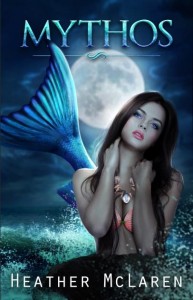 MYTHOS features a great cover (as you see) and an interesting way to bring the myth of Atlantis to modern-day readers. Further, it has the age-old conflict that two lovers must face once they truly know each other: Will they stay together despite it all, or will they end up apart?
I’ve had several e-mail discussions with Ms. McLaren, which has led me to discover that she — like me — believes in the power of persistence. When I asked her what caused the plotline of MYTHOS to come to mind, she said this: “(I started) writing the outline for Mythos and Beyond Legend (due to) boredom in creative writing class during my tenth grade year.” Further questioning elicited the response that MYTHOS has been in development in one fashion or another for twenty years. (More power to her!)
I also asked what kept her going during this whole process. She said, “It was a way to escape from stress. The more I wrote, the more I wanted to finish it.”
Isn’t that a sensible motivation? (I think so, anyway.)
I look forward to reading more of Ms. McLaren’s work because I’m a sucker for updated tales of Atlantis, especially if they’re done well and sensitively. And while so far all I’ve read is a sample chapter (available here), her book looks quite promising!
 The next novel up is Belgian writer Dina von Lowenkraft’s debut novel, DRAGON FIRE. (Ms. von Lowenkraft is pictured at left.) This is a cross-cultural tale set in Norway about a dragon shapeshifter, Rakan, and the woman who loves him, Anna. Both have been told various things about other cultures and other races that may or may not be true . . . will they be able to get past this long enough to express their feelings for one another? And even if they do, will they be able to stay together with everything that stands against them?
 An updated take on dragons that just so happens to have a clash of cultures inherent along with a romance? And one that takes a few jabs at the whole Twilight phenomenon as well?
No wonder Publishers Weekly was intrigued.
More to the point, there’s a reason DRAGON FIRE is next on my reading list for pleasure reading (as alas, I cannot review it at SBR due to our conflict-of-interest policy). I’m always intrigued by cross-cultural tales, especially when they deal with two young lovers who’ve been systematically lied to during most of their short lives. (Sound familiar? It should, considering that’s a big part of ELFY‘s premise. Not that I’m the first person in the history of the world to have come up with that one, as it’s been around since time immemorial.)
BTW, A sample chapter of DRAGON FIRE is available here.
 Finally, Florida writer Scott Eder’s debut novel KNIGHT OF FLAME is also available (he’s pictured at right). I haven’t had a great deal of interaction with Mr. Eder (though I have had some on Facebook), which makes it a little more difficult to discuss what’s going on with his book — but I shall give it my best anyway!
KNIGHT OF FLAME stars Develor Quinteele, a normal-seeming guy from Tampa, Florida. Unknown to most, he’s also known as the sixth Knight of Flame, and has an important task: he must keep the world safe from the Gray Lord, a horrible person who revels in the evil he does . . . and unfortunately has many descendants to help him carry out his horrific plans.
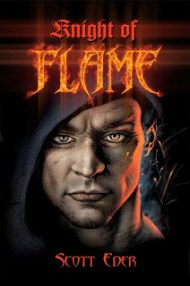 Develor’s control over his powers has never been the world’s best, and he’s turned to the easiest expedient possible — channeling his rage — in order to wield them. But this backfires spectacularly after Develor is falsely accused after a tragedy.
Stripped of his powers, will Develor regain control of himself well enough to get the other Knights to restore his power before it’s too late?
A few sample chapters of KNIGHT OF FLAME are available here. I read them, and was intrigued; there’s a swift writing style here and some excellent worldbuilding. The evil characters are hissable, and the good ones conflicted . . . I can see why Library Journal enjoyed this novel (even if I can’t seem to come up with a link to back it up, Eder’s blog points out the positive review).
At any rate, here are the three newest authors in the Twilight Times Books stable . . . please check them out, and see if their work interests you.
But in case you still need more motivation to check out TTB, take a gander at Maria de Vivo‘s THE COAL ELF. I edited this novel, and can tell you that Ms. de Vivo’s take on Santa Claus, Elves, and their comportment and demeanor is excellent. Witty and sarcastic by turns, heroine Ember leaves the safety of home and hearth to become, of all things, a coal Elf — those who are entrusted with digging out the coal that ends up in the stockings of bad children everywhere. And as you might expect, her job isn’t exactly coveted . . . especially when you consider that there’s never before been a female coal Elf of any sort.
Ember’s journey from rebellious teen Elf to a responsible, albeit still delightfully sarcastic, Elf fully in charge of herself is well worth the reading.
But don’t just take my word for it. Read this sample chapter . . . then come back and tell me if you don’t think Ember’s story is just the antidote to all the sappy Christmas songs you’ve been hearing on the radio lately.
Now, let’s get to reading and enjoying some books, shall we?
Writing and Cross-Promotion
Folks, I thought it might be interesting to write a blog about just what promotion is — and maybe a little bit about what it isn’t — while I also talk about a few of my favorite writers in the process.
Promotion tends to consist of a number of things. It can be as easy as Tweeting something on Twitter (if you do that), or sharing something on Facebook. It can be more complex, as when you write a guest blog for someone else . . . of course, the latter action is far, far more personal, and may grab a reader that much more easily.
Going to a convention, if you have something of your own to sell, is also a promotional experience. And even if you don’t, if you’re out there networking, that’s still considered under the heading of promotion.
Now, what’s not considered promotion? Going to unrelated websites and putting up a bunch of links to your work — spamming them, in short — as that’s completely unprofessional and extremely counterproductive, besides. (You could even think of this as anti-motion rather than promotion.)
Another thing that would not be a good idea from a promotional standpoint is one I’ve only rarely seen — thank goodness, as it’s again highly unprofessional. But here goes: when someone mentions inside a review that his work is better than the work that’s supposed to be under discussion, that’s just really bad form. (More anti-motion at work.)
Promotion is many things, but it’s not supposed to be either unprofessional or “spammy.” What you’re trying to do is get the word out, that’s all — which is why if you’re talking about your favorite authors, you could be said to have promoted them.
So if you have friends whose work you admire — and if they, too, are on Facebook, Twitter, or any number of other social media sites — you can help to promote them, providing you’re not being obnoxious about it.
It’s in that spirit that I wanted to let you know, again, about a few of my favorite authors. In no particular order, here are some of the authors I’ve either enjoyed reading or have enjoyed working with during the past two years (trust me, there’s many more, but I decided to stop with six):
Katharine Eliska Kimbriel, NIGHT CALLS (reviewed at SBR on 9/21/2013). Ms. Kimbriel, a noted author of hard science fiction, wrote a winning historical fantasy in NIGHT CALLS featuring levelheaded farmgirl Alfreda (or “Allie”), who must get a handle on her own magic in order to help her pioneering community, or die trying.
Stephanie Osborn, the Displaced Detective series (books 1 and 2 reviewed at SBR on 7/13/2012; book 3 reviewed at SBR on 7/19/2012). Ms. Osborn’s Displaced Detective series featuring Sherlock Holmes as brought to the present day by hyperspatial physicist Skye Chadwick is a must-read for anyone who loves hard SF, Sherlock Holmes, or just plain good writing.
Dora Machado, THE CURSE GIVER. I edited THE CURSE GIVER, and enjoyed every minute of it. There’s Bren, who’s trying to save his people and has fallen under a curse, and Lusielle, the healer he initially saves, thinks he must kill (but fortunately refrains), and finally ends up falling in love with. There’s a phenomenally complex plotline twisting through all this that needs to be read and enjoyed . . . all I can say is, don’t miss this complex, epic tale of revenge, romance and redemption.
Aaron Paul Lazar, THE SEACREST (reviewed at SBR on 12/14/2013). Lazar is noted for his mysteries, but THE SEACREST is a straight-up romance (albeit with a few mysterious touches) about Finn and his first love, Libby. They first have a teenage romance, are riven from each other due to misinformation, then come together in a way that you need to read if you’re any kind of romance reader at all. In short, if you enjoy Nicholas Sparks, you really owe it to yourself to give Aaron Paul Lazar a try.
Kate Paulk, IMPALER (reviewed at SBR on 4/17/2011). Ms. Paulk has a gift for historical fantasy; while she is also good at writing funny fantasy (KNIGHTS IN TARNISHED ARMOR), IMPALER shows her full range as a novelist — it’s an exceptional read that combines equal measures of historicity and heart, and makes Vlad Tepes into a sympathetic character despite his flaws — or maybe even because of them.
And finally, I edited Florence Byham Weinberg’s ANSELM: A METAMORPHOSIS last year and was intrigued. Here’s a story about a rather faithless, feckless young academic, Eric, transported into the much-older Father Anselm’s body. The original Anselm was and remains an evil man who’s out only for his own pleasures, but Eric grows and changes, becoming far more spiritual and thoughtful in the process.
So there you have it — some SF mysteries, a romance, a couple of historical fantasies, and a literary fantasy. All exceptionally well-crafted books. All must-reads in their various ways.
All authors I keep an eye on, to see what they’re going to come up with next.
In that vein, please also go check out Jason Cordova’s novel of near-future suspense, CORRUPTOR . . . let’s hope he writes a sequel one of these years!
Two New Book Reviews are up at SBR
Folks, I’ve been busy this week. Between getting up that guest blog over at Murder X 4, editing a friend’s book (he’s trying to get his book out by the end of the year, and there have been a number of revisions to date — but I’ll keep helping him all I can, as you’d expect), editing another friend’s book, and doing a bit of Tweeting and Facebooking to promote fellow authors (most particularly the Twilight Times Books “stable” as I’m a part of that, and I like their work so why not?), I haven’t had a whole lot of time.
That’s why, again, I got two reviews up over at Shiny Book Review (SBR for short, as always), but could not get over here to write anything about them.
So it’s time to remedy that.
Last night for SBR’s Romance Saturday, I reviewed Aaron Paul Lazar’s THE SEACREST. This is a heartwarming sensual romance between a deeply honorable man, Finn McGraw, and a complex and rather tormented woman, Libby Vanderhorn. There’s a great deal to the plot that I didn’t even get into at my SBR review due to lack of space — things like domestic violence, post-traumatic stress disorder, lesbian friends (one of whom just happened to have been married to Finn’s estranged brother once upon a time) and more — but my most favorite thing in THE SEACREST, other than what I’ve already remarked upon during my SBR review, was the character of Fritzi the cook.
Yes, really.
Fritzi was a woman who could’ve been a stereotype, but somehow she broke free of that (mostly, anyway — because aren’t we all stereotypes from time to time?). This is a motherly woman who loves to cook, is German by descent and talks with a substantial accent, yet despite all that possible baggage, Fritzi emerged as a real person with a mind and heart of her own.
And Fritzi plays an important part in THE SEACREST, too, being one of Finn’s quiet supporters in his struggle for Libby to first realize his love for her, then to give it a chance despite all the obstacles in their way.
So if you love romances — especially of the sensual contemporary variety with just enough spice to be realistic but without too much to make it gross-out awful — give Aaron Paul Lazar’s THE SEACREST a try . . . or at least go read my review and see if that whets your interest any.
Completely changing the subject, but staying with book reviews written this week, I also reviewed Leo Champion’s LEGION, which is a particularly impressive piece of military science fiction set in 2215 that has only one drawback: very, very few female soldiers at any level.
I mean, everything works in this novel. The combat scenes are excellent. The “bromance” stuff between the military guys (all men) is very good. The dialogue for the most part rings true (I didn’t ding Champion, who’s originally from Australia, with a bunch of Australianisms I found in his MS from people who are supposed to be Americans — things like “in hospital” instead of “in the hospital,” mostly because this was a debut novel and they mostly didn’t impede the action any), the characterization was crisp and sharp and the writing was quite, quite good.
But if you’re going to write a story about freedom fighters on a colonial world — whether it’s mostly from the men who are tasked to fight them (the United States Foreign Legion, or USFL for short) or from the freedom fighters themselves — it is nearly inexplicable that there wouldn’t be one single woman soldier of note down on that planet on one side or the other.
The women in LEGION, aside from one Naval Commander on a spaceship high above the action and one notable politician, tend to be one of three things: cooks, waitresses, or prostitutes. And while there’s some justification for this — I was a military wife once upon a time, and I remember the zone outside of Fort Carson, CO, quite nicely, thanks — it still didn’t work for me.
My view is simple: there should be at least one woman among the freedom fighters. On the one hand, it doesn’t take a great amount of physical strength to fire most weapons. And on the other, the guys in the U.S.F.L. obviously would never expect it, young and relatively ignorant about male-female relationships as they are.
Furthermore, it seems extremely unlikely that male convicts would be allowed to go into the U.S.F.L. to “make something of themselves,” but female convicts would not be given the same opportunity — providing, of course, that the female convict had any hope of getting through boot camp in the first place.
Being a female reviewer (yes, sometimes I must point out the obvious, folks; sorry), it was really perplexing for me to read such an interesting book that captivated me for thirty pages or more at a stretch . . . then I’d come up for air and think, Now where are all the women soldiers? Surely they must be there somewhere.
And I just didn’t see it.
Mind you, this is a military SF buddy-buddy piece that is obviously geared toward men. It’s not likely to hurt Champion’s audience in the short run whatsoever. And I am aware of this.
But it also won’t build his audience with women who don’t already know him or know of him (by this, I mean people who’ve either met him personally or who’ve read his short stories in the past or who’ve talked with him online about something or other). And that does not seem like a winning strategy, long-term.
So that was it for the week — I reviewed first a milSF novel, then a romance. And I enjoyed them both, albeit for different reasons . . . maybe you’ll enjoy one of the two books, or perhaps even both of ’em, as well.
Guest Blog at Murder X 4 Is Up . . .
Folks, when writer Aaron Paul Lazar asked me if I was willing to write a guest blog for his shared blog site Murder x 4, I leaped, yelled, and said yes . . . though of course only the last part was verbalized as I didn’t want to scare the dogs.
Aaron asked me if I had anything Christmas-themed that might be interesting, and as my relationship with my late husband Michael started around Christmas of 2001 — and as I have two of his stories up at Amazon right now that are desperately in need of new readers, “A Dark and Stormy Night” and “Joey Maverick: On Westmount Station” — I decided to talk about that. And because Murder X 4 is a writer’s blog site where they often talk about the process of writing, I asked if it was OK to talk about everything I’ve done to keep Michael’s words and work alive.
Fortunately for me, Aaron said yes.
Those of you who’ve known me a while, or who’ve faithfully read my blog posts since I was coerced — er, convinced to start blogging will most likely know why I’ve done my best to keep Michael’s work alive. Even though it’s now at least partly mine, and at least some of the choices I’ve made might not be the choices he would’ve made, I had to try.
Michael meant everything to me, and in many ways, he still does. So I just couldn’t bear the thought of his work not getting any chance to find a readership . . . bad enough he was dead, but did his work have to die out, too?
Not everyone is going to like what I’ve done. I know that.
I also know that some people have told me along the way that Michael is dead, I’m not, and that it doesn’t really matter if his work stays alive. Michael, had he lived, would’ve undoubtedly written more things, and he might not even have wanted these particular works to stand.
But I knew Michael very well, and the people who’ve told me this other stuff did not. Michael did not give up, not on himself, not on other people. He was trying to figure out how to get action into his novel about Joey Maverick (MAVERICK, LIEUTENANT) at the time of his passing; he and I were both wracking our brains to figure out what he could add that wouldn’t blow his premise completely out of the water. (That premise being “quiet heroism,” which I discussed in today’s guest blog.)
Michael definitely would’ve kept trying to figure it out, and I can’t believe he’d have let these adventures rot.
But he almost certainly would’ve found other ways toward the same ends . . . and I truly wish he were alive so he would’ve found them, rather than me doing my poor best toward getting whatever I possibly can done.
Still, as a good friend of mine told me a few nights ago, the important thing is to write something Michael would’ve liked and enjoyed reading. Michael would like what I’ve done, by that logic, and even if he quibbled with me as to how I got things done, he’d still like it that I did it.
That’s why I’ve kept trying, both on his behalf and my own.
Anyway, please do go read my guest blog, and see what you think of my efforts. Then come back here, if you would, and tell you if it makes any sense . . . I just know it’s what I have to do, or else I’ve failed.
And I refuse to fail.
Corey Hart Leaves Milwaukee for Seattle . . .
It’s official, Milwaukee Brewers fans — Corey Hart has signed a one-year, incentive-laden deal with the Seattle Mariners.
While I’m extremely disappointed, I understand why this happened. Earlier this baseball offseason, the Mariners signed former New York Yankee second baseman Robinson Cano to a huge deal worth $240 million. As the Mariners for the past several years have been pitching-rich but offense-poor (Felix Hernandez won a well-deserved Cy Young in 2010 with a 13-12 record and a 2.27 ERA with 232 strikeouts, and the Mariners’ offense hasn’t improved since then), they needed to upgrade their offense desperately if they had a hope of maximizing Cano’s abilities as a hitter.
So . . . enter Corey Hart. As Doug Melvin told the Milwaukee Journal-Sentinel’s Tom Haudricourt, Corey Hart can be a DH for Seattle, as they’re an American League club. This means it’ll be easier for Hart to meet whatever benchmarks his incentive-laden contract includes (as the specifics of Hart’s contract are not yet known, partly because Hart must still pass a physical before the contract is approved) than it would be if he were still playing for the Brewers in the National League, as the NL does not have a DH.
In addition, the Mariners traded for OF Logan Morrison, sending P Carter Capps to Miami in exchange. So it’s obvious that Seattle has majorly upgraded its offense — first they got Cano, next they got Hart, and now they’ve acquired Morrison.
One would think that the Mariners’ offensive woes will now be a thing of the past, providing Hart and Morrison (who both have extensive injury histories) can stay on the field.
Anyway, Brewers fans, while you nurse your disappointment, you may want to check out this post from Book View Cafe author Maya Kaathryn Bohnhoff — Ms. Bohnhoff is a baseball fan, just like me, and also like me, she’s written several baseball-themed SF stories. (Though unlike me, she’s actually gotten her stories into print. Well, the century is young and I have faith . . .)
Here’s a quick taste (keeping in mind that Ms. Bohnhoff is talking about author W.P. Kinsella and his novel SHOELESS JOE in addition to her love of the game):
One day, after years of believing that baseball was a boring game played by overweight men in their jammies, the corn fields and the thrill of the grass and the brilliant sounds of the diamond gave me that sensation, just as Ray Kinsella describes it to Salinger.
As my husband tells it, we were driving home from a nursery, having purchased a trunk load of plants for our garden. I was pregnant with our second child. Jeff turned on the car radio to a Giants game and braced himself for a wisecrack from me. Instead, I said (and this is the Gospel truth), “You know, I just realized that I love baseball!”
And I did. And do. Because the word is baseball.
Yes. Yes it is.
And it’s good to be reminded of that, even when your favorite player has just signed with a team that’s so far away, geographically, that you have next to no chance to see him play unless his new team does so well that they end up getting picked up several times for ESPN’s or MLB Network’s game of the week.
Reviewed Vera Nazarian’s “Cobweb Bride” at SBR
Folks, I’m still — still! — dealing with The Sinus Infection from Hell (TM), which is why I wasn’t able to write an immediate blog about my recent book review for Vera Nazarian’s COBWEB BRIDE over at Shiny Book Review (SBR). COBWEB BRIDE is an excellent book about what happens when Death decides not to take anyone’s life until he gets his “Cobweb Bride” — all aspects of this premise are explored, including the darker ones. I gave COBWEB BRIDE an A and believe it’s perfect for lovers of dark fantasy with a bit of romance. But anyone who loves interesting, original books containing aspects of horror, romance, fairy tales, dark fantasy and historical fantasy should enjoy it.
Now, there are a few things to keep in mind before you pick up COBWEB BRIDE. As I said in my review, there are some really horrific things that Ms. Nazarian writes about — to my mind, the squealing of a pig after it’s been butchered but cannot due was among the most plaintive and heart-rending — and they will disturb you unless you have a heart of stone. (Then again, they’re supposed to disturb you. Trust me on this. )
The main reason to read COBWEB BRIDE, though, is because the most admirable characters — Percy, the Infanta Claere, and even Vlau — are admirable not only because of what they do (in Vlau’s case, in some ways it’s in spite of what he does), but because they keep on doing it no matter how difficult things are all around them.
Writing about that sort of persistence and making it work makes COBWEB BRIDE well worth the price of admission.
So please. Go read my review. Then go take a gander at the book . . . it’s available in e-book and trade paperback . . . and see if you don’t agree with me.
Short Story Sale Announcement…
Finally, it can be publicly announced . . . the short story I sold in October was bought by the STARS OF DARKOVER anthology, edited by Deborah J. Ross and Elisabeth Waters. This is set in the long-running Darkover universe created by late author and SFWA Grandmaster Marion Zimmer Bradley.
Looking at the table of contents, it’s fairly obvious that I’m the only author who doesn’t have a number of professional short story sales to my credit and who doesn’t have at least one book out as of yet save one. The other person who doesn’t seem to have a number of stories out is Gabrielle Harbowy, an editor with a number of well-received anthologies to her credit.
Now, as to what my story “At the Crossroads” is about? I figured that judges have never really been talked about in the various Darkover anthologies, yet MZB herself had mentioned an extremely important and influential Renunciate judge, Fiona n’ha Gorsali, at the very end of THE SHATTERED CHAIN. My story is about how Fiona got to her high position on the Courts of Arbitration (that MZB described her as having), as Fiona was the first woman ever named to that court.
Because THE SHATTERED CHAIN is set after the Terrans have recontacted their former colony after many millenia apart, that gave me a time frame to deal with that seemed fertile with possibilities. I picked one . . . no, I’m not about to say what just now (maybe later) . . . and rolled with it.
And fortunately for me, Ms. Ross liked my idea enough to work with me and help me get it done.
So now you know . . . and I’m very excited about it. (Between this and getting Michael’s stories back out and of course getting my novel ELFY ready to go as well, it’s been a very busy end of the year!)
Michael’s Two “Joey Maverick” Stories Available at Amazon
Folks, it’s official — both of my late husband Michael’s two “Joey Maverick” stories — “A Dark and Stormy Night” and “On Westmount Station” — are available at Amazon as of 9:07 CST Sunday December 1, 2013. These stories both previously appeared at e-Quill Publishing (one in 2010, the other in 2011), and in addition “A Dark and Stormy Night” appeared at the Written Word Online Magazine in May of 2005 (but was not archived).
This means “A Dark and Stormy Night” has been published three times, and “On Westmount Station” has now been published twice. (I know, I know; it’s boring and mundane to count it up this way. But these are the only stories I’ve worked on thus far that have actually been republished, and I like to think that my husband would be happy with my efforts on his behalf.)
If you’re wondering what I actually did with these stories (as in: Did I edit them? Did I write anything into them?), here’s a brief rundown:
For “A Dark and Stormy Night,” I added about 1400 words, mostly dealing with internal monologue (what Joey’s thinking about as he acts) or beefing up a few (romantic) scenes to make it a little clearer as to Joey’s motivations. I also edited the final version, proofread it, did my best to format it, actually sent it out to two different people to format it for me, and after all of that ended up posting the file I’d started with anyway . . . just a little work, all told.
For “On Westmount Station,” I did a lot more writing, as I added at least 5000 words to the story, doubling its original size. This included writing subplots, adding additional interior monologue for several characters (as “On Westmount Station,” unlike the first Joey Maverick adventure, has multiple POV so multiple characters are sharing the storytelling load), came up with several all-new characters and gave a completely different spin on what Joey is doing while he waits to ship out at Westmount Station than what Michael had to begin with. I also edited it, again tried to format it, again sent it out to two different people and again ended up using the file I started with as I just liked it better. (I still intend to do something nice for the people who tried hard to help me. Just haven’t figured it out yet, that’s all.)
Now, for those of you who read any of Michael’s work years ago — this means the Baen’s Bar crowd, as Michael showcased his novel MAVERICK, LIEUTENANT there many moons ago — you’re obviously going to know what I did. But you might not know why.
The main reason I added subplots and action and characters to “On Westmount Station” is because of something Jim Baen said to Michael on Baen’s Bar. What Baen said was very succinct: “Where is your plot, sir?”
And, of course, Michael took grave exception to this. (Had Jim Baen said instead, “Where is your action, sir?” Michael would’ve understood. Sometimes communication hinges on these tiny things.) Because Michael’s novel had plenty of plot — but after the opening novella (“A Dark and Stormy Night”), there wasn’t a whole lot of verifiable action to be had.
Even though Michael was quite distressed by Baen’s comments — I remember this clearly — he took them to heart once he understood (via another friend of ours, a professional writer and editor) that what Baen actually meant was action. And that while our friend felt Michael could still sell his novel as it stood, perhaps it might be a good idea to look for places action could be added.
As Michael had a very strong belief that many military men and women often had careers consisting of “quiet heroism” — that is, they did important things, but most of the time the public either didn’t know or care what they’d done — this action had to take place in such a way that it wouldn’t call attention to Joey Maverick. Because Michael’s further conceit was that Joey Maverick’s one known piece of heroism was going to be during “A Dark and Stormy Night” (where Joey takes command of the low-tech sailing ship he’s been crewing on during an emergency, and rescues a whole lot of people and not-so-incidentally meets the love of his life in the process), that made it tough to figure out where to add some action in.
Michael and I were still brainstorming and trying to figure this out at the time he passed away, very suddenly, in September of 2004.
So here I was, a newly-made widow, desperately and deeply grieving the loss of my husband, and I had what I knew to be an excellent novella. I added 1400 words to it mostly to make it a legal collaboration so I could more easily sell it — but “A Dark and Stormy Night” probably would’ve been just fine as it was. (I’ll be honest. I like the version I’ve worked on better, but the original is quite good.)
But figuring out what to do with Chapter 1 of Michael’s novel was much harder (yes, this is my roundabout way of saying this is where I got much of the backbone of “On Westmount Station”). All Michael had Joey doing was picking up his ship assignment and forming up his temporary troops, admittedly with great flair and elan. But it would be hard to make a stand-alone story out of that, which is why I thought long and hard about what to do next.
Over the course of a year, I added material, came up with new characters, and figured out just what could threaten a space station (at least in part) but be kept quiet enough that no one would hear about it but a few of the higher-ups in Joey Maverick’s command . . . and, of course, the men and women who helped Joey stop whatever the problem was in its tracks. Once I had all that, I wrote the scenes, integrated them into what Michael had, sent it to my first readers (my long-time writer’s group, Barfly Slush) and then tried to sell it.
But I couldn’t find any buyers.
I even tried the Writers of the Future contest with “On Westmount Station,” as I felt it was the best work I’d ever done. (I made sure, of course, that it was OK to submit it despite it being a collaborative work with my deceased husband.) But it sank like a stone there, just as everything else I’ve ever sent to Writers of the Future has always done.
Soon after “On Westmount Station” was rejected, I offered it to Lawrence at e-Quill Publishing and it was accepted. And there it stayed until I dissolved my relationship with e-Quill in 2012.
Now, as to why I brought them back out? It’s simple. They’re really good stories. Michael worked hard on “A Dark and Stormy Night,” and it consists of some of his finest work. And I’m extremely proud of what I did with “On Westmount Station,” as I feel it’s exactly what Michael would’ve done . . . if he’d have only had time to do just that.
Some people have told me over the last few years that I shouldn’t waste my time on keeping Michael’s stories alive. He’s dead, I’m not, and if Michael were still alive he probably wouldn’t be still trying to get these stories published — whether it be independently (as I have now) or through a publisher.
I disagree — and disagree very strongly — with that assessment, mostly because I know how persistent Michael was. I also know that Michael, like myself, would never give up on his stories. And finally, I know that Michael wrote very well and deserved to get a chance for his stories to find their audience.
All of that is why I kept trying to get the stories back out and available for sale.
And now, they are.
Please, do go take a gander at ’em. Let me know if you enjoy them. And spread the word . . . ’cause if you can do all that, I plan to bring out more of Michael’s other stories in the years to come. (Promise.)
Just Reviewed Mario Livio’s “Brilliant Blunders” at SBR
Folks, I’m a bit behindhand on letting you all know what I’ve been doing over at SBR lately. This is partly because I’ve been dealing with the sinus infection from Hell (TM), and partly because I’ve been trying to get everything caught up by the end of the year. (Yes, I’m still playing catch-up from that bronchitis I suffered in the spring.)
Anyway, today’s review over at SBR is for Mario Livio’s excellent BRILLIANT BLUNDERS, a scientific history that deals with the five biggest mistakes of five eminent scientists — Charles Darwin, William Thomson (Lord Kelvin to thee and me), Linus Pauling, Fred Hoyle, and Albert Einstein — and discusses these mistakes in the context of both the history of science and the particular scientist’s career. Livio’s writing is clear and concise, and is accessible to the layman without being shallow or stupid, a neat trick.
I also interviewed novelist and rocket scientist Stephanie Osborn for SBR a few weeks ago. This was a wide-ranging, no-holds-barred interview where Ms. Osborn discussed literacy and panic attacks right along with her own work, and talked a great deal about how she comes up with her plots for good measure. Do go take a gander at that, then read her books as soon as you can, too.**
Aside from that, my plans for this Black Friday are to stay far, afar away from any store (except maybe for the grocery store, as that should be safe) as I’m not interested in fighting with anyone over a toaster. Or a TV. Or even something I would really like to have, like a book card . . . no, life is just too short for such silliness.
(Besides, I can always go get the book card tomorrow, and the lines will be far shorter, too!)
Stay safe, everyone.
———
**BTW, I’d meant to get up something about the interview a few weeks ago, but this sinus infection from Hell (TM) is just not allowing me to do much, as I haven’t had the energy to do it with. I figured actually finishing the interview, then posting it was much more important than me coming over here to my own blog and discussing it — but as I always had intended to discuss it, today seems to be the day.
So if you haven’t already read the interview with Ms. Osborn, please go ahead and do so at your earliest convenience. You may learn something . . . or better yet, you may both learn something and find a new favorite author. (Stranger things have happened.)
 Barb Caffrey's Blog