Posts Tagged ‘music’
Linkin Park Hires a New Co-Lead Singer, and I Have Thoughts…
In case you haven’t heard yet, Linkin Park has a new lead singer, or probably better explained as co-lead singer along with singer/rapper Mike Shinoda. They needed someone because their iconic lead singer Chester Bennington died seven years ago by his own hand, and most of Linkin Park wanted to play together again. (The exception was their original drummer, Rob Bourdon.) So they’ve hired a woman, Emily Armstrong, who fronted a group known as Dead Sara, to sing the parts that Chester would’ve sung had he still been alive.
Note that I did not say “to replace Chester,” as there’s no way to replace Chester Bennington. But Linkin Park wanted/needed someone to sing those parts, and Emily Armstrong can sing melodies and then scream in a heartfelt way. My guess is that Emily A. sings in a similar range to Chester, or at least is close enough that with some minor arrangements (perhaps changing the key signature and/or mode — as lots of groups use modes like Mixolydian, Lydian, Dorian, etc., in addition in order to better reflect a mood or feeling), Linkin Park’s songs can be rendered well enough for fans to appreciate them.
This is a big controversy because of two things. One, you can’t replace Chester; he had a unique set of skills, including an emotional awareness that was almost uncanny, that could never be reproduced by anyone else. Two, one of Chester’s sons, Jamie, is very unhappy about this. Jamie pointed out that September is International Suicide Awareness month, which seems disrespectful to him as his father Chester died by suicide.
That raises a good point: as Linkin Park had been working with Emily A., quietly, for months, why didn’t Linkin Park wait another month to drop this news? Or why not move it up into August? Why court this sort of drama when you don’t have to?
See, there was someone else, a musician — I can’t remember the guy’s name right now — who had reported about four, maybe five months ago that he’d heard that Linkin Park had hired a new female singer. Mike Shinoda and other Linkin Park members pooh-poohed this and said if there was any news to report, they’d report it themselves, thank you.
But the guy who reported this was a fellow musician. I knew at the time, being a musician myself, that something was undoubtedly going on even though the guy who’d said he’d heard Linkin Park had a new lead female singer backtracked pretty quickly once Mike Shinoda, et. al., basically said the man should mind his own business. Still, from that report, I figured Linkin Park was probably rehearsing, trying to lay tracks in the music studio, and figure out if a combo with some woman — who we know now to be Emily A. — was commercially viable.
That’s exactly what was going on, as we now know.
My thoughts on this are a bit mixed. First, it is hard for me to conceive of anyone singing the parts Chester sang so well and so distinctively. Chester Bennington was an integral part of Linkin Park, and as I said before, I do not believe he can ever be replaced. But second, as a musician, I know that the members of Linkin Park wanted to play again. It’s been seven years since they last played a concert in public, and most of them (Rob Bourdon, original drummer, aside) were itching to get out there and to perform.
I can’t blame any musician for wanting to perform, OK? That’s kind of what we do, providing we’re healthy enough to do it. Every performance, even of a well-known song like Linkin Park’s “In the End,” is a little different, because the energy of the crowd may be different. Or maybe one or more of the group members is feeling especially emotive. Or there’s some extra tenderness in a quiet musical interlude. Or the bombastic, up-tempo stuff seems to have extra fire one day, while the next, while still fun to listen to and hopefully fun for the group members to play, doesn’t quite meet that level of intensity.
This is true of any human music group anywhere in the history of time. Live music has variables to it, and can be extremely good one night, good the next, a bit off the third (though probably the audience won’t recognize it, the members of the group assuredly will know and feel like they let themselves down), and back to good the fourth night. It is just the nature of the beast.
As I’ve said before at my blog, there are such things as post-concert highs and post-concert lows. For example, I believe famous singer Chris Cornell may well have been dealing with a post-concert low before he called his wife and sounded so odd just a few hours before he took his own life. Audience members, from what I can recall at the time as he passed a couple of months before Chester did, said that Chris seemed frustrated, maybe a little unhappy, and his performance was not necessarily up to par. Again, some of this is the nature of the beast, and every musician worth his/her/their salt knows it. But it can be hard to remember, in the moment, that as wonderful as music is, and as wonderful as it is that some people get to live their dreams and make a living from music, that being a musical performer is not the sum total of everything we are.
I’ve had both post-concert highs and post-concert lows. They can be disconcerting, but the lows are worse by far than the highs. On those nights, I wonder why I even bothered to take up an instrument. (I don’t sing in public and am glad I don’t.) My hands felt a little off, maybe, or it was very hot outside and playing an outdoor concert was uncomfortable and unpleasant. Either way, it affected my performance for the worse. Because of that, I felt like I’d let down the audience, let down the group I was playing in, let down myself too, and just wished the ground would swallow me up, whole.
At any rate, getting back to Linkin Park and their new singer Emily A. — I think we should give the new-look and new-sound Linkin Park a bit of time to see how things go. I also think that as open-hearted as Chester B. often was, he’d not want to keep his bandmates from making music with someone else (even if it doesn’t feel easy for fans).
Finally, Shinedown’s lead singer Brent Smith posted on social media that he believes Linkin Park is doing what’s right for them. It sounded to me like Smith also believes fans should give the new version of Linkin Park time, and at least be open to listening to Emily A.’s vocals. (He spoke in a quite complimentary manner of Emily A., too.)
I think that’s a good position to take, and it’s one I can live with.
So, while I still wish that Chester was alive, singing his heart out, and playing/singing music to his heart’s content, I’m at least willing to listen to the new version. I make no promises yet as to what I think…but I will at least listen, and hope all goes well for them.
Thoughts on Papa Roach’s “Leave a Light On (Talk Away the Dark)”
Sorry about the brief hiatus in posts, folks. Nothing much to report, except that I’m still working on writing, editing, and that I hope to finish a musical composition of some sort soon.
Anyway, while I have been “away” (away in no real sense, but not posting), I’ve been contemplating Papa Roach’s single “Leave a Light On (Talk Away the Dark)” quite a bit. (Here’s a link to the YouTube video.) This song is a fundraiser for the American Foundation for Suicide Prevention (AFPS.org), a group close to Papa Roach’s heart.
Those of you reading along may not know who Papa Roach is. I didn’t, a few years ago, though I knew a few of their songs. (“Last Resort” is a personal favorite.) They are an American hard-rock group from California, and they once had a regular trombonist. (I approve of that! More rock groups should have interesting instrumentation.) They also have talked much about suicide, suicide prevention, depression, and anxiety throughout their career, as it’s important to them.
I’ve posted before about how this is a cause important to me (though I may not have put it that bluntly). One of my best friends killed himself before age forty. (We were on the same bowling team, years ago.) I’ve also watched as excellent singers and other musicians have struggled with addiction, anxiety, suicidal ideation, and more with my own unique perspective. (Hey, being a musician who’s not known along with being a writer who’s not known either has to have a unique perspective, or she’d just give up. I’m not into giving up. Moving on…)
When high-profile singers such as Linkin Park’s Chester Bennington and Soundgarden’s Chris Cornell die too young, what else can you think other than that life can be a major struggle? Being extravagantly talented can’t always save you.
But talking about your problems, honestly and with empathy, can.
That’s what Papa Roach’s song is all about.
Fortunately, because those musicians did so much to acknowledge their struggles while they were still alive, other musicians have continued to acknowledge their own struggles, partly because of the memories of their dearly beloved and departed friends. Papa Roach has a live version of “Leave a Light On (Talk Away the Dark)” that is dedicated to Chester Bennington, for example. Disturbed’s song “Hold on to Memories” has pictures of Bennington, Cornell, and quite a few other musicians who’ve died too young that Disturbed knew well to get across the fact that these people’s lives mattered. (I’ve discussed “Hold on to Memories” before.)
Perhaps a quote from a previous blog, which I called “When Life Does Not Go as Planned,” applies here:
Life, sometimes, is just damned hard. But we get up, we try, we do our best, we create or build or work hard on whatever it is that we feel called to do. Even when we’ve felt like we’ve failed at our deepest levels, what we’ve done matters. Even when our lives have been shattered, what we’ve done and who we’ve loved and how hard we’ve tried matters.
I believe, quite firmly, that’s what Papa Roach’s song “Leave a Light On (Talk Away the Dark)” is all about.
Anyway, I hope you will enjoy this song, if you haven’t heard it before. It’s one of several songs I’ve been paying attention to lately, along with the aforementioned “Hold on to Memories” and Shinedown’s “A Symptom of Being Human.”
Remember this, though: You don’t have to be perfect. You don’t have to do great things every single day. You don’t have to be anyone other than yourself. You are valuable just the way you are, and if you can keep putting one foot in front of the other, that absolutely matters. Whether anyone else aside from you knows it or not…it does, does matter.
Discussing Daughtry’s SFnal, Dystopian Single, “Artificial”
The other day, I heard a new song from Daughtry, the band fronted by former American Idol contestant Chris Daughtry. Daughtry is known mostly for their single “It’s Not Over.” That’s a hopeful song, in its way, about the ups and downs of relationships. But the new song, “Artificial,” definitely is not hopeful. In any way.
“Artificial” is about human beings being supplanted by robots, AIs, synthetics…the world has turned poisonous, and the scenery looks like an old Mad Max movie, which sets the scene for the dystopic lyrics. For example, the second verse includes the lyrics, “No sickness, no dying, no disease/no begging for mercy on your knees. No God, no religion, no beliefs.” This may seem somewhat innocuous, especially to secular humanists, but the choruses definitely aren’t. “Welcome to your worst nightmare. Days are getting dark, you should be scared. It doesn’t have a heart. Plug into the new you…the death of who we are is right here.” (I jumped a few lines down, thus the ellipsis.)
Because Daughtry himself is muscular and fit–especially for age 44–he plays himself being uploaded into the “perfect,” human-looking robot. Fortunately, or maybe unfortunately, it doesn’t exactly work out.
Now, why did I say fortunately, or maybe unfortunately? Well, in this dystopic nightmare of a world, that’s apparently the only way you’re going to survive. It’s a travesty; it’s not human, as the lyrics say. The whole bit about “no begging for mercy on your knees” is about compassion, and about how the robots–or whatever they are–don’t have any. They’re just beings, without true emotions; they think, but they don’t sleep. They can’t admit to fear, even if they feel it–then again, they don’t feel much of anything–and it’s obviously not the way a human being wants to live.
There is a second level to “Artificial,” though, that’s more relevant to me as a writer and editor. There’s a real problem right now, that’s grown significantly worse in the past five years, with AI programs grabbing hold of people’s work–whether music, art, writing, you name it–and not paying anything for this. If one, single AI was the creation of some guy in his basement who had no money at all, then maybe this wholesale “borrowing” (read: using without paying) would be understandable even if still wrong. However, the AI programs are being developed by some of the biggest and wealthiest companies in the world.
They don’t have an excuse. They should be paying writers, musicians, artists, etc., for the use of their works if they’re going to be used to try to bring about a better and more comprehensive version of AI (artificial intelligence).
So, the lyric “It doesn’t have a heart” in “Artificial” could, conceivably, be talking about Google. Or Microsoft. Or whomever else that’s trying to develop an AI. If they had hearts, working souls, and even an ounce of compassion, they’d not have taken so many different people’s work without paying for it.
They certainly don’t seem to have ethics, either. Or they’d be paying writers, musicians, etc., for their work. As they should.
So, getting back to “Artificial,” Daughtry seems to be saying that in the not-so-distant future, there will be copies of what he does. Purporting to be what he and his band have actually done. (Maybe he’s referring to deep-fakes, in an elliptical way.) But it’s “ice cold, mechanical. Artificial.”
A real musician, a real band, playing in real time (even if it’s recorded and played back in any medium), has a nuance and resonance that, so far anyway, synthetic programs can’t match. The sound, itself, may seem to be easily replicated, but it’s not.
You might be asking, “Barb, what are you talking about? The YouTube video will always play the same version of the song, with no variations.”
But in live performance, there will be variations. There have to be. Every time a piece of music is played, sung, or performed in any way, it’s going to be a little different in one way or another. That’s because it has life. Purpose. A sort of drive that infuses the music, makes it far more than simply numbers on a page represented as notes (and put to lyrics, in the case of Daughtry’s “Artificial”).
In short, music has soul. The best music, made by thoughtful musicians throughout our recorded history, has touched something in us, something profound. (Even something as silly as “Purple People-Eater,” with the lyrics of “one-eyed, one-horned flying purple people eater,” will make us laugh. Laughter, itself, can be profound in its way. So sayeth I, at any rate.)
Chris Daughtry and the rest of his band, Daughtry, are excellent musicians. They put together songs that tell stories. They have multiple levels in at least some of their songs (as seen with the recent song “Artificial”), which shows a remarkably fluent and in-depth understanding of what they’re trying to do. There’s life to their songs. And just a bit of edginess (which I appreciate), along with outstanding performance values, brings about the best of results.
So, “Artificial” is a departure for Daughtry due to being dystopic. But it’s a welcome one, especially under the circumstances. I hope they write a whole lot more songs about whatever they feel like, as there’s no way an AI could ever reproduce their passion, drive, wit, and ability.
Do not accept substitutes, people. (Further the writer sayeth not.)
Tell Negative Self-Talk to Take a Hike
Folks, I’ve recently realized something that I think has value. And that is exactly what I said in the title line: tell your negative self-talk–the stuff that hits you in the middle of the night, or maybe at other times, that says nothing you do will ever matter and that no one wants your creativity, thank you anyway–to take a hike.
See, because of my initial training as a musician, I know a lot about failure. Very rarely does a musician get through a performance playing everything the way they wanted. If you get all the notes right, you didn’t get the feeling right. If you got the feeling right, you missed notes. Maybe near the end of the concert, you thought you were finally going to have a perfect one…and then something went wrong at the last minute.
We’re human, so nothing is ever going to be perfect. This means if you want perfection, whether it’s as a writer or as a musician or as anything, you are doomed to disappointment.
Now, as for negative self-talk: it can be insidious. “Well, your sales record shows that no one wants what you write…” is one of the biggest problems I have right now, and I have to throw it out.
Besides, I know better than that. Sometimes you can do everything right, and for whatever reason, it’s not time for your books yet to make any sort of dent at all.
How do I know this? My friend Loren Jones had it happen to him. When his books were picked up by Twilight Times Books several years back, he did far better than he’d done with a previous micro-press. Same books. Same editor (yours truly). Better visibility and covers. Which all led to more sales–far, far more sales.
Yet Loren’s work hadn’t changed. He wrote good novels, then and now.
See, all we can do is our best. We can’t force the world to notice us, or our hard work. We can only continue to do the work, because it matters to us, and because it’s the only thing we want (and need) to do.
It can be difficult to tell those awful words inside you, that tell you that nothing you do matters or ever will, to take a hike. But you must do it.
Don’t let your fears keep you from realizing your dreams. And those fears include, most definitely, negative self-talk.
Want to Read Some of My Books, Free? (Here’s How…)
 Folks, we’re almost into Read an E-Book Week, which is held from March 3 to March 9, 2019. Two of my books will be given away by Twilight Times Books if you go to their site here, one on the third (tomorrow!), one on the fifth. So, if you have ever wanted to read something by me but have not had the money to do it, now is the chance to check out what I’m doing.
For nothing.
(Nada. Zero. Zilch. You get the point.)
At the Twilight Times Books freebie site (again, the link is here), 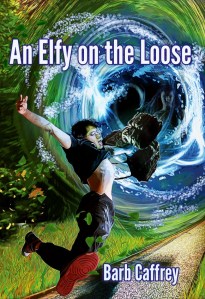 you can download my first novel, AN ELFY ON THE LOOSE, on March 3. (Again, that’s tomorrow, though you may be able to get it now if you’re reading late on Saturday night as the links appear to be open and active.) You will have your choice of a PDF file, a .mobi file (that’s for Kindle), or an e-pub file (that’s for just about everything that’s not Kindle). I’ve talked a good deal about AN ELFY ON THE LOOSE here at my blog, so I’ll only say this about it: It’s funny fantasy with two young kids who aren’t what they seem, and there are layers and layers to it. You may meet a few ghosts, too…
Anyway. There are other folks also giving things away that you should know about.
For example, you also can download my friend Loren K. Jones’ first book in his story about Stavin DragonBlessed, ALL THAT GLITTERS, on March 3. I edited Loren’s book, and it is a lot of fun. If you give it a chance, you’ll enjoy it, especially if you like military realism with your fantasy.
And that’s not all. Loren is giving away his book STORIES OF THE CONFEDERATED STAR SYSTEMS as well, and not just on March 3…but all week long.
And as if that weren’t enough, you also can download my friend Chris Nuttall’s first novel in his Schooled in Magic series, also titled SCHOOLED IN MAGIC, all week long. I also edited this book, and am happy to point people to it as I believe it’s one of Chris’s best books to date. (Though I am also partial to several others, this is the one that started it all.)
“But Barb,” you say. “What about your second book? The one you’re giving away on March 5…what book is that?”
That book is CHANGING FACES. It is a contemporary fantasy/ romance between a straight male clarinetist in graduate school, his bisexual (and, secretly, gender-fluid) girlfriend, also a clarinetist and in graduate school, and two meddling, but mostly good-hearted angels. They mix in because the female half of the pair (and yes, despite being gender-fluid, she uses female pronouns to describe herself all the time) is afraid to tell her boyfriend that she is gender-fluid and wants to explore a more masculine self-image. This isn’t what he signed up for, and while he loves her desperately, he doesn’t know if he can handle her presenting as male, or possibly even going as far as having surgery later to confirm her believe in her masculine side. (She is more than a little confused, herself, about all this, at least how to describe it. She knows how it feels to be who she is, but living her truth is not easy.) So, she’s going to leave her boyfriend, even though she loves him, and he prays that he will do anything, absolutely anything, so long as he gets another chance with her.
That “anything” ends up with him in her body, now a straight man in a woman’s body (definitely transgender), and her in his body in a coma is also not what he expected. And he can’t tell anyone what happened…while she’s forced to deal with herself and her demons, as only that way can she wake again and try with her boyfriend, this time with the outward masculine identity she felt she needed (even though she’s always going to be who she is).
The angels are funny. The music is inspired. And the two main characters, Allen and Elaine, are deeply in love, but aren’t too good at communicating with each other…and yet, they both want to try. So the angels give ’em this chance…can they realize that even though their faces have changed, their love remains?
I hope you will remember to go to the TTB Freebies site often this week, and download as many books as you want. Every day, new books will be given away, to let people know we’re here, we have good books to offer, and we hope folks will give us a chance.
There’s also a general site (not run by TTB) for Read an E-Book Week on Facebook here. More publishers will be giving things away there…lots of stuff to choose from, so maybe you can mix and match?
Enjoy!
Mozart, and Persistence
Folks, what comes to mind when you think about Wolfgang Amadeus Mozart?
Is it the fact that he was a gifted composer?
Is it that he was considered a virtuoso before the age of fifteen or so?
Is it that his father, Leopold, was also a composer and conductor?
Or is it that Mozart, like every other creative person on the face of this Earth (past or present), had to struggle at times, and not everyone liked what he was doing, or cared about it either?
Yes, Mozart was famous during his own lifetime. But he had struggles, too. (My conductor for the Racine Concert Band, Mark Eichner, pointed this out earlier this evening during his remarks.) For example, Mozart desperately wanted to break into the Paris opera scene; it was considered the “happening place,” back in the 1770s or so, and every composer who was anyone wanted to be known there.
So, he went to Paris. Taught some students, probably played some gigs here and there (as Mozart played any number of instruments, though he was known most for strings and piano), and managed to get a gig composing an overture for a ballet, “La Petite Riens.” (We played this piece tonight, hence Mr. Eichner’s remarks about Mozart. But I digress.) He thought that this would be his big break, as anyone who heard his music tended to adore it…but when he read the papers the next day after the ballet was premiered, he found out that his name wasn’t mentioned in the review. Nor was it mentioned in the concert’s program…
Yes, even W. A. Mozart could get treated badly, folks.
Anyway, the point here is that Mozart didn’t give up on his dreams after this setback. (It must’ve really smarted, too, considering.) He kept going. While it must’ve felt like a retreat, he went back to Germany, then to Italy, and elsewhere in Europe, and did what he needed to do in order to get his music played and published.
It may seem odd, that Mozart — the great Mozart — ran into problems. (This wasn’t his only problem, mind. He suffered money woes, health problems, problems with his kids and their health, difficulties with his wife’s family, and goodness knows what else.) But he was a human being, and as such, he had to deal with the “slings and arrows of outrageous fortune” like anyone else.
And it’s not like the man couldn’t compose. Anyone who’s heard any of his symphonies, or better yet, any of “The Magic Flute” (perhaps his best-known opera), knows that Mozart was an incredibly gifted and prolific composer…the large amount of music Mozart left behind, considering he died before the age of forty, testifies to that.
So, if you’ve run into problems with your creative pursuits, because you don’t think anyone cares, or you wonder what the point is, or you even wonder why you try so hard for so little of a result, remember what happened to Mozart.
Whatever has gone wrong this time, it is temporary. It doesn’t have to stop you if you refuse to let it do so.
So, remember this story…and don’t give up.
Concert Over…
Folks, I’m glad to report that I played my sax solo reasonably well last night, and the preparation that went into that worked out.
I am mostly writing this follow-up blog because of a comment I received from a fellow musician on Facebook. He isn’t aware of all of the various issues that went into me playing this solo, or even wanting to play a solo at all, and that reminded me that not everyone has read my blog for years.
And if you haven’t, you’re maybe not going to know exactly what did go into the persistent effort to play well enough to ask for a solo…much less anything else.
For longtime blog readers, this is going to be old hat to you, so if you want to skip over this post, feel free…but for the rest of you, here we go.
When my husband died in 2004, I was so devastated, I wasn’t able to do much of anything for years. Because I’d already been battling carpal tunnel syndrome (or what I thought was that, at the time), my hands became so stiff and sore, they were almost unusable — at least, when it came to playing a musical instrument. (I could still type, with effort, but I also saw problems even there.)
Then, for several years, I just didn’t play. I looked at my instruments, and grew frustrated; I’d gone through so much to get my two degrees, and now, I couldn’t do anything whatsoever?
In 2011, I finally felt able to talk with my old band director, Mark Eichner. He was still at UW-Parkside, and hadn’t yet retired; he told me when the Parkside Community Band was going to start rehearsing for their winter concert, and so, I rejoined the band. I played a solo there, within the band rather than standing up in front of it (as I did yesterday), which was difficult but worthwhile.
And not long after that, in 2012, I rejoined the Racine Concert Band as a saxophonist. They needed someone to play the second part, you see…and occasionally, I could play tenor sax or clarinet as needed. I knew playing every week in the summer, where I’d battle against my asthma as well as my hand issues, was going to be a challenge, but I appreciated being able to play again.
In a way, it took a few more years for my ego as a musician to reassert itself. (Ego is not necessarily a bad thing, mind.) By this point, I wanted to play a solo. So I asked for one, preferably on clarinet.
My conductor (again Mark Eichner, who also conducts the RCB) gave me a sax solo instead.
Note that my friend Vivian is the saxophone section leader. I’ve known Vivian for years. She’s a great person, she plays well, and she makes going to rehearsal fun. I did ask her if she had any problem whatsoever with me wanting to play a solo, and she basically said, “Of course not. Don’t be silly!”
(And she was the first person to congratulate me, too, last night. Just saying.)
So, I hope that fills in a few blanks.
As for why I said things the way I did before? It’s because I am a human being, fallible and mortal, and I really do struggle sometimes depending on what types of parts are written for the sax. (Many times, Vivian doesn’t have a good part, either. Nor does any other sax player in the section. It really depends on the arranger how well the sax section is used and/or exploited.) I have an easier time playing second clarinet or even third clarinet than I do second alto sax, because the clarinet parts in a band are based off the violin part in an orchestra — meaning that usually those parts are more interesting, or at least can be, than the second alto part. (And oft-times, they’re more interesting in my opinion than the first alto part, too. But that’s probably just me.)
I’m glad I feel well enough to play, and that I was able to do a good job last night. (And that my section leader, Vivian, puts up with me. Because I’m like anyone else — sometimes I can be a major pain in the buttinsky.)
 Barb Caffrey's Blog