Archive for the ‘Inspirational stuff’ Category
Sunday Thoughts: We Are All Works in Progress
Lately, I’ve had one very important thought running through my head. That thought is, “We’re all works in progress.”
Think about it, please, for a moment, and perhaps you’ll understand.
Our lives are happening right now, all around us. We are a part of history, whether we understand it or not. Whether our lives feel important or not, we partake of something akin to an infinite tapestry…our shades of thread are different from anyone else’s, and what we do with our gifts and talents is up to us.
Yes, there are obstacles. Yes, there are frustrations, and pain, and problems, and many times we wonder if what we’re doing makes any sense. Yes, there are issues with getting along with others, even those you are most motivated to understand. Yes, there seems to be more and more difficulty, the older you become (in experience, if not in age), of how to put yourself first or at least get it into the equation (rather than automatically putting yourself last, which does not work and only adds to the frustration, pain and problems accordingly).
Every day we get up, though, we can accomplish something.
Even if we’re sick, we can get up and take care of ourselves the best we can. Get our rest. Eat whatever we can tolerate. Save our strength.
And if we’re lucky, even on the bad days, even on the sick days, and even on the least encouraging days, we can find that spark of creativity that lies within us.
I live for creativity. (No, it’s not just for pointing out Michael’s memory to people who didn’t get a chance to know him. Though that’s important to me too, as I’m sure you know if you’ve spent any time at my blog at all.) So when I can’t create, it stifles me.
The only thing I know is that as a work in progress myself, every day brings a new chance to do something good. Something creative. Something positive.
Or at least to help a friend and/or loved one feel a bit better about the burdens they’re enduring.
We can do something to help the world around us. We can do something to become our authentic selves.
On this Sunday, reflect upon what you can do to make the world a better place. Then, perhaps, call a friend if you’re up to it, or write, or cook up a storm, or crochet, or do whatever you can that feeds your spirit and gives you positive reasons for living.
That, to my mind, is the winning strategy. And it helps us fill in our own works in progress with more beauty, delight, and joy, too.
Sunday Thoughts: Reject Hate
Lately, I’ve been very worried about how the United States — and the world around us — has given in to both tribalism and despair.
I understand despair better than I wish, but I don’t understand tribalism.
Why? Well, it seems to be a conduit for hatred. And we need to reject hate, in all its forms, as best we can.
We are all human. It can be hard to remember that, with some of the awful things that people do. But we are all human, and we are neither the least of our actions nor the best of our actions.
Instead, we are the sum total of our actions.
Where I live, we’ve seen an uptick in senseless violence in the past several years. Last week, some guy with a long gun ran out into the middle of a busy highway, and carjacked not one, but two people. He wrecked both cars, and was killed by the police before he could do any more harm.
I don’t know what caused this man to run out into the middle of the street with a long gun, much less carjack two different people. But I do know that he gave them nothing but pain. Their cars are wrecked. Their finances will take a hit in trying to get new ones (and in this area, the public transport is so spotty, you absolutely need to have a car), their mental health will take a hit in that they were hostages, and their emotional health will take a hit because they were helpless to affect their own lives in those moments.
I don’t know if this man hated everyone, or hated himself, or hated his situation. But he spread nothing but vitriol in the last hours of his life on this Earth.
I also don’t know what the answer is to people like this, except for trying to be a better person myself. As I said above, I know we’re not either our lowest moments (what my good friend calls our “blooper reel”), and we’re also not our highest moments (what she calls our “glamour shots”). But I can try, the best I can, to help others, to understand them, or at least make that effort in trying to understand.
That matters, even when I think it doesn’t. (Does this make sense? If it doesn’t, blame the lateness of the hour.)
I don’t know about you, but I often wonder if I am making a difference. After all, the Earth is huge. The amount of people living on Earth is staggering. And it’s only possible to get to know a few, select people most of the time. That means there are so many others we don’t know, that we can’t ever know, and yet we have to act as if we know them all.
Or at least as if we want to know them all.
Anyway, I know that any given human being (myself included) can only reach so many people, whether it’s emotionally, or mentally, or (even fewer people) physically. If we’re fortunate, it’s also possible affect them in a spiritual sense, too. (Hopefully for good, and not for ill. But I digress.)
And every little bit does help. Every time you can help someone, even if it’s just smiling at them and actually seeing them, or if you can listen for a while without judgment (very tough to do, if you do it right, but necessary), or if you can run an errand for someone who’s shut-in, or if you can be good to a stray animal and find that animal a home…every little bit helps.
When I’m depressed, or worse, despondent, I think that everything I’ve done has no meaning. I am honest about this, which I guess is unusual in and of itself.
I know it does have meaning, though. Even if I don’t exactly know what that meaning is, I know it does.
So, I will continue to do my best to reject hate in all its forms. I will continue to do my best to help others, as best I can. And I will continue to live my life on my own terms, and hope I can affect others’ lives for the better in the process.
May we all choose to reject hate. (Please?)
Johnny Weir, Individuality, and You
Recently, I’ve been watching the American version of “Dancing with the Stars.” I had stopped watching regularly a few years ago (though I would catch it if I happened to be near a TV and someone else was watching), mostly because all the storylines seemed the same.
But not this year.
Nope. This year had my favorite figure skater, Johnny Weir, partnered with a new pro, Britt Stewart (who’s Black, dignified, and quite talented). And the two of them danced like nobody’s business; they were a dynamic, engaging, and energetic pair that did more interesting things in ten weeks than I’d seen in the previous five or six years on the show.
Now, why do you think that was?
(I know I’ve been asking myself this question, anyway, ever since Johnny and his partner Britt were eliminated earlier this week.)
My view is this: Johnny Weir knows who he is, as an individual. And Britt obviously knows who she is, too. They both understood each other, down to the ground, and because of that, were able to work together and create some truly amazing dance routines. (Johnny and Britt’s tribute to Amy Winehouse, for example, was simply stunning. And that’s only one of the fine dances the two of them created together.)
“But Barb,” you say. “What’s this about being an individual, and how does that apply to me?”
It’s simple. The better you know yourself, the better work you can do. And Johnny and Britt showed that, over and over again, during this season on “Dancing with the Stars.”
You know, if you’ve read this blog for any length of time, that I am a firm believer in being your authentic self. I think it wastes time and energy that most of us don’t have to keep up a front. I also think the better you know yourself, the easier it is to get things done.
If you use Johnny and Britt as examples — and I think you should — you can extrapolate a little. For example, the two of them, together, were able to bring a certain style and verve into the ballroom. Johnny is more of an extrovert when he performs, while Britt has a quiet dignity to her. The two, together, were more than the sum of their parts.
And it all started because Britt apparently decided, when meeting Johnny for the first time, to use that uniqueness of his — not to mention hers (though she probably takes that for granted, as she can’t see herself from the outside anymore than any of the rest of us) — to create movement and magic.
Granted, if you think about it, it makes perfect sense. Johnny’s been a figure skater since the age of twelve. He knows about movement. He studied some dance (though I think it was ballet) because that helped him express himself through movement on the ice.
And knowing about movement helped him a great deal, I think. It meant Britt did not have to teach him from Ground Zero.
However, it also may have hampered him a bit, because ballet — and the associated movements of that dance — are nothing like either ballroom dance or Latin dance. They’re not even that close to “freestyle” contemporary dance.
What that meant for Johnny was, he had to unlearn at the same time as he learned. And that’s tough to do.
How do I know this? Well, Johnny once said, about learning a new technique for one of his jumps, that he was “old.” At the age of twenty-five or twenty-six, he said this. (Chronologically, of course, that was just silly. But with the wear and tear of figure skating, I’m sure he did feel old.) And he admitted, at the time, it was not easy to unlearn the previous technique.
(I probably should say “jettison,” but learning is not like that. It stays with you. It can’t truly be jettisoned. You can only use it, or not, or get past it, or not. But I digress.)
So, Britt taught Johnny, as well as helped him correct various issues, and worked with him and his uniqueness from the get-go. (Maybe all of the pro dancers do this, but it seems to me as a longtime viewer of “Dancing with the Stars” that it was far more pronounced in Johnny’s case.)
Being an individual, see, has its charms as well as its quirks. You can do more, if you know exactly who you are. (Again, I think it has something to do with refusing to waste your energy on non-essentials.) Add in the fact that when you’re doing more, you are giving your all to it rather than holding some back to “save face.” And top it off with a good, healthy dose of self-skepticism, for that matter, as that will keep you from getting too arrogant to be borne. (That last has nothing to do with Johnny Weir or his partner, Britt, but it certainly should be factored in by the rest of us.)
Anyway, the points of this blog are simple:
- Be yourself. Be unique.
- Don’t put on fronts, as they waste your time and energy.
That’s the way to “win” at life, you know. Because that’s the way you will be remembered: as the unique, powerful individual you are, who touched many lives and did many things and knew many people and tried your level best.
Anything less than that just isn’t worth bothering about.
Sunday Meditations on a John Wesley Quote
I have been taken with this John Wesley quote for a while now. As it’s Sunday, let’s dive in!
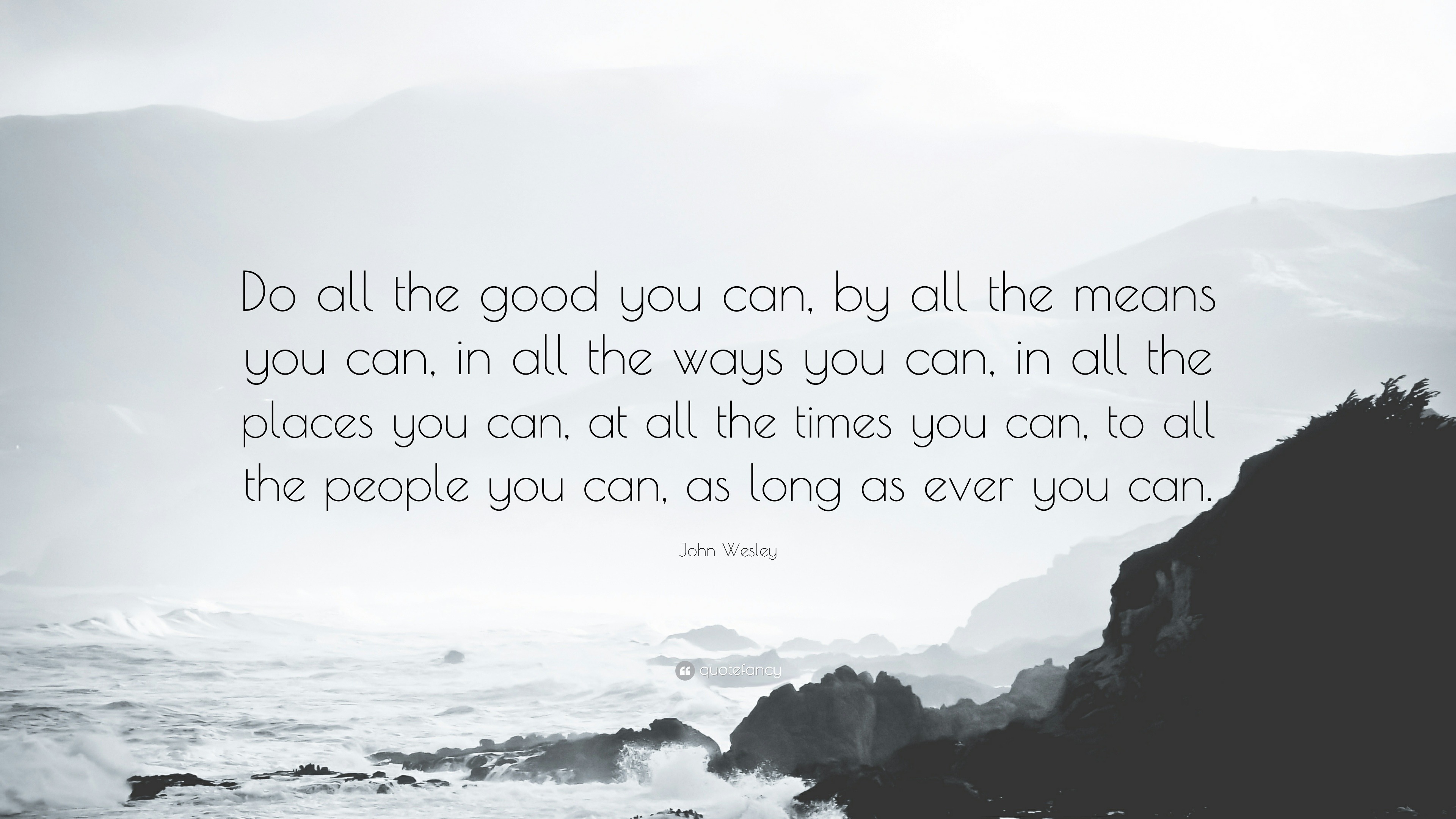
The above quote resonated with me the first time I heard it, which was sometime in junior high school. So I’d like to dissect this quote, starting with “do all the good you can.”
Too many of us think we can’t do any good at all, so we don’t do anything. And that’s not wise, nor is it smart. We can all do something to help our fellow man, woman, and/or child…it may be something small, like carrying in some groceries if you’re able-bodied and the person you’re helping isn’t. Or it could be something big, like helping someone fix a car when they can’t do it themselves but desperately need it.
(Note I’m talking about individual big things rather than societal big things. But I will get there.)
The key words there are “good” and “can.” Do your best, always; do what you can, always. And if you are in distress, and all you can do is offer good thoughts one day, do that. If you can offer a shoulder to cry on (even a virtual one, these days), that’s even better.
“But Barb,” you say. (Yes, I can hear you.) “What if I truly can’t do anything? I’m in a nursing home. Or I’m in the hospital. Or I’m just…tired, I guess.”
If you’re in a nursing home or in a hospital, the best thing you can do is to heal up. But while you do that, speak kindly to the nurses, doctors, and the staff. Encourage other patients, if you see them. Continue to learn whatever you can learn, via the TV or books or magazines or computer. And again, heal up.
If you’re just tired — and I know the feeling, because I often feel this way myself — you have to look at it a different way.
If you have had an abysmal day, just one from the Hells, and there’s nothing at all you can think of to do that’s any good for anyone, the best thing you can do is to calm down. Talk to a friend. Read a good book. Watch a movie that makes you laugh. Listen to some music that moves you. Whatever works, but do something to get your mind off these problems that are plaguing you.
Anyway, on to the next part of the quote, which is “by all the means you can.” Here, I think John Wesley was talking about the various ways you can help someone. Yes, you can help financially, but you can help emotionally, you can help physically sometimes, you can help spiritually (often we need that the most no matter what it looks like from the outside), and you can do it in whatever fashion you want.
The main thing is to not give in to despair. (Or if you need to, use my late husband’s Zen Buddhist trick and give in to it for five minutes. Then say to yourself, “Self, I’ve heard you. Now let’s get on.” I have used this trick frequently in recent days, and I know it works.)
Wesley here is saying again that you can make a difference by whatever means necessary. And that’s important.
The next part of the quote is “in all the ways you can.” I have already covered this, to an extent, in my previous paragraphs, but I will reiterate for the record: do whatever you need to do to help others in whatever possible ways you have available. Even if they seem small, they can do wonders.
For example, if you are at the grocery store in these days of Covid-19, you can be extra-nice to the cashiers. (Or just polite if you’re normally rude, I guess. Though I would hope none of my readers are rude on a regular basis. Yes, that’s a small joke. Probably very small. Moving on…) You can also help others get their groceries to the car if the clerks are too busy to do it or are unable to do it. You can be polite in the parking lot and make sure you give extra space and time to people walking to and from the store, and pay extra-close attention to the various cars in the lot because not everyone else is.
These are all small things. But they add up. And the clerks will appreciate someone who is not rude or abrupt. The people you deal with, in or out of the car, will appreciate that you are paying attention whether they realize it or not. And if you are helping someone get their stuff to the car, that is vitally important and will probably have made someone’s day.
Small things do add up, you know.
Wesley goes on to say “in all the places you can.” I think what he meant by this is for people not to stop thinking about ways to help others when they walk out the door of the church. If you can help someone in the store, do it. If you can help someone on the road, do that. If you can help a friend by listening even if it’s the tenth time you’ve gone over the same subject and you’re just tired of it — but you can rein in your frustration, and listen and empathize anyway — these things matter.
The next part of Wesley’s quote is “at all the times you can.” I think Wesley put it this way because of what I said before about “days from the Hells.” But it could also be that he dealt with too many people who thought the only time to be charitable was when they were actually in church. And once they walked out the door, that was it for charity for the week, almost as if they had “banked” the charity by going to church and enduring the hour-long sermon. (Or whatever.)
The message here is simple. We are all children of God/dess. (Or Deity. Or “Hey, you, big guy in the sky.” Call Deity what you wish; I don’t think it matters much to Deity.) We are all fallible, imperfect, mortal, all that — just as I’ve said in many other blogs — but along with that fallible, imperfect, mortal stuff comes some pretty good basic instincts. We, most of us, want to help others; we want to do good, not just because it’s the right thing to do, but because it makes us feel better to do it. (Maybe that was a biological thing Deity built into us, for all I know.)
And when we deal with those who just don’t seem to care, or don’t seem to want to do the right thing to help their fellow man (or woman or child), it can be frustrating to know that you’re doing your best but someone else is slacking off.
(I don’t know if that’s something Wesley considered during the writing of this, but it makes sense to me.)
The next part of the quote is, “to all the people you can.” I think here Wesley was saying that you should not stop caring about those you dislike. That you should try to find ways to help everyone, not just your own family, your own church, your own clique. That you should make a point to reach out, even when it’s hard (some days it’s very hard; I know!), to help someone who needs it. (Especially as some days, that person is going to be you. But I digress.)
And finally, Wesley closes his quote with, “as long as ever you can.” (I know that reads oddly to modern readers, but Wesley died in 1791. Word choices were different then.)
What does that mean, exactly? Well, I think Wesley believed you needed to keep doing whatever you possibly could to help others for the entirety of your lives. Period. Full stop.
Now, I did some digging into this quote. Wesley is attributed with it because of several sermons he gave during his career as a minister. This was seen to be his overarching philosophy, but Wesley probably never put it exactly the way this quote is put now during his lifetime.
(Which does make me wonder about that “ever you can” stuff, but again, Wesley died in 1791.)
What is important is that Wesley believed we all could and indeed should make a difference. That we indeed should do these things outside the church as well as inside; that we should do these things in the stores as well as our homes; that we should help those we knew and those we didn’t; that we should continue to pray for those we don’t understand and even those we dislike, along with those we know and do understand and deal with on a regular basis.
On this Sunday, take a minute and ask yourself, “What can I do to help someone else today that I normally don’t do?” And then, if you can, do that thing; if you can’t do it today but can do it tomorrow instead, do it then.
But do it. Because it matters. Even when it seems like it doesn’t.
Sunday Meditation: Learning to Let Go

It’s no secret that over the years I’ve had a hard time letting go of things, good and bad. The best I can do with certain things is agree that I’m going to go on with my memories intact, and do the best I can with them. With my late husband’s death, that’s the level best I can do — letting go is not an option, because that would also let go of all my hopes, dreams, aspirations, and anything else positive that I still wish to obtain.
But maybe I can let go of how angry I am that he died too early. (I’m not angry at him. I’ll never be angry there.) And maybe I can let go of some of the nonsense I saw immediately after my husband died, including some of the rudest comments any widow could ever get. (Including one idiot who said that I would be just fine because I was young, and could still remarry. Um, what?)
So I’m not great with letting go, but I’m working on it.
This becomes more imperative with other things in my life, though. Things I regret doing, that I cannot change now. People I wish who had been different, or better, or less toxic; again, I can’t change that now either. And things that frustrate the Hell out of me…again, if it’s not an ongoing occurrence, why waste any more time on it?
So just for today, I’m going to do my best to let go of all the negative emotions I feel and focus instead on whatever good I can find in the midst of this pandemic, including the love of friends and family who’ve stayed in my life (not to mention good books and good music).
While I know it’s going to be a work-in-progress, I have to do what I can to keep going and give myself a chance to find happiness. Or at least fulfillment. Or peace. Or all of the above.
If you are like me, and you need to let go, try to tell yourself, “Just for today…” and see what happens. (Then do let me know about how it went for you in the comments, OK? I care.)
Holiday Musings on a Prescient Bob Costas Quote
“I am a firm believer in this: one of the measures of a person is how do they treat someone they have no reason to believe can do them any good.” — Bob Costas, legendary sportscaster, quoted in MADDEN: A Biography, p. 189-90**
Bob Costas is right.
How you treat people is what matters. Whether they can help you in the moment or not, how you act when the world’s supposedly not watching is what defines your character.
But not everyone believes this.
Why? Well, there there are so many people in this life that can’t seemingly do us any good. From your local grocery cashier, to the clerk at the gas station, to the folks who answer telephones for your local Congresscritters, these are folks that some people seem to believe are disposable.
Obviously, I am not among them.
What you do for a living is not what matters. Who you are — that is what matters.
Your character, your soul, your willingness to understand others even if they seem very different from yourself…this is what separates good people from bad, in my opinion.
But in case you disagree, I want you to consider the following:
We are all human beings, fallible and mortal. We all have hopes, dreams, fears, and struggles. You name it, we all have it. And we are all worthy of care, consideration and respect.
I’d believe this even if I hadn’t been, often, in the situation where I was the one who seemingly “couldn’t do any good” for someone.
Please do your best, especially at this critical time of the year with the holidays fast approaching, to remember the Golden Rule. “Do unto others as you would have done unto you.”
That may help you recall that there are no disposable people.
We all matter, each and every one. We should be treated respectfully, with care, with consideration, and with as much compassion as possible.
Remember Bob Costas’ quote.
It is important. And so are you.
——–
**This quote stuck with me, even after I finished reading MADDEN: A Biography. It’s an older thought, but it’s well-encapsulated by Bob Costas here…and I realized, at the time, that I needed to come talk about this further.
Dealing with Disappointment, part the Nth
What are you supposed to do when your efforts are not rewarded?
This is something that every single human being has to deal with at some point in his or her life. You’ve done everything you possibly can, and yet, your efforts are not appreciated. And sometimes, you wonder just how to appreciate yourself when you think no one else on the face of the Earth does.
It can be very hard to deal with this sort of disappointment. Even though we know, realistically, that other people will sometimes disappoint us, the lack of appreciation for our efforts tends to come at the worst possible time, often adding insult to injury.
In addition, I know that I tend to look at myself through a very harsh lens. So when I do something to the utmost of my ability and it doesn’t seem to have made a dent — think of what I said earlier this week about the efforts to get politicians to do anything about mass shootings, for example — I just wonder what the Hell I’m doing here.
Then everything starts to spiral down, out of control…at least, until I get some perspective, and tell myself the following things:
- You can’t control what other people think, say, or do.
- But you can control your own reactions. So if someone takes your hard work, grunts, and turns away, rather than saying, “Great! Thanks for putting in the hard work to get this done,” you have to tell yourself that’s their issue and not yours. (Maybe something is going on in their lives that’s making them be less responsive and less empathetic than they should be.)
- Sometimes, you just have to celebrate your own efforts yourself.
- It’s OK to be upset if someone is rude. That’s natural, normal, and human.
- Don’t beat yourself up due to other people’s failings.
If you can tell yourself those five things, it may help you feel a little better.
And even if it doesn’t, there’s still one more way to deal with your frustration, anger, and hurt over whatever’s disappointing you.
My late husband, Michael, told me you should not push your anger, frustration, or disappointment away. Instead, you should fully feel whatever it is, and put a time limit on it. (Say, five or ten minutes.) Then, after that time, you tell yourself, “OK, self, I’ve heard you. Now, let’s go back to what we were doing before.”
This may not sound like something that works, but it does.
Why? Because you’re acknowledging your feelings. You’re not pushing them away. You’re telling yourself it’s OK to have these feelings, even if they’re ugly and make you feel less than your best self; you’re reminding yourself that you’re a human being, and we all have bad days.
And when you can accept your feelings, even if you still dislike them, it’s much easier to get back to what you were doing.
In a few days or weeks, whatever was upsetting you probably won’t be as bad. (Excepting this whole mass shooting mess. That just seems to go on and on. But I’m putting that aside for now…hm de hum de hum.) But even if it is, you may have figured out how to deal with it better, and how not to beat yourself up for being human.
So, that’s how I deal with disappointment. What do you do? Tell me about it in the comments!
 Barb Caffrey's Blog