Archive for the ‘Religion’ Category
Sunday Reflection: What Can You Learn from the Parable of the Talents?
Folks, it’s been a while since I wrote a Sunday Reflection post, so here it is. Enjoy!
There’s something important in the Bible about the parable of the talents. It’s in the book of Matthew, to be exact. (Matthew 25:14-30)
Before I discuss it, I’ll mention that I’m using the New Revised Standard Version Catholic Edition, as I learned it from my Grandma’s Catholic Bible years ago. I thought the language was clear, distinct, and couldn’t be more evocative, so…here we go.
14 “For it is as if a man, going on a journey, summoned his slaves and entrusted his property to them;
15 to one he gave five talents, to another two, to another one, to each according to his ability. Then he went away.
16 The one who had received the five talents went off at once and traded with them, and made five more talents.
17 In the same way, the one who had the two talents made two more talents.
18 But the one who had received the one talent went off and dug a hole in the ground and hid his master’s money.
19 After a long time the master of those slaves came and settled accounts with them.
20 Then the one who had received the five talents came forward, bringing five more talents, saying, ‘Master, you handed over to me five talents; see, I have made five more talents.’
21 His master said to him, ‘Well done, good and trustworthy slave; you have been trustworthy in a few things, I will put you in charge of many things; enter into the joy of your master.’
22 And the one with the two talents also came forward, saying, ‘Master, you handed over to me two talents; see, I have made two more talents.’
23 His master said to him, ‘Well done, good and trustworthy slave; you have been trustworthy in a few things, I will put you in charge of many things; enter into the joy of your master.’
24 Then the one who had received the one talent also came forward, saying, ‘Master, I knew that you were a harsh man, reaping where you did not sow, and gathering where you did not scatter seed;
25 so I was afraid, and I went and hid your talent in the ground. Here you have what is yours.’
26 But his master replied, ‘You wicked and lazy slave! You knew, did you, that I reap where I did not sow, and gather where I did not scatter?
27 Then you ought to have invested my money with the bankers, and on my return I would have received what was my own with interest.
28 So take the talent from him, and give it to the one with the ten talents.
29 For to all those who have, more will be given, and they will have an abundance; but from those who have nothing, even what they have will be taken away.
30 As for this worthless slave, throw him into the outer darkness, where there will be weeping and gnashing of teeth.’
There is a footnote that points out that a talent was worth fifteen years’ wages of an average laborer, which needs to be understood in the case of the last slave. (I don’t know about you, but realizing this master gave his slaves a whole lot of money and then went away creeped me out more than a little. It almost seems like a setup for all of them to take a huge pratfall.)
Of course, to God, we may not be worth more than slaves. That’s hard to understand in our individualistic society, as none of us want to be thought slavish to anything, much less the will of another person. And yet, we’re supposed to follow the Deity the best we can, learn all we can learn, master our abilities the best we can and keep going as long as we can…we’re supposed to make the most of ourselves, no matter what our situation is, and no matter how fraught with peril it is.
This situation most definitely was exactly that.
The master gave five talents to his most trustworthy slave/worker. He gave two talents to the second-most trustworthy slave/worker. And then he gave one talent to the third-most trustworthy slave/worker, before leaving on a journey.
After quite some time, the master came back and found, as it says above, that the first slave doubled his talents due to hard work and ability. The master was pleased. The second slave also doubled his talents due to his hard work and ability, too. Again, the master was pleased.
But that third guy…he either did not understand what the master wanted (when the other two clearly did), or he was too craven to make an attempt at doubling his own money. I got the sense, when I read this, that the master almost would’ve rather the slave tried but lost the whole talent than the slave going and burying it in the backyard.
It was because the third slave did not want to try, or did not think he could try, or really was daunted by what the other two slaves had done and thought he could not match up to them no matter what he did, that he simply buried the talent in the backyard.
That was not good enough. The slave was cast out, while the other two were exalted.
And this is where the lesson kind of fails some folks, because they figure that bit about those who have a lot more shall be given only relies on Earthly things. They actually are more like the faithless slave who buried his talent in the ground rather than try to do something with it, because they’re hanging on to what they have like grim death.
In addition, the idea that to those who have nothing, what little they have will be taken away, gets misconstrued also.
If you think about how Jesus said that it would be easier for a camel to go through the eye of a needle than for someone wealthy to gain the kingdom of God, and then contrast it with that last verse, you can see there’s a bit of a conundrum there.
The way I see it, we’re meant to maximize whatever talents we have. The first slave/worker was probably good at things like ordering, trading livestock, bartering in the bazaar, and suchlike. That’s why he could double his talents; he knew he was good at those things, and he had faith that if he did what he was good at, he’d succeed.
He was right.
The second slave/worker was probably good at things like working with the other slaves in the house, making sure the livestock on the property was being well-treated, and also that when it came time to sacrifice animals, it was done cleanly and without unnecessary distress to the animal. There isn’t as much easy wealth in such things, so to double what the second slave had been given took time, effort, and a whole lot of persistence. Maybe he wasn’t as sure he’d succeed, but he was going to do his best.
He did succeed after much travail, as I see it. The margin for wealth wasn’t the same, because his abilities weren’t the same, and the people and livestock he worked with only had so much of a wealth ceiling, perhaps. But he made the most of his abilities, and he doubled the master’s money.
Whereas the third guy saw the first two, and maybe thought to himself, “I can’t do either of those things. I’m not good at that.” Maybe he thought he was a farmworker, and while he had always worked hard, he didn’t try to better himself because he saw no point to it. And in his entire life, that was his way of looking at things: do just enough to get by.
That’s why he buried the talent in the backyard. He didn’t want to be responsible for so much money (again, fifteen years’ worth of his labor!) having been lost. He abdicated his responsibility, but did not abscond with it; he stayed the course, but didn’t learn anything new by the experience.
That is why he got tossed out. He missed the point of the exercise. He didn’t want to try because he believed for sure he’d fail. And then, he believed if he tried and failed, his master, someone he characterized as a hard man and perhaps even a cruel one, that would be worse than not trying at all.
The only thing the third slave did that was different besides that was, he told off his master. He more or less said that the master was benefiting from the fruit of everyone else’s labor, and why was the master worth that?
That’s a decent question, but it’s asked at the wrong time.
If you think about it, the whole parable of the talents goes like this: we are given a certain amount of things to start out our lives with. What do we do with them? Do we hoard them and refuse to learn anything or gain any new skills or abilities? Or do we try, try, and try again, even when it hurts, even when you wonder why you’re still after it, even when you know that it’s likely no one will remember your name in fifty to one hundred years?
The answer is simple. We can’t hoard our talents. We have to use them, and not just to our own benefit. Use it to the betterment of all, as best we can. Lift up those we can, and refuse to put down people who don’t have as much as we do.
It can be a hard lesson to learn. Many people learn the wrong thing from it and believe that if they’re wealthy, they’re going to stay that way because they’re inherently better. And that’s not true…wealthy people vary like everyone else, with some being quite good and helpful and honest and such, while others…well, they make Ebenezer Scrooge look tame, that’s all I’ll say.
At any rate, thus goes the Parable of the Talents. It has stuck with me for good reasons, and I believe that’s one of the reasons I refuse to give up.
You do the same, eh?
Easter Blessings…
Folks, it’s Easter. I usually try to write something, anything about the huge observance of Jesus Christ’s resurrection and assumption into Heaven as it’s one of the most interesting stories ever told.
I mean, really. Think about it. The Deity sent Jesus, the Deity’s child, to save the world. Jesus’s path was not easy. He was betrayed by one of his best friends and apostles, Judas. His death was treated as a type of spectator sport, and he died in agony. He really didn’t know why the Deity had seemingly forsaken him, and he had no idea of what his destiny truly was.
Why was this? I think it’s because life ground Jesus down somewhat. Jesus came into this world knowing he was special. His parents traveled to save his life, and his titular father, Joseph, was not Jesus’s actual father. Mary, Jesus’s mother, had been impregnated by the Deity, and was still virginal; she married Joseph, who by accounts was a kindly older man, to have some protection and some status while she carried the son of God/Deity.
So, you are told your whole life that you’re special. There were Wise Men who blessed your birth and gave your parents unusual and very expensive gifts. (Think about how difficult it was to get or pay for stuff like frankincense and myrrh back then. I don’t think it was something that just grew and could be harvested anywhere.) Your parents had more children, yet Joseph knew you were no part of him genetically…he was more like a foster Dad, or a Stepdad, and all of Joseph and Mary’s other children were Jesus’s half-sibs. Then he was trained by various scholars and legalists, something his half-sibs did not get and probably did not want. His rise was seen as almost assured.
Then, Jesus took up carpentry. This probably wasn’t what anyone had expected of him. He was not a rabbi at that point. He was instead a hard-working man, but at most he was probably lower-middle class as we see it today. He worked hard, he probably drank with his buddies, he may well have looked at women (he always liked women and did not look down on anyone who did what she did to survive, including prostitutes), and lived as close to a normal life as was possible.
Then Jesus was reminded of his special nature, and started to walk among people as a prophet of sorts. He gathered allies, many of whom were men; they gave up all their worldly possessions to follow him and help others.
Think about this for a moment. Our analogue for this would be something like hippies. Well-meaning, granola-crunching hippies. They wanted to feed the hungry, clothe the naked, treat the sick and comfort the elderly. Rabbis already did some of these things, but they weren’t doing enough and Jesus and his followers knew it.
Consider that, the next time you wonder why people didn’t listen to Jesus from the first.
Following what Jesus taught is not easy. Writer G.K. Chesterton once said something along the lines of “Christianity is the best religion that’s never been tried,” and there’s a lot of truth in that. Most of us are going to fall short in our observance of helping to feed the hungry, clothe the naked, treat the sick and comfort the elderly. The modern world — no matter what age we’re in — makes it tougher to have deep and meaningful relationships with people, and without such relationships, we as human beings tend to founder.
Anyway, it is Easter. If you are alive to read this, you are blessed.
If you want to help someone today, I think Jesus would like that. I also think that if it’s possible, you should pray for the Palestinians starving in Gaza, pray for the Ukrainians as they continue to fight a huge war against Mother Russia and Vladimir Putin, and do what you can to help those in your communities live better, healthier, and happier lives.
At bare minimum, though, remember this: Jesus said to love one another as he loved us.
This world needs a lot more of such selfless love, so try to give some today.
Sunday Reflection
In the past few weeks, I was reminded — forcibly — that life is incredibly short.
There is a Biblical quote that comes to mind about such times. It’s from Psalm 90, verse 12. “So teach us to number our days, that we may apply our hearts unto wisdom.”
It seems to me that too many people in this world forget both parts of that equation. Time is very short, so we have to work hard to find wisdom as our days are numbered and we have no idea when the end will come.
I try to find wisdom, teachings, and purpose wherever I can, partly because I know how short time is. (Ask anyone widowed young, and they’ll agree with me.) The other part is, I’ve always tried to find common ground with other people whenever possible, in the hopes that light can shine not only in my life, but in someone else’s life, too.
There are many things I’d do differently, if I had more energy, health, financial security, and overall stability. But seeking out purpose and wisdom would not be one of them.
As the ancient proverb says, “Time and tide wait for no man.” Please remember that, and don’t put off until tomorrow what you could do today to make someone’s life a little better.
Do What Is Right
Folks, whenever I ask myself what I should do next, I hear this: “Do what is right.”
Now, what’s right for me may not be right for you, and vice versa. But what I do know is, if I want to live with myself in any sort of harmony at all, I have to examine whatever I do in the lines of the above.
See, it’s very easy to say, “do what is right.” But doing it? All the time? As best you can? It’s not so easy…but in my case, it’s the only way for me to live with myself.
My view of “do what is right” is quite simple. If it’s ethical; if it’s principled; if it’s honest; if it’s above-board, those are the defining characteristics of that pithy phrase.
The few times I’ve gone against my nature and have tried to compromise my principles (more or less, “go along to get along”), it hasn’t ended well. I have to live an authentic life as well as I’m able, as I’ve discussed many times at my blog already. Doing all of this seems to help me, especially with regards to my creativity. It also helps me to stay grounded.
So, when I see that Millennials and Gen Z are talking about the same things I am, but as if they’re new ideas, I get a bit frustrated.
Why? Well, it seems to me that every generation seems to want to reinvent the wheel. Because of this, knowledge that folks who’ve come before them — either people they meet, or books they read — seems to be lost in the translation.
Hell, what I’m talking about is not new. Marcus Aurelius was the first person known to ever write an autobiography of sorts, called Meditations. He discussed Stoic principles along with various things he saw in his life, and believed the best way to live was in authentic harmony with yourself, as that was the easiest way to coexist with nature and the natural world.
Of course, there are various beliefs about whether Marcus Aurelius wanted this book to be published. He was a Roman Emperor, and as such, everything he did and said and wrote was kept, scrutinized, and analyzed. He knew this, too. But he didn’t let that stop him, insofar as coming up with a way he believed helped him live a good life.
In other words, we’re lucky we have Aurelius’s Meditations, and for more than one reason.
Anyway, think about what the phrase “do what is right” means to you. Is it too simplistic of a philosophy to be useful? Is it perhaps too difficult of a philosophy to wish to aspire to?
Personally, I don’t think it’s difficult at all. Especially if you think about it as the predecessor of the Golden Rule, also known as “do unto others as you wish them to do unto you.”
Our world has many religious philosophies, and many different ways of seeing the world. One thing we all seem to agree upon, though, is that honest, ethical, above-board people are far easier to deal with than dishonest, unethical, unprincipled people.
My hope is that over time, we can find ways to find more common ground rather than less.
I also wish that, as people, we start looking for ways to communicate rather than ways to throw up roadblocks because someone’s a different race, ethnicity, sex, gender, etc.
If you need to see someone who could’ve been a right bastard (excuse my language), but instead chose to behave in as wise a manner as he could — that person being Marcus Aurelius, of course — to understand that life in all its variety should be appreciated rather than besmirched, take a second look at old Marcus’s writing.
After all, at one time, all roads led to Rome.
Opposites Attract: The Jerry Falwell and Larry Flint Friendship
Folks, I’ve been thinking a great deal about friendship. Must we always be just like our friends? (You know I’m going to say no.) Can’t we appreciate different things in different people? (I would assuredly hope so.) And have other people managed to find common ground despite their differences?
Too many people get caught up in their “tribes” of folks who say they believe every single thing down to the last jot and tittle as themselves. They don’t challenge themselves, or their assumptions; they aren’t strong enough, perhaps, or maybe they just see no need.
Yet Larry Flynt — the famous owner of Hustler magazine (a men’s magazine that, shall we say, specialized in raunchiness rather than photographic artistry) — and Jerry Falwell, the famous Protestant minister, ended up friends after fighting like cats and dogs for years due to their obvious differences. (To say that Falwell did not approve of pornography, much less graphic porn like Hustler, is a severe understatement.)
How did they become friends?
Well, there’s a story behind that, and it goes like this: After Jerry Falwell lost a big lawsuit that went all the way to the Supreme Court, he went to Flynt and said, “I believe God wants us to be friends. Goodness knows we’ve tried everything else.” (This is my best paraphrase from several things I’ve read over the years.)
Flynt had some God-fearing friends, such as Ruth Carter Stapleton (former U.S. President Jimmy Carter’s sister), and had converted, at least for a short time, to Christianity in the 1970s. (I think he made it about a year before he again proclaimed he was an atheist.) He respected them despite their differences. But no one, not him and probably not Falwell, would’ve believed that these two wildly disparate personalities would become friends.
Why? Well, to put it mildly, most people do not become friends after they lose such a high-profile lawsuit. (Or any lawsuit.)
Yet Falwell extended Christian charity to Flynt, and Flynt responded. Flynt once said (again, from my best paraphrase), “We had almost nothing in common, yet he was a great friend.”
These two were unafraid to discuss their differences, too. They knew in many ways they were diametrically opposed. Yet…they also had some things in common, such as beliefs in integrity and fair dealing. They also believed people should honestly confront themselves, plus both believed in the rights of people with disabilities to fair treatment and understanding. They also were both, adamantly, against the death penalty, and Flynt backed it up when the gunman who paralyzed him was on death row as Flynt asked for the death penalty not to be applied.
In writing circles, we have a few other “opposite attracts” friendships, including the professional collaboration and long friendship between David Weber and the late Eric Flint. I know from my own knowledge of reading various posts by both men at Baen’s Bar (find it by going to baen.com and look for the link) that both men were intelligent, spirited, and tough but fair when discussing their various differences. (The respect between the two men was never in doubt.) What they had in common was personal integrity, honesty, commitment, a strong work ethic, and a willingness to work together to write excellent fiction.
My late husband Michael was a major admirer of David Weber, years ago. He had all the Honor Harrington books, plus the Bahzell books, and several other ones. (I can’t remember all the names now, but I’d probably recognize the various covers.) Michael, like myself, believed in traditional small-l liberal values and tended to vote for centrist candidates. (This was quite right-wing for San Francisco, he proudly used to say. I think Michael loved being contrary. But I digress.)
See, it is possible to respect and admire someone no matter what providing people are of good will and no malice. Flint and Weber worked together, were great friends, and appreciated each other. And the oddest couple of all, Flynt and Falwell, certainly became great friends and appreciated each other.
Knowing of these friendships makes me believe that people in general can, still, become friends with folks who seemingly have nothing in common.
So, when you abhor the state of the world — and truly, there are very difficult things going on all over the place, including a ton of stupidity — remember this:
It is possible to be friends with someone of a different political party. It is possible to become friends with someone of a different gender or sexual expression. It is possible to become friends with someone who worships differently than yourself…and it definitely is possible to be friends even if all of these things are present, providing we are people of goodwill and do as much listening as we do talking.
(That’s hard for me, but I’m working on it.)
Anyway, what “opposites attract” friendship have you wondered about? Tell me about it in the comments!
A Post of Quiet Contemplation
The last few weeks, I’ve needed to take a breather.
I’ve been doing what I can to watch nature as the weather starts to turn. There is a plethora of birds to see at this time of year in Wisconsin, and many are small and cute. While I’m no ornithologist, I enjoy bird-watching, as it reminds me that troubles are mostly transitory. Eventually, we fly away from our cares.
(BTW, jazz saxophonist Charlie “Bird” Parker had a song called “Ornithology.” That’s how I learned the word — and if you don’t know who Charlie Parker is, shame on you.)
I try to be aware of the various animals around at this time of year. We often have ducks crossing the road, or sometimes a pack of squirrels (with maybe one or two laggards)…there are some folks with outdoor cats that I’ve seen, too, along with a number of geese (rare at this time of year, as they usually like much warmer surrounds than Wisconsin in November).
When I see an animal wounded or dead on the road, I say a prayer for them. (I know that has to sound ridiculous, but it’s true.) They remind me of something that happened a few years ago now, you see.
There was a duck in the middle of the road with its feet up. It was only a two-lane road, and it was a county highway. There was no way for me to get off the road as there was no shoulder (road construction, I think, at the time); I couldn’t do anything except hope and pray my wheels would not hit the duck in its throes.
Unfortunately, I ran over the duck. I felt terrible about it. I kept wondering if there was anything I could do. (My bird-loving friends said no, there wasn’t.) I wanted to go back and get that duck and bring it to the side of the road, so it could die in peace, rather than perhaps getting run over by even more cars (I don’t think mine was the first car to hit the poor thing).
While I couldn’t do that then, I have tried to do similar things with other animals in the road. I haven’t found any live animals since that duck, but I have been able to get a few cats off the road and one poor little dog (no tags on any of them, and no collars, either). If all I can do is pick them up with a bag or some paper toweling to put them on the side of the road, at least I feel slightly better for it.
I wonder, sometimes, if we are like those poor things. Most of the time, no one knows what we’re doing while we’re doing it, and we seem to only be appreciated in retrospect. We mostly hurry, scurrying here and there, not watching the road very much as we just try to keep going about our business in our daily lives.
What I believe, mostly, is that we owe it to all of the Deity’s creatures to respect them and do our best to love them, if possible. (I have a hard time loving a flea or a mosquito, so when I see one, I mostly hope it goes somewhere else. But that’s probably a flaw in my faith.)
So, if you are out and about this week — and many will be in the US, as it’s the week of Thanksgiving for us — you owe it to yourself to fully partake in nature’s surroundings as best you can.
Look at the trees. See how they keep growing, changing, yet somehow keeping their essence the same despite all the seasons of their lives.
Look at the few flowers that have made it through the frost (if any are left); otherwise, look at the evergreens, and ponder how shrubbery makes it through all the seasons more or less unscathed.
Look at the animals, including rabbits, geese, ducks, birds of all sorts, and squirrels. See how they just go about their business, preparing for winter, but enjoying what they have in the meantime (even if it’s just a stray bar of sunlight now and again).
Don’t forget these things. Let them ground you, motivate you, or maybe both…but no matter what, keep an eye on them.
These are the things that matter, you see. Everything else, save love and faith, is extraneous. The animals know it.
We should know it, too.
Halloween Musings
Folks, as I write this, it’s two days until Halloween. Three days until All Soul’s Day. And the official Day of the Dead ceremonies go from October 31 to November 2, 2022.
As this is a time where we’re not quite to winter, yet it’s colder more days than not, there’s an awful lot of personal reflection going on. (I don’t think I’m alone in this.) What have we done this year? What would our loved ones on the Other Side be proud of, and maybe not-so-proud of?
When I was young, I was like everyone else. I wore cute costumes (I think I went one year as a pink fairy; Mom and Grandma helped me make a “wand” with aluminum foil that looked a bit like a Star of David), went out to get Halloween candy, and possibly went to a few minor parties. (They were all very tame parties. A “lock-in” at the local Aladdin’s Castle, a place to play a ton of video games, was one of them. Another was at a good male friend’s house; I knew he was gay, but we didn’t talk about it then, and I had a huge crush on him anyway.)
As I got older, I read a great deal about the significance of Halloween. It started out as Hallowe’en — as in, the evening before All Soul’s Day. (All Hallow’s Eve got contracted to Hallowe’en.) It was a Christian religious observance that happened around the same time as Pagan Samhain (“Sow’en” is the pronunciation), and it’s possible — I think likely — that the early Christian church kept the day and most of its rituals in order to help people convert without having to “convert” people by taking up arms against them.
Of course, Samhain this year is on October 31. (Many years, it coincides. But not always, to the best of my recollection.) It is celebrated from dusk to the dawn of November 1. It is thought by many, particularly those in the NeoPagan community, that Samhain is when the veils between this world and the next are the thinnest. (Note the similarity with the Day of the Dead celebrations. I’m sure it’s not accidental.)
For me, as a NeoPagan, what I do is very similar to what I did as a Catholic, earlier in life: I light a candle, and think about my loved ones. I have several that I think about in addition to my beloved husband, Michael…I think a lot about Grandma, great-grandma on my father’s side (called “Aiti”), my uncle Carl and aunt Laurice, my best friend Jeff Wilson, my good friend Larry (dead for over thirty years, now, via suicide, but not forgotten), and more.
If I can find it, I will buy a Mountain Dew (diet, even though that’s not what my husband drank; he drank the regular stuff, thank you very many, and he preferred Code Red or the orange Livewire if he could find them), and sip it slowly. (I don’t know what foods would appeal that much to any of my relatives or to Jeff, but I know for a fact that Mountain Dew and a few specific candy bars and such are what Michael would like, if he could taste them through me.)
But most of all, it’s about reflection. What have I done? What can I still do? Would my loved ones approve of what I’ve done or what I’ve at least tried to do?
So, yeah. It’s not all about the candy and the costume parties for me. Not anymore.
What are you planning to do this year for your Halloween/Samhain/Day of the Dead festivities? Let me know in the comments…and if it’s that you’re going to a costume party, that’s good (so long as I don’t have to go!)
Updates on Ukraine, the Empathy Gap Essay, and a Discussion of Muslims, Cigarettes, and Virtue-Signaling
Folks, I wanted to write a blog today about Ukraine along with updating last week’s blog about the empathy gap. I also veer into a discussion of smoking that may surprise you. So do keep reading, OK?
Sometimes, a news commentator utterly surprises.
Why am I saying that? Well, Malcolm Nance, a longtime MSNBC analyst, has joined the international force doing their best to push Russia right back out of Ukraine. He is a Navy vet, and he said that he was “done talking.” Therefore, he went to Ukraine, where he’s been now for over a week, and has been doing whatever he can to aid the fighters there.
I’m glad Ukraine continues to resist Russia’s stupid and pointless invasion. (Well, not stupid and pointless to Vladimir Putin, Russia’s President. He wanted the Ukrainian bread basket, as the land is exceptionally fertile there. And rather than pay for the grain like anyone else, he thought he’d just take the country, so he would just get the grain as well.) But it saddens me to see the destruction of once-beautiful cities like Kyiv and Mariupol.
Not to mention the loss of human lives, which is utterly incalculable.
I hope that whatever Malcolm Nance continues to do over there works. He has always struck me as a highly intelligent man, though I didn’t always agree with him. (I don’t always agree with anyone. Even with my late husband Michael, we had an occasional disagreement. Spice for the mix, I always thought, especially as we made sure to “fight fair” and not drag up old and dead issues over and over.)
Anyway, the next piece of old business has to do with my essay on empathy a week-plus ago. Paul, a regular reader, asked why I didn’t bring up someone on the left who’s sparked my ire as much as Marjorie Taylor Greene and Lauren Boebert have on the right. Another reader, Kamas, mentioned Maxine Waters — a very able legislator in her way, but also someone who seems to enjoy verbal conflict and hyperbole from time to time. And I’d brought up two other D legislators who seem to get into trouble on a regular basis, Rep. Ilhan Omar of Minnesota, and Rep. Rashida Tlaib of Michigan.
Rep. Omar is in the news right now for calling out a double standard on airplanes. Apparently, a church group that had just come back from working with Ukrainian refugees sang a Christian hymn on the plane. This upset her, as she believes Muslim groups would be shut down from singing on planes. (Maybe this has happened to her, but if so, she hasn’t said so specifically.)
My view of this is simple. The folks who went to Ukraine or the borders of Poland and Romania and elsewhere that border Ukraine, and did good work, deserve to celebrate any way they like. If their song wasn’t bothering anyone else on the plane, let them sing.
Mind, I’d also say the same thing for a Muslim hymn. There are many uplifting Muslim hymns, I believe, but we almost never hear of them — much less hear them — because Muslim in the US tends to equal “Shia or Sunni rebel” rather than pious person doing their best for God and country.
Still, why Rep. Omar waded into this one with both feet, I don’t know.
Centuries ago, the Muslim people were often literate, learned, urbane, and often had no trouble with other “People of the Book” (meaning Christians and Jewish people). The Muslims came up with algebra, created music and art and poetry and architecture, and did many wonderful things.
We tend to forget all that with the current crop of fundamentalists over in Iraq and elsewhere. Those rigid, ruthless sorts are not what being a Muslim is all about, any more than, say, the so-called Christians who helped burn down Minneapolis and Kenosha and other places in the last few years have anything to do with most actual Christians. (The Christians who protested are fine. The ones who burned for the sake of destruction are not. We forget about the former because we have had to dwell on the latter in order to rebuild.)
I have an online friend, a doctor, who’s a proud Muslim woman. She lives in India. I’ve known her now for several years, while she’s been at university, then started medical school in earnest (from what it sounds like), to studying for boards (which sounds harrowing) and being a medical resident (which, like the US and the UK, consists of many hours of work for not that great of pay, and is exhausting).
Tajwarr, my friend, loves makeup, loves to dress up, does not wear a hijab (not in the pictures I’ve seen of her), and writes poetry. She has many gifts, including that of putting people at ease. She is unfailingly polite, and does her best to be cheerful with patients, family, and friends without losing one ounce of authenticity.
I admire her.
In India, where she lives, Muslims are being persecuted. Hindus, by far, have the upper hand there. And like anywhere else, the folks with the most seem to lord it over those with less. So the populous Hindus have made it harder for Muslims — an ethnic minority in India, I think — to enjoy being themselves and to enjoy their own culture, religion, music, etc.
I say all this to point out one, simple thing: You can’t put all people in a box. Not all Muslims. Not all Christians. Not all Neo-pagans. You just can’t stereotype people like that.
One of the folks I know, who I worked with on Hillary Clinton’s campaigns in 2008 and 2016, worked on behalf of Joe Biden in 2020. She is a Black woman. Very smart, able, all that. She knew Biden would not be perfect, but she worked for him anyway. Part of the reason for this might have been that Donald Trump signed a bill that raised the minimum age to smoke from eighteen to twenty-one. She felt that was no one else’s business, and that if you’re old enough to go to war, you’re old enough to smoke.
(Even though I don’t smoke, I agree with her.)
My friend has always smoked menthol cigarettes, such as Newports. But Biden’s FDA banned menthol cigarettes citing their “adverse affects on Black Americans.” (This was often the phrase used by journalists and TV analysts when this happened last year.) Menthol, you see, masks some of the harshness of the tobacco, and it apparently opens up additional nicotine receptors. (I have never smoked, so all I can say is apparently.)
At any rate, my friend was absolutely furious about this. She felt it’s her body, her choice. Alcohol is allowed in many flavors, and alcohol kills many more people than cigarettes.
She also was deeply unhappy, and remains deeply unhappy to this day, about how people who smoke get treated like second-class citizens. Being a smoker is now worse than being a drinker, and that’s just wrong.
I’m not saying any vice is good. But I have two vices of my own: lottery tickets, and diet soda. (Well, three if you add in Snickers bars.)
Most of us have at least one vice, and for most of the time, this vice is harmless or reasonably harmless. (Some folks, knowing that I am a plus-sized woman, probably would tell me that a Snickers bar is not harmless in my case. Too bad. I definitely agree with my friend regarding “my body, my choice.”) Those who drink in moderation are not shamed in the same way as those who smoke in moderation.
My late husband, and my late grandmother, and most of my grandmother’s family before her, were all smokers. My grandma lived to be 89 years old. My husband’s heart attacks were almost assuredly not caused by smoking (this from the ME at the time), though it probably didn’t help. Most of grandma’s family lived to be 75 and up…they drank, smoked, gambled, some of the men probably wenched, and they enjoyed life to the fullest until the day they died.
Look. I am asthmatic. Smoke and smoking can cause trouble for me. Michael, my husband, knew it, and did his best to smoke outside. The smell on his clothes was minor that way. He used breath mints and did his best to keep the nicotine taste out of his mouth so when we kissed, we had a better experience.
In short, he did his best to minimize the effects of smoking. Plus, he was trying hard to quit — he tried at least six times during our marriage (we only got two-plus years together as a married couple, remember, so this is actually rather impressive), and was down to only four cigarettes a day from a pack-and-a-half habit. (He could not use the patch because of his skin issues. He didn’t do well with the gum because of his dentures. And the only other option for him, nicotine water, was so foul that he could not stand it. I didn’t blame him.)
Therefore, I cannot and will not censure any smokers. And, quite frankly, I do not understand anyone who does unless they’re “virtue-signaling.” (Yes, me, a left-of-center more-or-less liberal person, is using that term.)
We all have faults. We all have vices. We all have “Achilles heels.”
Lording it over anyone because you do not like their legal vice is not just stupid, pointless and wrong. It’s also cruel. So if you’re someone who’s told yourself, a non-smoker, that smoking is evil and have forgotten all about how the cigarette companies did everything they could to keep people hooked by altering the levels of nicotine, etc. (look up the old “60 Minutes” episode if you don’t believe me), and have decided to blame the smoker rather than the cigarette company, you need to stop doing that.
Right now.
Sunday Meditations on a John Wesley Quote
I have been taken with this John Wesley quote for a while now. As it’s Sunday, let’s dive in!
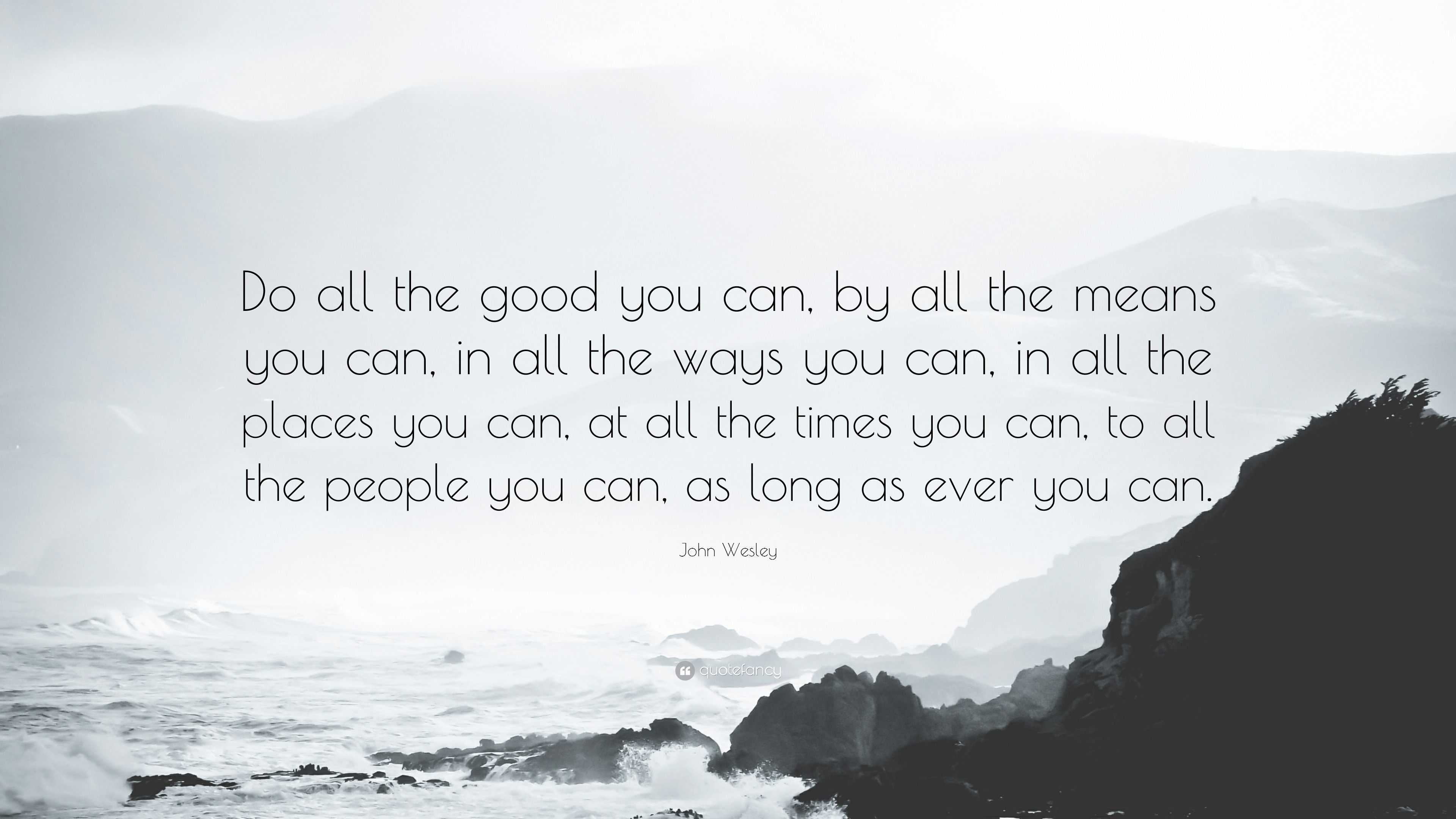
The above quote resonated with me the first time I heard it, which was sometime in junior high school. So I’d like to dissect this quote, starting with “do all the good you can.”
Too many of us think we can’t do any good at all, so we don’t do anything. And that’s not wise, nor is it smart. We can all do something to help our fellow man, woman, and/or child…it may be something small, like carrying in some groceries if you’re able-bodied and the person you’re helping isn’t. Or it could be something big, like helping someone fix a car when they can’t do it themselves but desperately need it.
(Note I’m talking about individual big things rather than societal big things. But I will get there.)
The key words there are “good” and “can.” Do your best, always; do what you can, always. And if you are in distress, and all you can do is offer good thoughts one day, do that. If you can offer a shoulder to cry on (even a virtual one, these days), that’s even better.
“But Barb,” you say. (Yes, I can hear you.) “What if I truly can’t do anything? I’m in a nursing home. Or I’m in the hospital. Or I’m just…tired, I guess.”
If you’re in a nursing home or in a hospital, the best thing you can do is to heal up. But while you do that, speak kindly to the nurses, doctors, and the staff. Encourage other patients, if you see them. Continue to learn whatever you can learn, via the TV or books or magazines or computer. And again, heal up.
If you’re just tired — and I know the feeling, because I often feel this way myself — you have to look at it a different way.
If you have had an abysmal day, just one from the Hells, and there’s nothing at all you can think of to do that’s any good for anyone, the best thing you can do is to calm down. Talk to a friend. Read a good book. Watch a movie that makes you laugh. Listen to some music that moves you. Whatever works, but do something to get your mind off these problems that are plaguing you.
Anyway, on to the next part of the quote, which is “by all the means you can.” Here, I think John Wesley was talking about the various ways you can help someone. Yes, you can help financially, but you can help emotionally, you can help physically sometimes, you can help spiritually (often we need that the most no matter what it looks like from the outside), and you can do it in whatever fashion you want.
The main thing is to not give in to despair. (Or if you need to, use my late husband’s Zen Buddhist trick and give in to it for five minutes. Then say to yourself, “Self, I’ve heard you. Now let’s get on.” I have used this trick frequently in recent days, and I know it works.)
Wesley here is saying again that you can make a difference by whatever means necessary. And that’s important.
The next part of the quote is “in all the ways you can.” I have already covered this, to an extent, in my previous paragraphs, but I will reiterate for the record: do whatever you need to do to help others in whatever possible ways you have available. Even if they seem small, they can do wonders.
For example, if you are at the grocery store in these days of Covid-19, you can be extra-nice to the cashiers. (Or just polite if you’re normally rude, I guess. Though I would hope none of my readers are rude on a regular basis. Yes, that’s a small joke. Probably very small. Moving on…) You can also help others get their groceries to the car if the clerks are too busy to do it or are unable to do it. You can be polite in the parking lot and make sure you give extra space and time to people walking to and from the store, and pay extra-close attention to the various cars in the lot because not everyone else is.
These are all small things. But they add up. And the clerks will appreciate someone who is not rude or abrupt. The people you deal with, in or out of the car, will appreciate that you are paying attention whether they realize it or not. And if you are helping someone get their stuff to the car, that is vitally important and will probably have made someone’s day.
Small things do add up, you know.
Wesley goes on to say “in all the places you can.” I think what he meant by this is for people not to stop thinking about ways to help others when they walk out the door of the church. If you can help someone in the store, do it. If you can help someone on the road, do that. If you can help a friend by listening even if it’s the tenth time you’ve gone over the same subject and you’re just tired of it — but you can rein in your frustration, and listen and empathize anyway — these things matter.
The next part of Wesley’s quote is “at all the times you can.” I think Wesley put it this way because of what I said before about “days from the Hells.” But it could also be that he dealt with too many people who thought the only time to be charitable was when they were actually in church. And once they walked out the door, that was it for charity for the week, almost as if they had “banked” the charity by going to church and enduring the hour-long sermon. (Or whatever.)
The message here is simple. We are all children of God/dess. (Or Deity. Or “Hey, you, big guy in the sky.” Call Deity what you wish; I don’t think it matters much to Deity.) We are all fallible, imperfect, mortal, all that — just as I’ve said in many other blogs — but along with that fallible, imperfect, mortal stuff comes some pretty good basic instincts. We, most of us, want to help others; we want to do good, not just because it’s the right thing to do, but because it makes us feel better to do it. (Maybe that was a biological thing Deity built into us, for all I know.)
And when we deal with those who just don’t seem to care, or don’t seem to want to do the right thing to help their fellow man (or woman or child), it can be frustrating to know that you’re doing your best but someone else is slacking off.
(I don’t know if that’s something Wesley considered during the writing of this, but it makes sense to me.)
The next part of the quote is, “to all the people you can.” I think here Wesley was saying that you should not stop caring about those you dislike. That you should try to find ways to help everyone, not just your own family, your own church, your own clique. That you should make a point to reach out, even when it’s hard (some days it’s very hard; I know!), to help someone who needs it. (Especially as some days, that person is going to be you. But I digress.)
And finally, Wesley closes his quote with, “as long as ever you can.” (I know that reads oddly to modern readers, but Wesley died in 1791. Word choices were different then.)
What does that mean, exactly? Well, I think Wesley believed you needed to keep doing whatever you possibly could to help others for the entirety of your lives. Period. Full stop.
Now, I did some digging into this quote. Wesley is attributed with it because of several sermons he gave during his career as a minister. This was seen to be his overarching philosophy, but Wesley probably never put it exactly the way this quote is put now during his lifetime.
(Which does make me wonder about that “ever you can” stuff, but again, Wesley died in 1791.)
What is important is that Wesley believed we all could and indeed should make a difference. That we indeed should do these things outside the church as well as inside; that we should do these things in the stores as well as our homes; that we should help those we knew and those we didn’t; that we should continue to pray for those we don’t understand and even those we dislike, along with those we know and do understand and deal with on a regular basis.
On this Sunday, take a minute and ask yourself, “What can I do to help someone else today that I normally don’t do?” And then, if you can, do that thing; if you can’t do it today but can do it tomorrow instead, do it then.
But do it. Because it matters. Even when it seems like it doesn’t.

