Sunday Musings: You Can Only Fix Yourself
Over the past several weeks, I’ve been grappling with something that has completely vexed me. To wit: Why do I allow myself to get so frustrated over what other people do?
See, we can’t fix other people. It’s impossible for us, as human beings, to wave a magic wand or think a magic thought or do something otherwise that changes the outcome of someone else’s behavior.
It just doesn’t work that way.
Because I’ve chosen to be friends — and, in some cases, family — with some rather iconoclastic people, this means sometimes I just don’t see eye-to-eye with them. I understand this, but I still get upset when I realize we can’t meet in the middle…and sometimes, we can’t even agree to disagree. (That last bothers me greatly, but unfortunately I can’t do much about it.)
See, people are who they are. They only change when they’re good and ready. They only make it easy for you to stay in their lives and talk with you and be communicative when that’s what they want, too.
Again, as a communicator — and, perhaps, as a peacemaker — at heart, this is something I have a hard time wrapping my head around. The whole idea of a casual long-term friendship where people dip in and out of my life on a whim isn’t something I do, as a general rule.
Now, what do I do instead? I try to be as steady as a rock with my friends and family. I don’t always succeed at this, but that is my intention. I do my best to live up to my obligations; I do my best to live up to my own, personal belief systems; I do my best to be ethical, aboveboard, and honest; I do my best not to throw vitriol for the sake of throwing vitriol.
But if you’ve read my blog for any length of time, you probably know all these things. So what’s got my goat to the point I felt I needed to come blog about it?
I think what got to me most, lately, is the idea that came up in a friend’s telephone chat. He mentioned that everyone lies in public. Everyone puffs themselves up. Everyone puts up a front.
I think many people do. But I try hard not to.
What’s the difference in what I do versus what my friend said everyone supposedly does? Well, I’ve decided that I am not going to waste my time or energy pretending to be something I’m not. I see no point to that whatsoever. And because I see no point to that, I don’t expect other people who know me well to still want to put up fronts.
Why we can’t all meet in the middle, sometimes, is just beyond me.
Still, this all relates to my overarching theme somehow. (It must, or I’d not be typing this out. Picture me smiling ruefully here.) And that theme is that we can’t fix other people.
And just as they can’t make us be what they want us to be (how horrid would that be, huh?), we can’t make them what we want them to be either. We can only choose to accept them as they are, or not. And get to know them on their terms, just as they get to know us on ours. Or not.
So, for all of the above reasons, I urge you to remember this: The next time someone vexes you, because they aren’t who you want them to be, remember that they don’t have to be anything but themselves. Just as you don’t have to be anything but yourself, either.
If the two of you can’t figure out how to be friends under those circumstances, well, then maybe the friendship is doomed. (But I’d like to think it’s not.)
And either way, you can’t fix them. Just as they can’t fix you. So you can delight in being different…or you can walk away, knowing you tried your level best. (The choice is yours.)
Continuing On, Independence Day Weekend Edition…
Folks, we’re about to hit July 4th — Independence Day — in the United States. That’s a major holiday, where we normally have fireworks, music, and parades.
Not this year, though.
This year, due to Covid-19, Independence Day is going to look a whole lot different. There will be no local concerts (and very few, if any, live concerts in the United States). There will be no parades. And in most of Wisconsin, there will be no fireworks.
In fact, we’re going to have a repeat of last year’s fireworks on local TV. And, perhaps, some repeats of concerts as well. (No word on if anyone’s going to show a repeat of the various parades, though it wouldn’t surprise me.)
It doesn’t feel much like a holiday, to my mind, because we are lacking all of those things. Plus, there have been so many deaths due to Covid-19 in the United States that it’s hard to be festive anyway.
But we must continue on, and do whatever we can. Live our lives, help others, read books, listen to music, continue to do whatever we can to further our pursuits (in my case, music and writing), and refuse to surrender to the despair and anxiety that seems to pervade the United States right now.
We’re also dealing with a heat wave in Wisconsin that isn’t helping. (It’s humid, hot, and nasty, with poor air quality. Definitely not my cup of tea, and I don’t think it’s something most people would want to deal with if there were any other options.)
Because of all of that, I wanted to make sure I reminded everyone to do the following five things:
- Be kind
- Stay hydrated
- Eat when it’s a bit cooler, so it has more likelihood of staying down
- Work smarter, not harder
- Give yourself a break now and again, the way you (hopefully) do for others in similar situations.
If you can do those five things, you’re going to be better off in the long run as well as the short run. And it may remind you that this, too, can be overcome. (But it will take time, and most of us — myself included — are not patient.)
What’s your plan for Independence Day? Tell me about it in the comments!
Peace and Remembrance
Yesterday was my eighteenth wedding anniversary, AKA the sixteenth wedding anniversary I’ve spent alone since my husband Michael died suddenly and without warning in 2004. Usually, observing this day and remembering how wonderful Michael was in all his allness crushes me. (I’m not going to lie.)
But this year was different.
(Why? I don’t know.)
I decided that I was going to do my best to remember Michael as he was. How he loved to make me laugh. How he enjoyed doing just about anything with me. How he wanted to hear whatever I had to say on whatever subject, and about how interested he was to hear about my day even when I had been sick for three days running and hadn’t even been able to go to the computer.
In short, Michael was an outstandingly good husband as well as an outstandingly good man. And I felt better for remembering him that way.
Many anniversaries, I’ve thought more about what I’ve lost than what I’ve gained. I don’t think there’s anything wrong with that, either. It’s how I felt at the time, it was authentic, and it was the best I could do to process my catastrophic level of grief.
But this time, I was able to think more about what Michael and I did together. How we wrote, together and separately, and talked our stories out together. How we watched current events, sometimes bemusedly, sometimes with great insight, and could talk them through in a historical context. How we were able to talk about spiritual matters, him being a Zen Buddhist and me being a spiritual seeker who probably best aligns with NeoPaganism (but isn’t NeoPagan enough for some because I still appreciate the life and works of Jesus Christ and try to make common cause with what makes sense to me, especially “love one another”). How we were able to forge a life together despite previous divorces…
Anyway, concentrating on what we were good at together, and how good we were together, helped me a lot. I was able to get through the day with more peace than usual.
I will always wish Michael were still alive, beside me, on this plane of existence. I wish he were still here, writing his stories, writing with me, helping me with my stories, and editing for other people. I wish he were able to tell me what he thinks of the state of the world — most particularly the coronavirus concerns and the #BlackLivesMatter protests, though I’d be interested to hear his (likely trenchant) takes on the current crop of DC politicians (most especially President Trump, someone I don’t think Michael would’ve cared for at all due to that gentleman’s previous experiences as a reality TV star). I wish he were still here so I could see his smile, hear his laugh, enjoy his touch, and get to watch and listen and observe how he got through the world with such serenity and optimism.
But as he’s not alive on this plane — though I do believe the spirit is eternal, and that love never dies either, so in those senses he’ll always be with me — I can only do what I can to remember. And yesterday, I chose to remember the good.
Sunday Meditations on a John Wesley Quote
I have been taken with this John Wesley quote for a while now. As it’s Sunday, let’s dive in!
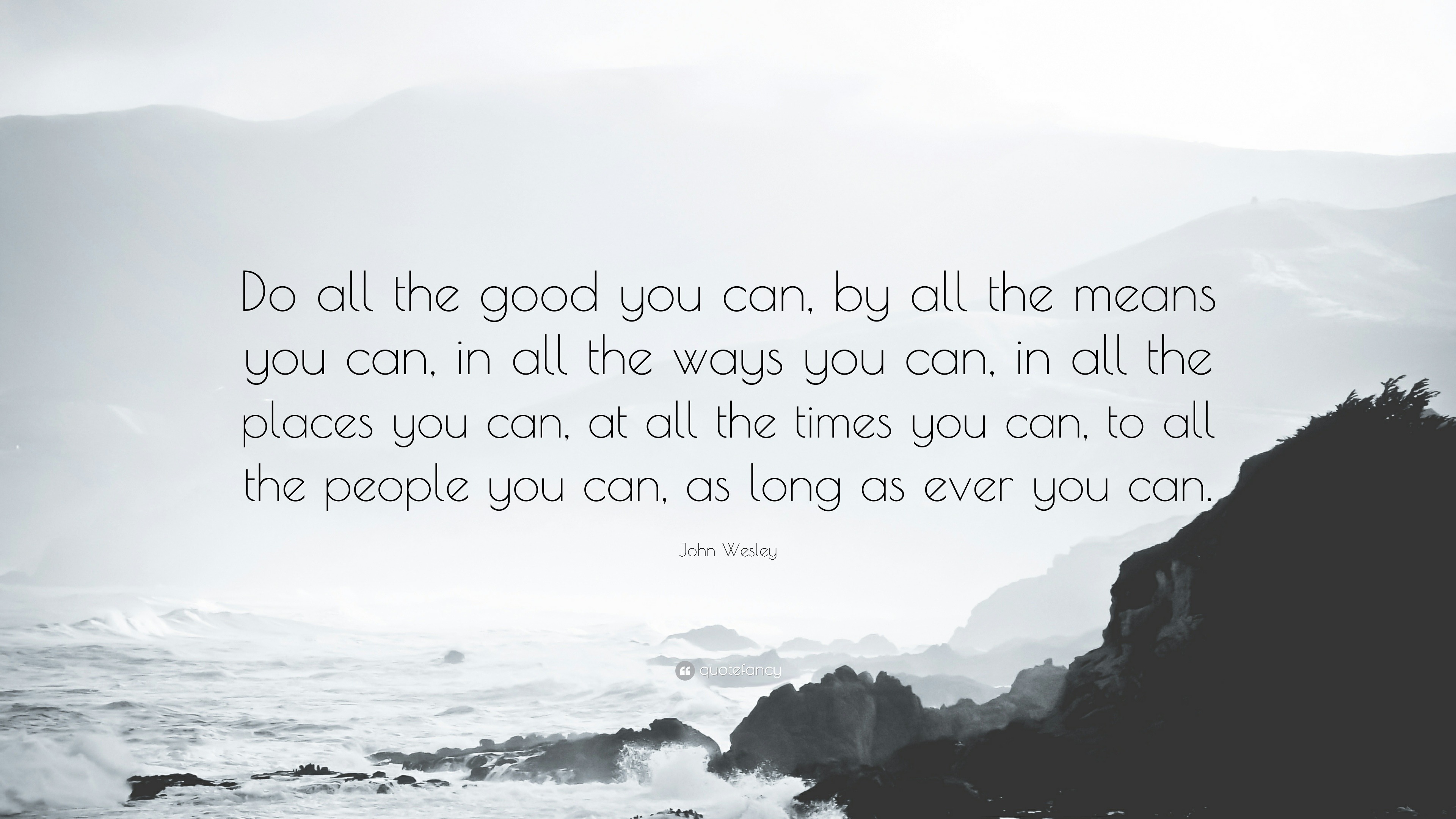
The above quote resonated with me the first time I heard it, which was sometime in junior high school. So I’d like to dissect this quote, starting with “do all the good you can.”
Too many of us think we can’t do any good at all, so we don’t do anything. And that’s not wise, nor is it smart. We can all do something to help our fellow man, woman, and/or child…it may be something small, like carrying in some groceries if you’re able-bodied and the person you’re helping isn’t. Or it could be something big, like helping someone fix a car when they can’t do it themselves but desperately need it.
(Note I’m talking about individual big things rather than societal big things. But I will get there.)
The key words there are “good” and “can.” Do your best, always; do what you can, always. And if you are in distress, and all you can do is offer good thoughts one day, do that. If you can offer a shoulder to cry on (even a virtual one, these days), that’s even better.
“But Barb,” you say. (Yes, I can hear you.) “What if I truly can’t do anything? I’m in a nursing home. Or I’m in the hospital. Or I’m just…tired, I guess.”
If you’re in a nursing home or in a hospital, the best thing you can do is to heal up. But while you do that, speak kindly to the nurses, doctors, and the staff. Encourage other patients, if you see them. Continue to learn whatever you can learn, via the TV or books or magazines or computer. And again, heal up.
If you’re just tired — and I know the feeling, because I often feel this way myself — you have to look at it a different way.
If you have had an abysmal day, just one from the Hells, and there’s nothing at all you can think of to do that’s any good for anyone, the best thing you can do is to calm down. Talk to a friend. Read a good book. Watch a movie that makes you laugh. Listen to some music that moves you. Whatever works, but do something to get your mind off these problems that are plaguing you.
Anyway, on to the next part of the quote, which is “by all the means you can.” Here, I think John Wesley was talking about the various ways you can help someone. Yes, you can help financially, but you can help emotionally, you can help physically sometimes, you can help spiritually (often we need that the most no matter what it looks like from the outside), and you can do it in whatever fashion you want.
The main thing is to not give in to despair. (Or if you need to, use my late husband’s Zen Buddhist trick and give in to it for five minutes. Then say to yourself, “Self, I’ve heard you. Now let’s get on.” I have used this trick frequently in recent days, and I know it works.)
Wesley here is saying again that you can make a difference by whatever means necessary. And that’s important.
The next part of the quote is “in all the ways you can.” I have already covered this, to an extent, in my previous paragraphs, but I will reiterate for the record: do whatever you need to do to help others in whatever possible ways you have available. Even if they seem small, they can do wonders.
For example, if you are at the grocery store in these days of Covid-19, you can be extra-nice to the cashiers. (Or just polite if you’re normally rude, I guess. Though I would hope none of my readers are rude on a regular basis. Yes, that’s a small joke. Probably very small. Moving on…) You can also help others get their groceries to the car if the clerks are too busy to do it or are unable to do it. You can be polite in the parking lot and make sure you give extra space and time to people walking to and from the store, and pay extra-close attention to the various cars in the lot because not everyone else is.
These are all small things. But they add up. And the clerks will appreciate someone who is not rude or abrupt. The people you deal with, in or out of the car, will appreciate that you are paying attention whether they realize it or not. And if you are helping someone get their stuff to the car, that is vitally important and will probably have made someone’s day.
Small things do add up, you know.
Wesley goes on to say “in all the places you can.” I think what he meant by this is for people not to stop thinking about ways to help others when they walk out the door of the church. If you can help someone in the store, do it. If you can help someone on the road, do that. If you can help a friend by listening even if it’s the tenth time you’ve gone over the same subject and you’re just tired of it — but you can rein in your frustration, and listen and empathize anyway — these things matter.
The next part of Wesley’s quote is “at all the times you can.” I think Wesley put it this way because of what I said before about “days from the Hells.” But it could also be that he dealt with too many people who thought the only time to be charitable was when they were actually in church. And once they walked out the door, that was it for charity for the week, almost as if they had “banked” the charity by going to church and enduring the hour-long sermon. (Or whatever.)
The message here is simple. We are all children of God/dess. (Or Deity. Or “Hey, you, big guy in the sky.” Call Deity what you wish; I don’t think it matters much to Deity.) We are all fallible, imperfect, mortal, all that — just as I’ve said in many other blogs — but along with that fallible, imperfect, mortal stuff comes some pretty good basic instincts. We, most of us, want to help others; we want to do good, not just because it’s the right thing to do, but because it makes us feel better to do it. (Maybe that was a biological thing Deity built into us, for all I know.)
And when we deal with those who just don’t seem to care, or don’t seem to want to do the right thing to help their fellow man (or woman or child), it can be frustrating to know that you’re doing your best but someone else is slacking off.
(I don’t know if that’s something Wesley considered during the writing of this, but it makes sense to me.)
The next part of the quote is, “to all the people you can.” I think here Wesley was saying that you should not stop caring about those you dislike. That you should try to find ways to help everyone, not just your own family, your own church, your own clique. That you should make a point to reach out, even when it’s hard (some days it’s very hard; I know!), to help someone who needs it. (Especially as some days, that person is going to be you. But I digress.)
And finally, Wesley closes his quote with, “as long as ever you can.” (I know that reads oddly to modern readers, but Wesley died in 1791. Word choices were different then.)
What does that mean, exactly? Well, I think Wesley believed you needed to keep doing whatever you possibly could to help others for the entirety of your lives. Period. Full stop.
Now, I did some digging into this quote. Wesley is attributed with it because of several sermons he gave during his career as a minister. This was seen to be his overarching philosophy, but Wesley probably never put it exactly the way this quote is put now during his lifetime.
(Which does make me wonder about that “ever you can” stuff, but again, Wesley died in 1791.)
What is important is that Wesley believed we all could and indeed should make a difference. That we indeed should do these things outside the church as well as inside; that we should do these things in the stores as well as our homes; that we should help those we knew and those we didn’t; that we should continue to pray for those we don’t understand and even those we dislike, along with those we know and do understand and deal with on a regular basis.
On this Sunday, take a minute and ask yourself, “What can I do to help someone else today that I normally don’t do?” And then, if you can, do that thing; if you can’t do it today but can do it tomorrow instead, do it then.
But do it. Because it matters. Even when it seems like it doesn’t.
Deifying the Flawed Man
Jason makes some interesting points here. I think you should read his blog, think hard about it, and then wonder if you’re doing any of this unnecessary deification of flawed people in your own lives.

Cancel culture is rampant throughout the world right now as we know it. If a person isn’t 100% in line with the “flavor of the week” cause they are ruthlessly culled from the ranks of the “good” and instantly cast as wicked, evil, and on the “wrong side of history”. That last phrase is one I particularly dislike because unless our descendants place us upon pedestals to be worshiped, history should remember us for both the good and the bad we do in our lives.
But how does this work? Any historian can tell you that George Washington, Thomas Jefferson, Martin Luther King, Jr., et al, were flawed men. They meant well and set in motion events which would change human history as we know it. Human history which is wealthier, healthier, and safer than it ever has been. They brought about true change to society and should rightly be…
View original post 997 more words
Thoughts on Stereotypes
Years ago, here at my blog, I wrote a piece about discrimination. At the time, my mother had urged me to write it because I was frustrated at the amount of ridiculousness in this world when it comes to discriminating against people different from yourself.
Right now, we have additional problems with discrimination and stereotyping, which kind of go hand-in-hand. There’s way too much stereotyping going on, and way too many people over-reliant on stereotypical behavior.
We are all human beings, regardless of creed, color, ethnicity, gender, sexual preference, or any other thing that could possibly be used to divide us. We were all created equal. We were all created by love (at least, at the highest level possible, the Deity Him/Her/Itself).
But we forget this when we rely upon stereotypes.
I was talking to a good friend the other day about how he gets stereotyped often. He is not white. And while I guess he could pass, on some days, if he truly wanted to (and you didn’t know what his last name was), why should he have to worry about this?
I mean, isn’t he the same no matter what?
It’s about the content of your character. Not anything else. (I’m still with Martin Luther King., Jr., on that one, and always will be.) Your actions flow from your character. Your mind and spirit and heart are informed by that same character. And you, as a person, should never be judged by externals — never.
That said, it happens far too often.
With the recent murder of George Floyd by a white police officer in Minneapolis, I was reminded again that stereotypes can kill someone. He was stopped for apparently passing a counterfeit $20 bill (this is the best information I heard/read anywhere). And I know, from past experience as a cashier, that police do not have to kill you to get you to go to court to defend yourself. It’s a misdemeanor ticket if you’ve passed one, and if you can prove that you didn’t know, you will not be charged or blamed.
But Mr. Floyd was black. He was tall. It was a hot day, and he wasn’t wearing very much. And perhaps he looked offensive in some way — I don’t know how, mind — either that, or the white police officer just didn’t like the man on sight. Mr. Floyd was stereotyped as a dangerous individual solely because of his race.
It’s hard for me to type that. Because I want to believe we’re all better than that.
I referenced a good friend of mine from high school in my first blog about discrimination. I would like to talk more about her now, because I think it’s relevant to the discussion.
My friend was a viola player, and one of the best viola players in the city of Racine. She was easy to talk to, and we talked music, some sports, current events…you name it, we probably talked about it. She was cultured. She was opinionated, in the best of ways. She was intelligent. And yes, she was black.
I gravitated toward her because of her abilities, her interests, her intelligence and quick wit, and because I found her an interesting and admirable person. I didn’t care one whit about her color then, and I don’t now either.
But I do wonder what her life has been like since. Did she have the money to go to college? (I never asked.) Did she keep playing? (I wasn’t here in Racine for many years, and by the time I got back, I couldn’t find her in the music scene.) What happened to her?
I feel terrible that I lost track of her, as we all seem to do with many of our high school friendships. But I wish I knew all these things, because I’d like to ask her what she wants people to know right now regarding the murder of George Floyd. What she thinks about stereotyping, and how to get past it…what she believes will work to get people to see the content of people’s character, rather than only seeing the externals as we seem to be doing now.
Mind, I have other friends, as I’ve said, who also aren’t white or straight. They’re Latino, or Asian-American, or black, or mixed-race; they’re gay, lesbian, transgender, and gender-fluid/queer. I have friends of all shapes and sizes, and I’m glad of this. Because it means I can see past the stereotypes to the human beings underneath.
While there’s no way to turn the clock back so Mr. Floyd doesn’t die (or, on a happier note, that I didn’t somehow lose track of my old friend), we can have a better and brighter future. One based on the content of our character, rather than the outmoded and outdated stereotyping and discrimination that we’ve seen thus far.
May that day come soon for us all.
Sunday Thoughts: On Forgiveness
We all go through moments in this life where we wonder, “What is the point?” Especially when we’re on the outs with people we feel close to and care about, as not getting along with loved ones makes everything seem pointless and unfulfilling.
“But Barb,” you protest. “Your post is supposed to be about forgiveness. How on Earth does this relate?”
I’m getting there, I promise. But this may take a while. (Settle in with a cup of coffee, or tea, or some sort of beverage of your choice.)
Recently, I’ve reconnected with an old friend I’d been estranged from for quite some time. Life took us in different directions. It was hard to talk with this friend for a while, though I did keep trying; on my friend’s part, I think it was difficult to keep trying, and eventually, communication just stopped.
I often wondered what the point was, after this happened. Because this friend was quite close to me, and was one of the few folks I felt understood me. It was difficult for me to do without this friendship. And it was frustrating not to know what was going on with this friend, as I truly did care — and, obviously, considering the recent reconciliation, still do.
It turned out that there were miscommunications between us that drove a wedge into the friendship. And those had to be talked out so we could move forward. Which led to inertia, which led to…pointlessness, I guess, at least on my part.
But over the time of the estrangement, I learned how to forgive myself for this. I can’t be everything to everyone, as much as I’d like to some days; I can only be myself.
And I forgave my friend, too, because I understood — as best I could, anyway — what led my friend to make their decisions. (Yes, I’m using singular “they” today. My editorial side doesn’t like that much, but I’m getting used to it.) I understood what was going on with them and I knew what had happened to get them to this point. So forgiveness was a must, a moral imperative…or, at least, the best way to live with myself and the end of this estrangement.
But saying that is easy. It took two solid years for me to process all this, and to get through it; it also took two solid years for my friend to process all this, and to get through it, before we could attempt to repair our friendship and move forward again.
And those two years were not easy. Not for me. And, I suspect, not for them either.
I know I am fallible, mortal, have my biases and quirks and habits; I do try to get past these things, but I still have them, and some days I am much more limited by them than on others.
I also know that my friend is just as fallible and mortal as I; they have their biases and quirks and habits, too. And I suspect they try hard to get past these things, but still have them, and some days are better than others in dealing with it all, too.
All of that led to what I like to call “the road to reconciliation.”
It’s not an easy road. It sometimes can be a damned hard road, in fact; your feelings get shoved in your face, by yourself, and you have to figure out what you’re going to do about it. You’ve been hurt before, and you don’t want to get hurt again…all of these things are natural and normal thoughts, but they are also self-limiting, not to mention frustrating.
But forgiveness makes the most sense, to me. I still care about my friend. I want to know what happens to them. I want to try to help in whatever ways I can, without damaging myself, to help them enjoy life a little better and to know that they are valued and understood no matter how imperfect or flawed.
Personally, I think we gain value from our imperfections, not to mention our flaws. But they are not always easy to deal with. (Oh, no. That would be far too easy.)
Anyway, I also continue to work on the idea of forgiveness of the self for getting to this point. I’m not a perfect person; far from it. (Then again, no one is.) There are things in the past — and not just in the context of this friendship — that I wish I’d done better, or differently.
That said, I have learned from my mistakes. I’ve drawn value from my imperfections, as best I can. And I’ve tried to husband wisdom from all of it, and be a better friend because of it, while realizing that life is a process and a choice as much as it is about your circumstances beyond your control and what you do about them.
So, those are my thoughts on forgiveness, both of the self and others, for today. What’s on your mind, and what did you think of this blog? Let me know in the comments!
Getting On With Getting
I figured I’d check in with y’all to let you know I’m still alive. (Thus the “getting on with getting” title, above.)**
Now, what have I been doing? Mostly, other than avoiding Covid-19 and staying as cool as possible (as we’ve been dealing with a heat wave, and I have no air conditioning at all), I’ve been able to write a little fiction and I’ve of course been editing (as per usual). I’ve also been taking care of family responsibilities, and petting Mom’s surviving dog Ms. Brat as needed. (Hey, a dog named Ms. Brat needs as much care as possible, if to avoid getting any brattier. Not that she’s all that bratty. But it’s her name ’cause she answers to it; we did try several others, but that was the one she liked. Go figure.)
I’ve also tried to help a few friends here and there, too. Because I got help when I needed it the worst, and I want to pay it forward if at all possible.
At any rate, I hope you’re a) staying safe, b) staying cool (if you’re in the Northern Hemisphere) and c) enjoying life as much as possible.
After all, Covid-19 can’t last forever. (Can it?)
Let me know how you’re doing in the comments. OK?
————
Edited to add: I realized I had left out half of what I’d wanted to talk about, and I’m sorry.
The United States hit 100,000 deaths from the coronavirus yesterday. 100,000. And that’s a terrible milestone.
Worse yet, I didn’t see anything from our President regarding it. Just nothing at all. Crickets, radio silence…call it whatever you want, but ignoring such a thing is unPresidential (to put it mildly). The President is supposed to be the consoler-in-chief along with everything else, and that isn’t happening at all.
When we’re having to take our cues from Democratic Presidential candidate Joe Biden, a former Vice President, because Biden’s the only one willing to talk about these poor people who’ve died, well…the mind reels.
My attention is split between the coronavirus and trying to get anything done. And because I was happy I actually have been able to get stuff done despite it all, I wanted to write this post.
But I didn’t want to forget about the 100,000 people who’ve died. And I didn’t want anyone to think that I ever would forget about them, either…because these were real people with real lives, and Covid-19 has ended it all for them.
Somehow, some way, we must eradicate Covid-19 from this Earth. And remember the fallen, as long as we possibly can. (This is a war we must win.)
Sunday Meditation: Learning to Let Go

It’s no secret that over the years I’ve had a hard time letting go of things, good and bad. The best I can do with certain things is agree that I’m going to go on with my memories intact, and do the best I can with them. With my late husband’s death, that’s the level best I can do — letting go is not an option, because that would also let go of all my hopes, dreams, aspirations, and anything else positive that I still wish to obtain.
But maybe I can let go of how angry I am that he died too early. (I’m not angry at him. I’ll never be angry there.) And maybe I can let go of some of the nonsense I saw immediately after my husband died, including some of the rudest comments any widow could ever get. (Including one idiot who said that I would be just fine because I was young, and could still remarry. Um, what?)
So I’m not great with letting go, but I’m working on it.
This becomes more imperative with other things in my life, though. Things I regret doing, that I cannot change now. People I wish who had been different, or better, or less toxic; again, I can’t change that now either. And things that frustrate the Hell out of me…again, if it’s not an ongoing occurrence, why waste any more time on it?
So just for today, I’m going to do my best to let go of all the negative emotions I feel and focus instead on whatever good I can find in the midst of this pandemic, including the love of friends and family who’ve stayed in my life (not to mention good books and good music).
While I know it’s going to be a work-in-progress, I have to do what I can to keep going and give myself a chance to find happiness. Or at least fulfillment. Or peace. Or all of the above.
If you are like me, and you need to let go, try to tell yourself, “Just for today…” and see what happens. (Then do let me know about how it went for you in the comments, OK? I care.)
 Barb Caffrey's Blog