When Creativity (Temporarily) Dries Up
As I’ve said for a few weeks now on my blog, I’ve been dealing with a family health issue that has pushed almost everything else to the back of the line. As that seems to be resolving, my creative life is re-emerging…and as such, I thought I’d write a blog about why I think my creativity (save my editing work) more or less dried up during the recent emergency.
You see, we all have so much energy. (I’ve heard this called “spoon theory” or even “so many f**ks to give,” so whatever terminology works for you.) And when most of it is going to manage an emergency of some sort, there’s just not a lot left.
As there are probably more people out there who have to deal with this sort of thing, or maybe have dealt with it in the past, I know I’m not alone in dealing with the lack of energy or utter exhaustion that dealing with a crisis (along with continuing to do as much of your own work as humanly possible without collapse). But it is difficult, while you’re in the midst of it, to remember that…you feel isolated, almost the loneliest person in the world, and your own needs go to the back burner while you take care of someone else.
This has been called “caregiver fatigue,” and is a known phenomenon.
What makes me feel like myself, more than anything, is to create, whether it’s words, music, or a combination of the two. (That’s how I saw my work on CHANGING FACES, at any rate. I still intend to cut a companion CD of some sort down the line, if I can raise the money for such and regain the energy and strength to play my clarinet at top form.) But I can’t create like this, or at least can’t create very much.
No one can.
You just don’t have enough spoons to play with, as creativity takes a lot of spoons — far more than it seems at the time.
I know, from past experience with traumatic events, that my creative impulses will come back online after I’ve regained strength, rest, and health again. (As dealing with the crisis, especially coming out of two full months of illness, wasn’t easy.) And I look forward to the day I can wake up with a story idea, happily write it down, and think hard about what I’m going to do next without exhausting myself even further.
However, I’m not there yet. And admitting that isn’t easy, because I want to be known as a strong person, someone who can do anything she puts her mind to…someone who writes ten thousand words a week, maybe, as I did while my late husband Michael was alive, and haven’t managed to do consistently ever since.
I think overall that the important thing to remember, if you’re in a situation like I’ve been, is that so long as you’re still alive, and so long as you are doing your best, your talents will re-emerge once there’s sufficient energy for them.
And as a persistent person (I’ve sometimes been called almost pathologically persistent, which I don’t think is exactly a compliment), it’s all I can do now to remember that, and trust — as my niece, Jenni, also a writer, told me — that my creativity isn’t absent. It’s just brooding, waiting, and will burst out of me again once the energy has been restored to allow it to flourish.
What have you done in similar situations to nurture your creativity? Tell me about it in the comments!
Timing, and Jason Cordova’s DARKLING
I read Jason Cordova’s hotly awaited new novel, DARKLING, over the course of three weeks. (Normally I would’ve devoured it in one sitting, but the fact that I had a crisis going on with a family member’s health made me put it to the side for a time.) It is absorbing, intelligent, fast-paced, dark, depressing, menacing, and in its way a damned good read — but the timing of my life and reading this book were not fully aligned.

I submitted a review to Amazon, as per usual, but because I am much more scattered/distracted than usual, I didn’t make a copy of it before I left their page. (Edited to add: After waiting for nearly a full day, I gave up and reviewed the book at Goodreads.) Because of that, I can’t quote the review I’ve already written; all I can do is tell you to go read DARKLING, as it’s very good dark military SF with some absorbing political machinations. (Yes, you should read WRAITHKIN, the first book of Jason’s “Kin Wars” series, first. But you’ll easily understand DARKLING whether you do or not, providing you’ve read any military SF or dark SF at all.)
The rest of this blog is going to talk about aspects of the book that were tough for me to handle, due to the timing. If you don’t want your reading spoiled (though I will try to avoid the worst of spoilers), go do something else and return for the next blog, will you? (I won’t be offended. Promise.)
We have three brothers in DARKLING: Gabriel Espinoza, a Darkling soldier and second-class citizen dealing with dehumanizing treatment due to all soldiers of this type being recruited from the Imperfect class (meaning they could develop cancer, or have some other “genetic defect” that’s been rooted out by the galactic civilization they live in); Andrew Espinoza, a spy (a damned good one) who’s acted in many regards as a chameleon mole; Kevin Espinoza, a politician and born diplomat. Gabriel is a brooding hot mess from an emotional standpoint (it’s understandable, though; the love of his life is dead, he had to give up his daughter due to his line of work and because he didn’t want her tainted by the knowledge of his “imperfect” father, and he’s cut off from his family due to various considerations, even though his family wanted nothing of the sort. I can’t explain this fully because of spoilers, and also because much of it is explained at the very end of WRAITHKIN as I have written before, so I hope you can take this as read.) Andrew, as a chameleon mole, has other issues with trying to maintain his inner self, and also has been cut off from his family due to completely other concerns (again, his family certainly doesn’t want this, but with his job, there’s no other way). And finally, Kevin is a good guy, the only brother attuned to his emotions and fighting hard for the Imperfects as he views his society as closed-minded and hypocritical (and rightfully so). But he’s mostly there as a foil, to explain what the other two brothers should’ve been if not for the circumstances that led them to fight a war in their disparate ways…and that’s a conscious author’s decision that I can’t fault Jason for, as he needed that foil desperately due to the darkness of everything else.
Now, as to the circumstances of my life, and how it applies to how I saw DARKLING.
First, I was reading along, and enjoying the book immensely despite its darkness. (I knew what I was getting in for, as I read and enjoyed WRAITHKIN, and I really wanted to see what would happen next to the Espinoza clan.) Then, my family member’s health crisis arose, and suddenly the world stopped meaning much. I had to put DARKLING down, and deal with immediate realities; my blogs dried up for a bit (which I’ve already explained); I went to “work, sleep, go to hospital/rehab center” mode, rinse and repeat.
Finally, I was able to get back to DARKLING and realized two things; one, I hadn’t forgotten anything in the intervening time since I’d last been able to read and concentrate on anything. (This is the sign of a good writing and an absorbing read, that you don’t forget anything even in the midst of a crisis like this.) And two, the fact that these brothers are put through the emotional and physical wringer was all of a sudden more visceral, more immediate, than before, due to the circumstances of what was going on all around me.
See, writers are observers by nature. We have to be, or we can’t explain or show any of the stories we tell with any verisimilitude at all.
So, I was observing everything that happened around me, as per usual, whether I was picking up on that observation consciously or not. And all of that — all — hit me as I restarted my read of DARKLING. The injuries these men suffered were almost overpowering in their intensity, in this context, and it was difficult for me to keep reading despite the quality of the writing. (Jason keeps getting better and better, and tells a damned absorbing story, as I have said before.)
To my mind, DEVASTATOR is more my cup of tea (as I wrote here). I like Tori so much as a character, and her relationship with Dylan (the shy, almost innocent love she has for him) helps to enliven even the darkest of moments.
But DARKLING is quite good. Quite, quite good, in fact.
I just had a hard time reading it due to what’s been going on. So I tried to say that, without getting into personal details, in the review at Amazon (that still isn’t up as I type this, though if it does go up anytime soon I’ll add a link to the review so you can read it directly).
I do think Jason’s created a new genre, or at least fused a few, in DARKLING. I call this “grim-dark military SF.” (If you read it, you’ll understand why.) There is a palpable sense of menace in even its quieter moments; everyone is on edge, everyone is waiting for the next shoe to drop (or axe to fall, depending), and Gabriel in particular seems like a bomb waiting for a place to go off.
The writing is stellar, though, and if you know going in — as you should, providing you’ve read WRAITHKIN — that it’s going to be grim, you should be able to handle DARKLING just fine.
Just don’t read it before going to sleep if you have a weak stomach or are prone to nightmares. As this book will give you more than a few, else.
Easter Week Thoughts: Carrying Each Other’s Burdens
It’s Sunday, and this blog still says what I want even though it’s been a week since Easter came and went this year…take a good look, and think.

Is it possible for human beings to comprehend that other people have burdens, too?
Sure, we know our own burdens — the problems we carry mile after mile, day after day. They’ve become so much a part of us, it goes without saying…they’re just there, and we keep on shouldering them because we know no other way.
But we don’t always know what burdens the other person is carrying, just as the other person doesn’t know our burdens.
Yes, there’s a way around this problem. You can ask what’s going on. Maybe you can help shoulder the load for a while, if the other person allows it…if the other person lets you reach inside, so you can see them in the same way you see yourself.
Because it’s Easter Week, I’ve been thinking a lot about this. I know all sorts of people, and every one of them has problems…
View original post 370 more words
We Must Do Better and Insist on Better Health Care (A Collaboration with a Purpose Post)
Sorry ’bout the lengthy title there, folks…on with the show, er, I mean blog.

I am especially cognizant this year of World Health Day due to the myriad of health problems my family has suffered over the past year. Because of all the times we’ve been to the doctor, or in the hospital, or in the rehab center, I am more aware than ever about how we need better quality health care in the United States. (I can’t speak for the rest of the world, though my fellow bloggers have done so brilliantly. Links will follow at the end of this post.)
What I’ve seen shocks me. (And I thought I was unshockable.) A woman who needs hearing aids was in one of the rehab centers my family member dealt with this year, and can’t get them because she can’t afford them. She is over sixty-five, is retired, has Medicare–meaning, she does have state-sponsored insurance that’s subsidized by the federal government–and she still can’t afford hearing aids.
This affects her quality of life.
This affects how she can interact with her family, her grandchildren, and those working with her to help her heal up so she can go home.
There’s something wrong with a country that doesn’t find a way to help someone who needs hearing aids find a way to get them. (She is willing to pay, mind. Her daughter told me that. But it’s a matter of making it affordable so she can, and still eat, pay her bills, and afford her medications.)
Or how about this? I, myself, have dealt with a problem trying to get any help with my vision. I have Obamacare. I am eligible to be seen and get glasses, which would be subsidized (but not free)…yet every time I try to set up an appointment, and I’ve been trying now for over two years, I am told there are none.
So, I continue to wear glasses that are over two years old. My backup pair is over ten years old. My vision hasn’t changed much in all that time, but that doesn’t mean I shouldn’t have a checkup or get another pair of glasses that is perhaps a little bit more up-to-date than my backup pair.
How many other people are out there who can’t afford to pay full price for glasses, thus wait to be seen, and then never get an appointment because it’s supposedly always full?
Then, there’s the problem of paying for medication. My family members have radically different insurance. One has no help at all to pay for her prescriptions. Another has some help. But when your medicines can cost over $300 per month — yes, one of the cardiac meds my mother takes is at least that expensive — the co-pay is still plenty high. And when you’re on a fixed income, in retirement, coming up with that high co-pay is damned difficult.
Why is this considered acceptable?
Then, there’s the problem of getting doctor’s appointments when you’re sick. (I know first-hand about that one, too.) Getting your doctor’s office to even call you back is a pain in the buttinsky. And then, if you do get to talk with a nurse, they just send you to urgent care anyway, so why did you waste your time?
In short, there are major problems with health care.
Right now, we have a proliferation of forms, a proliferation of HMOs, PPOs, and all sorts of other alphabet-type agencies, that basically boil down to, “No, we’re not going to help you.” And that is utterly unacceptable.
Mind, there are wonderful people in health care. I’ve met more great nurses and doctors (much less PAs and CNAs) than I can shake a stick at. These people genuinely want to help, but they are overwhelmed by paperwork and there aren’t enough slots to see everyone who needs to be seen. And nothing at all seems to get done whatsoever about fixing these systemic problems.
The World Health Organization has done this World Health Day since 1948, to call attention to the need for better health care for as many people as possible. (Preferably, it would be for every single last one of us, and that is indeed their goal.) And this year, their slogan is called #HealthForAll.
I think we badly need to be reminded that health must be cultivated. We have to have enough resources to help people get hearing aids when they are on fixed incomes. Or afford expensive cardiac medicines when they are on fixed incomes. Or have access to doctors, nurses, and appropriate care, while being treated as the human beings we are rather than an inconvenience or worse, someone to be brushed off and ignored.
So I’m pleased that the Collaboration with a Purpose group wanted to talk about World Health Day this year. It is something that is close to my heart. And it is something we desperately need — better health care, for as many people as possible, in as many ways as possible, so we all can live better and happier lives.
Because if you don’t have your health, you don’t have anything.
Period.
Now, please go check out my fellow Collaboration with a Purpose group members, as they all have interesting takes on the subject. (Links will be added as their posts go up.)
- Jothish Joseph — “Are You Healthy?”
- Mylene Orillo — “The Truth About Getting Sick in the Philippines“
- Ipuna Black — “Health is a State of Balance: Mind, Body, Spirit“
- Sonyo Estavillo — “#WorldHealthDay & Why #MentalHealthMatters“
- Tajwarr Fatma — “World Health Day” (about mental illness/mental health)
- Nicolle K. — Intro post about World Health Day
- Nicolle’s regular post is up! — “Health for All — Self-Care“
- Jane Love — “Three Vital Components of a Healthy and Balanced Life“
- Gelyka Ruth Dumaraos — “How My Father’s Health Condition Made Me Shift to a Healthier Lifestyle“
- Divyang Shah — “World Health Day!“
- Sadaf Siddiqi — “Health is Wealth“
Updates, Updates…
Folks, I’m still dealing with some stuff on this end that I can’t talk about, and that will be going on for weeks.
But I will update you as I am able.
Otherwise, I finished another couple edits last week (fortunately before the emergency I discussed in the last post), and am working on another now.
Writing-wise, I’m plotting, still, and am thinking about my stories. Not much time to do anything with ’em right now, but I am writing things down as I can as prose notes, and I hope to expand them out as soon as things settle down a tad.
And I’m thinking already about this month’s Collaboration with a Purpose blog event, as it’s about World Health Day on April 7. (I definitely have a great deal to say about that. But is much printable? We’ll see how things shake out in a few days.)
What’s mostly kept me going is the start of the baseball season. So far, the Milwaukee Brewers (my team) seem to be working well as a team despite — or perhaps because of — the additions of two outfielders, Lorenzo Cain and Christian Yelich. Both are great players, but you never know how team chemistry will be affected when you bring in one new player of Cain’s or Yelich’s caliber, much less two of them. Cain came up in the Brewers minor league system, and seems to be enjoying himself immensely in a Milwaukee uniform, while Yelich seems much more laid back in Milwaukee than he ever did in Miami. (I tended to see him as extremely intense, there.)
It’s good to be able to watch baseball again.
Finally, I hope to write some about some interesting books soon. One is a book about philosophy called, appropriately enough, THE CONSOLATIONS OF PHILOSOPHY by Alain de Botton; another is a book I edited, Chris Nuttall’s THE ZERO EQUATION; the third will be released soon and I have it on my Kindle to read/review, Jason Cordova’s DARKLING. (The last has been very hotly awaited, and I’ve enjoyed — in a dark way — what I’ve read so far, though I’m only a quarter of the way through. Life has just been too hectic to read it all, lately…but I’ll get it done in the next week so I can review on 4/13/18, its release date.) Books are always fun to write about, and perhaps I can say something, anything, that will make someone think or laugh or cry or even scream…again, only in the best of ways, in order to get you out of your head and away from your troubles.
Stay safe, folks. I’ll write again in a few days for World Health Day, as promised.
Easter Saturday, and Stuff…
Folks, it’s the day before Easter. In the Christian faith, Easter is the day Jesus rose again, and thus gave hope to humanity that our sins would be forgiven and we’d ultimately ascend to Heaven if we only believed (and did our best). (Yes, this is a major oversimplification. But it’s the best I can do right now, which I’ll get into in a bit.)
So, when Easter is about to be celebrated, it’s usually a time to count our blessings. And indeed, I try hard to do that.
However, a couple of days ago, one of my family members fell hard on the concrete, face-first. There are multiple fractures involved, and while it could’ve been much worse (the doctors involved feel the relative lack of injuries are damned near miraculous), this has necessitated a stay in the hospital for my family member and perhaps may lead to either long-term rehab in a facility or at best, long-term rehab with home-health nurses coming in multiple times a day.
I have tried to keep my siblings in the loop. I have tried to keep my close friends in the loop. And I’ve also tried hard to help in whatever ways I can.
I still have to get my work done. I still have to do some writing, or I don’t feel much like myself. I still have to deal with my own health issues, and I have to make long-term plans.
But saying that is very difficult, because I don’t feel like I should be dwelling on myself when my family member got badly hurt.
How does these two things relate? I honestly am not sure. It may just be the juxtaposition of the timing and my family member’s injuries that’s getting to me. Or it could be that I feel like I’ve failed in some way, because I can’t do any more than I already am.
I’ll do what I can to hold the happiness of Easter in my heart, even though I’m more of a spiritual seeker than a Christian at this point. (I believe in Jesus, though. No question about that.) We all need hope, and we all need to believe that no matter how dark our lives may be, there is light at the end of the tunnel — and it’s not an oncoming train.
Anyway, I thought I’d give an update, as I know I didn’t write the blogs I’d intended due to my family member’s injuries. (I had wanted to write a Brewers preview, and also discuss the Milwaukee Bucks a bit as they’re going to make the NBA playoffs this year again and might just do a bit better than last year…but if I do that at all, it’s going to have to be a bit late, as my family member will need weeks if not months of recovery.)
I will keep writing, I will keep editing, I will do my best, and I will keep trying.
But there’s a reason Three Days Grace’s song “The Mountain” appeals to me…just sayin’.
How have you dealt with close family members and their illnesses or injuries? Do you have any tips for me? Tell me about it in the comments.
In Praise of Video Games
Folks, I am tired of video games being blamed for everything. Supposedly, video games are bad for you; they create addictions; they may even lead, some say, to school shootings, especially if you play the more violent games on a regular basis.
Banana mush. (This is my very polite way to say “BS.”)
Why is it, hm, that no one ever talks about the pluses of video games? How they help you test your reflexes, or maybe how they help you figure out unusual solutions to problems, or even that they give you something to do when you’re worrying about a problem and have no other way to get out of your own head?
Seems to me that those three reasons, right there, are good reasons to praise video games. Because problem solving, improving reflexes, and giving yourself a mental “out” when you truly need one and have no others (providing you do this in moderation), are all good things.
I know that I play a number of games, and have for years. From Space Invaders to Pitfall (OK, I’m “old school,” all right?), to Ms. Pac-Man to Tetris, to Castle Age to Candy Crush, I’ve probably played just about everything. (Including “Operation Wolf,” back in the day. And no, I didn’t turn into a gun-toting criminal, thank you.)
Why do I do this, when my life is busy and stressful? I think it’s because of needing that out, along with a need to test my reflexes and improve my problem-solving skills.
It gives me some serenity, to be able to zone out for an hour, playing cards online (yes, I do that, too), or at Club Pogo (yep, I’m a member, and I’m especially partial to the planet-zapping Space Hunt game), or at any number of other places. And this little “mental vacation” allows me to finish up all the other things I need to do…even though I can’t do it every day, the fact that I can do this on some days helps enormously.
At any rate, I wish we’d see more people talk about the positives of playing video games, rather than the negatives. Because there truly are positives…we just need to look at ’em in a different way. (Sometimes I wonder if that’s the case with many things in this world. But I digress…)
What video games do you play, or have you played? Which ones would you say have helped you most, as a person, or given you the most relief over time? Tell me about it in the comments!
Modern Living Has Its Advantages
With all the doom and gloom of the last few weeks, I thought it was time to write a blog about something I truly enjoy: Living in modern times.
You see, as children of the Twentieth (and now, Twenty-First) centuries, we have grown up with many creature comforts that our ancestors never had. And I’m not just talking about smartphones, the internet, or computing.
Think about it. We can get fresh produce in the off-season because of modern-day shipping practices. In the Midwest in winter, we often see produce from Chile, Mexico, Indonesia, and even Africa. These are luxuries that we almost never think about; they’re just there, in the grocery store, waiting to be bought.
(That some of it is more expensive than others, well…comes with the territory, I suppose. But I digress.)
In addition, the array of spices we have available for purchase is astonishing, too. If you go back several centuries, and you study history at all, you’ll realize that wars were fought over the spice trade. They were hard to get, and extremely difficult to keep in stock once traders had acquired them, because of their respective rarity.
And that’s not all.
Think about your modern carry-out dinner. In America, that’s probably pizza and wings; in the UK, it might be fish and chips. Either way, that food you just bought is better for you than what kings used to eat, and is far more quickly prepared, too. (The old-fashioned brick ovens, while pretty to look at and quite useful even now, do take far more time to use. And cauldrons over fires could only cook as fast as what a modern-day slow cooker could do, on average.)
And then, there’s the wide variety of alcoholic spirits. In the US, we can get tequila from Mexico, vodka from Russia, whiskey (from Scotland or Ireland), or any number of other types of alcohol. We are not limited to whatever brewmaster might be available at an alehouse. And while we still do have brewpubs and small-batch beer and the like, that’s now considered to be an optional luxury. Nice to have once in a while, but more pricey than other options.
Of course, to my mind, antibiotics are among the biggest perks of living in these contemporary times. While they aren’t a cure-all, and while there are issues with “superbugs” that are chemically resistant to them, antibiotics have been a lifesaver and a game-changer for many. (Including me.)
So, the next time you think about how frustrating your life is because you don’t have whatever the starlet of the month is hawking on Instagram or Twitter, remember all the things you do. If you live in the Western world in particular, even if you are not wealthy by any stretch of the imagination, you probably live far, far better than most of the kings and queens of yore.
And are far better-educated, too. (But that’s a separate post.)
What modern-day creature comforts can you not live without? Tell me about it in the comments!
Language, Editing, and THUNDER AND LIGHTNING
Folks, my most recently edited book is Chris Nuttall and Leo Champion’s THUNDER AND LIGHTNING, about first contact with aliens gone spectacularly wrong. I was very happy with this book, because I thought it showcased Chris’s gift for political machinations of the interplanetary sort plus Leo’s gift for the nuts and bolts of warfare. Putting them together in one book was a worthwhile challenge for me as an editor, and one I welcomed.
Both of these men did what they did best, and did it superbly. And I was not disappointed.
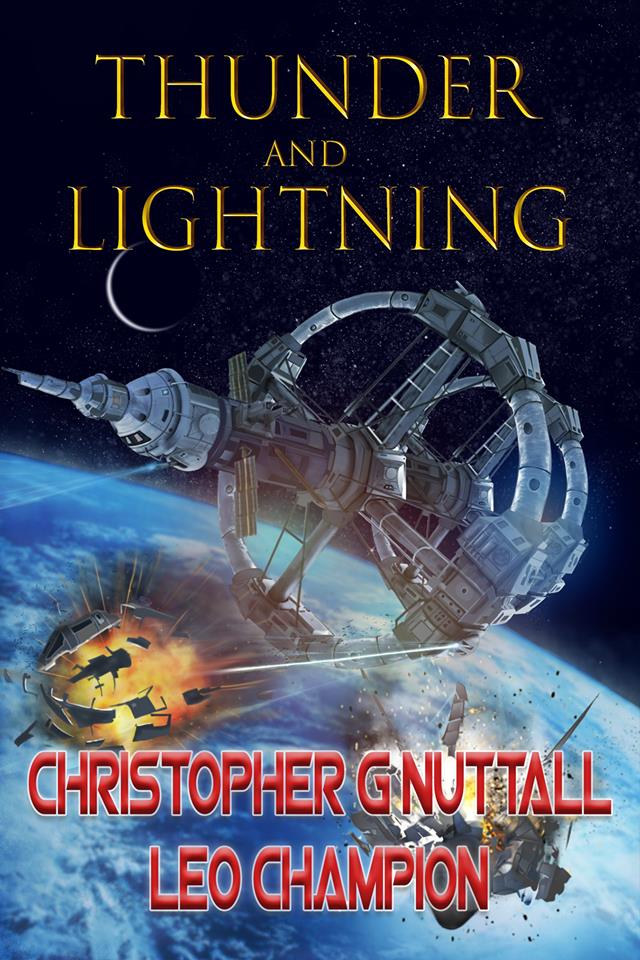
But, you must be sitting there asking yourselves, “Barb, what is this about language? Why are you talking about that with regards to editing and THUNDER AND LIGHTNING?”
Some of what I’m going to say is blindingly obvious, but here goes: When you’re writing about soldiers, you cannot take the high road all the time. And you certainly can’t use what I derisively call “sparkly language,” in that you dumb-down what soldiers say during a war.
Chris and Leo’s soldiers start off in a nasty fight in Africa against terrorists they call “the Wreckers.” These Wreckers are abysmal human beings who, like others in the past, have corrupted a holy book — in this case, the Koran — for their own purposes. The soldiers call them “radical Islamicists,” which is not that dissimilar to what is said overseas now in the Middle East or in other war zones.
And there’s a reason they do this. The reason is very simple. They are fighting a war. They cannot afford to see these people as worthy of redemption, for the most part, and they have many reasons not to see them that way either as the behavior of the Wreckers is truly abhorrent. (Hell, they even take female slaves.)
So, when I saw that, as an editor, I left it alone. I’ve heard from my own cousin, who’s served overseas any number of times in the Middle East as a member of the Armed Services, that what’s said about those we’re fighting (ISIS now, Al Qaeda earlier) is far worse than that.
But will some people be offended by this term? Probably.**
My job, though, as an editor, is not to dumb down what anyone says or feels even if I think it’s something someone out there will dislike. My job is to make that soldier sound and feel real. So you can get caught up in the story. And keep going.
If that soldier says some things you don’t like, well…I urge you to read James Clavell’s KING RAT. There’s lots of stuff that’s not said in “sparkly language,” but if it were, you’d never buy into it.
And you shouldn’t.
Anyway, THUNDER AND LIGHTNING isn’t just about soldiers. It’s about an idealistic woman scientist, Samra, who first finds evidence of aliens we later come to know as Oghaldzon (kind of like three-legged deer), and believes that any aliens coming must be peaceful. (She’s wrong, but you can see why she’d believe otherwise.) And what happens when she finds out the Oghaldzon are almost completely incomprehensible to humans, and humans to the Oghaldzon in terms, is scary, difficult to read, and sometimes incredibly sad, in turns.
We see her in lighter days, when she’s just a scientist at work. We see her finding the aliens’ signal (a fleet) in space, the scientific high point of her career.
And then, we see her disastrous fall, and with her fall, the attempted subjugation of Earth.
We also see a cyborg commando soldier, who saves Samra and stays by her side as they try, somehow, to stay alive and hope for better days. (Perhaps the commando is hedging his bets. Or waiting for a better opportunity. But it’s important to know that without him being there, Samra likely wouldn’t have a reason to fight so hard.)
Along the way, we meet numerous others. Some are politicians. Some are just average Joes. Some are Rockrats — that is, asteroid miners, extremely isolationist in outlook and incredibly hard-headed, to boot.
We need every last one of them to come together, in whatever ways they can, or we cannot save our own solar system from the Oghaldzon.
And along the way, the Oghaldzon are found to be, oddly enough, a different type of idealist entirely. But their idealism doesn’t match ours by any standard, and that is part of why we end up in a protracted war.
I don’t want to spoil the outcome of the book. So I will stop there.
Just know that as an editor, I maximized everything I could for the sake of realism, verisimilitude, and dammit all, for the sake of a damned good read. That is my job.
And if you read the book, and you like the book, do tell Leo and Chris that you enjoyed it. (You can come tell me, too. I’d enjoy that, also.) Reviews matter.
(I know that from personal experience. But I digress.)
In other words, when I edit, I try to find the authors’ voices. And I believe I did exactly what I should, to make THUNDER AND LIGHTNING the best it could be, in the hopes that people would feel, think, and enjoy the book and tell others.
Or in shorter form: Sparkly language, get lost.
—–
**Note that I, myself, have a Koran and have read it many times. My late husband admired the Sufi Muslims, and often called himself a “Zen Sufi Pagan.” And Chris Nuttall himself was exposed to all sorts of different religions when he lived in Malaysia, certainly including Islam, and knows, as I do, that people come in all flavors in all religions: that is, followers of the prophet Mohammad are mainly very good people.
Those who’d chain and enslave women, though, are hardly that. And if they’re using Islam as a way to make that palatable to their (mostly male) believers, that is disgusting.
There are bad apples in any bunch. These Wreckers definitely fit the bill for the type of people who’d try to turn religion to their own ends, rather than live in loving kindness and generosity, as I believe Mohammad truly wanted.
 Barb Caffrey's Blog