I had to start this post by thanking everyone who lives to help others. Isn’t that what this world is about? Every day we have an opportunity to impact another person’s life. Take a moment to look at the pictures above. Each person is impacting another life. We can choose any profession we want, so why not choose something you are passionate about? Passionate people in their professions impact thousands (and maybe even more) people.
Concerts and Life
Folks, I’m preparing right now for a concert later this evening with the Racine Concert Band. We’re playing at 7 PM at Park High School in Racine, a joint concert with the Park High School band…and I have a few things to say about concerts and life.
First, sometimes you prepare for something, and it doesn’t happen. But that preparation is still a good thing to do, because it might help you down the line with something else.
In an immediate sense, we had this happen last night in our dress rehearsal with the RCB. Our first-chair clarinetist was unable to play for a very good reason, and her husband brought the folder in so someone else could play her parts.
So, what happened? One of the other clarinetists moved up to play the parts instead. That clarinetist is my former teacher from my college days, Tim Bell…if anyone can play a concert on one rehearsal, it’s Tim.
But Tim had prepared the second parts. He didn’t really want to move. And he would’ve preferred playing the parts he already had, with the first-chair player being healthy enough to play. (I think we all would prefer that, as the first-chair player is a beacon of light whenever she’s around.)
Still, he was called upon, and he answered the call. And he did very well. (Come to the concert tonight and see just how well he did, learning the parts in one rehearsal.)
Second, as is seen by what happened to the first-chair clarinetist, you can do everything in your power to do everything right, and something out of the blue happens so you can’t perform. This is incredibly frustrating, and it’s not easy to deal with whatsoever.
All you can do in such situations is your best. That seems trite to say, but it’s the absolute truth.
Right now, for the first-chair player, rest is what she needs. She’d rather be playing, but she can’t right now. So all she can do is rest, recover fully, and get back to being that positive presence she’s always been down the line.
That’s the winning strategy, now that life dealt her a bad hand. But because she’s a mature and thoughtful soul, she realizes that bad hand is temporary.
Third, while concerts are ephemeral, music itself isn’t. Music can last forever, even though the pieces we play will sound a little different every time we try, as we learn and change and grow and become wiser (and hopefully, just a bit better, too).
This is why music is important. The players may change, sometimes through no fault of their own. The pieces change, too. And the audiences definitely change, something no musician can ever predict…nor would we want to in advance, as that’s half the fun of playing, in my not-so-humble opinion.
Anyway, that’s why I think concerts are interesting. They are a microcosm of life, in their own weird way, and as such, the preparation for the actual event may — or may not — match what ends up happening.
But no matter what, the music will endure. And the Racine Concert Band shall do its best to play it with passion, vigor, and authenticity, later tonight at Park High School.
Sunday Musing: Aaron Rodgers
Folks, on Sundays I often try to write something a little different, something that makes you think. And today, I have an almost ideal subject, albeit for a not-so-great reason, that subject being Aaron Rodgers. (He was injured today, you see. But I’ll get to that in a bit.)
When Rodgers first became the starting quarterback for the Green Bay Packers, I wasn’t happy. (Yeah, I’ll admit it.) I was a big fan of Brett Favre and Favre’s happy-go-lucky style of play, and Rodgers was more sedate, much quieter, and far less flamboyant.
However, over time, I’ve learned to appreciate Rodgers. He is a deep thinker, as well as a fierce competitor, and he seems to have a very solid moral compass. (He reads, too, and I’m a big fan of that…no surprise, huh?)
Rodgers is the type of guy who learns from experience. He is mature, and has a personality that I probably would like, one-on-one.
So, why was it that when Rodgers, who probably had all of these qualities to begin with in some fashion or another, came into his own with the Packers that I didn’t appreciate him very much at all?
I think there’s something to do with loyalty that came into play, there. It was hard to give Rodgers a chance when I still liked Favre and believed Favre could play, and play well, in the NFL. And even though it wasn’t up to Rodgers at all as to when Rodgers would finally get his time to shine (as if it were, Rodgers would’ve started from the moment he got drafted by the Packers, and that obviously didn’t happen), it was difficult to see Rodgers’ worth or value.
This is the value of time, though. It gives you the opportunity to re-evaluate your snap judgments. Some of them are right; I liked Favre from the start, for example. But some are flat wrong, and are colored by prejudgments that can’t help but keep you from seeing the whole picture.
As my cousin Wayne put it a while back, Favre and Rodgers are both great, but in different ways. One was relatable and quotable; the other humane and thoughtful. But both are wonderful players, and are interesting people with unique perspectives on life, to boot.
And that’s important to think about. Rodgers is a person, with feelings and wants and needs and desires of his own. He’s not an automaton. He’s a real, live person, and he’s about to have to endure the hardest thing any athlete in his prime hates, that being a major injury.
Earlier today in the game versus the Minnesota Vikings, Rodgers suffered a broken collarbone. He will be out for quite some time. There’s even a possibility that Rodgers will be out the entire remainder of the 2017 season.
I hope Rodgers will heal quickly and well.
But while he heals, I also hope he’ll continue doing what he was already — that is, studying, reading, thinking hard, doing good for others, and caring deeply about the world we live in.
Because as great a quarterback and football player as Rodgers is, I think he’s an even better person. And we need more people like him in this life.
Alassa’s Tale–Snippet
I loved this, and just had to share it…enjoy!
Resist the Echo Chamber (AKA Negativity)
Folks, I’ve heard a lot recently about negative reinforcement, which from here on out I’ll call “the echo chamber.” And it needs to be discussed, because too many of us never think about it.
Whether your echo chamber is from a person or from the news (as the news tends to repeat negativity over and over and over again, as that’s what many viewers seem to want), or even from your own past experiences, you need to throw it off.
Why?
Let’s put it this way: If you are inundated by negativity, it’s hard to create. It’s also hard to believe that anything will be any better than it is today.
(Which probably is why it’s so hard to create, if you think about it. Anything worth creating takes time, and if you are worrying yourself into a frenzy all the time due to the negativity you see around you, you can’t believe that time will be well-spent. Which is a lie, but I digress.)
One of the hardest things in this world to do is to throw off that echo chamber. It is liberating to do, once you realize you need to do it, but just getting to the point you can even have that thought is hard.
Some of you may be going, “Barb, what on Earth are you talking about this time?”
Simply this: If you live your life defined by negativity, you can’t help but be weighed down.
But if you see your life as full of possibilities, as best you can, you have a better shot at throwing off that echo chamber and doing whatever it was you were meant to do.
(In my case, it’s creating. I love to create, whether it’s music, words, cooking…it gives me fulfillment and peace, when I can do that. But since you’re here at my blog, you may have realized this already…)
You must throw the echo chamber away, and with great force, and lose those weights that confine you. Because they do not — I repeat, do not — define you.
How do you resist the negativity in your life? Tell me about it in the comments!
More Professions to be Thanked, via Collaboration with a Purpose
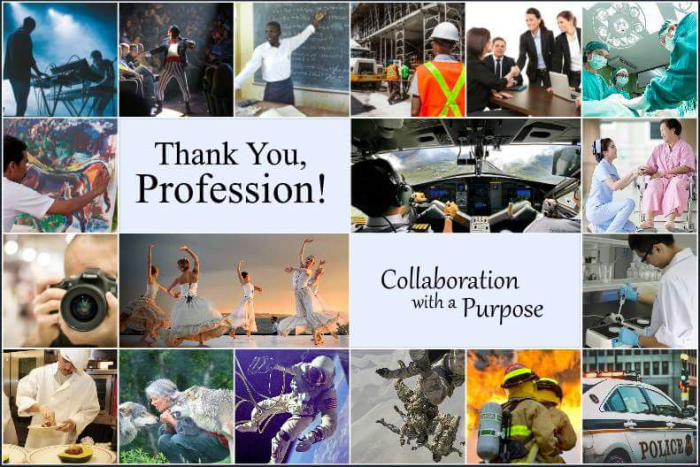
Folks, my Collaboration with a Purpose buddies came up with some great blogs this time, and I wanted to make sure you knew about them. (My blog, of course, thanked teachers, but there are all sorts of other professions to thank…) So, without further ado, here’s a bit about each blog, and why I found it interesting!
Addison D’Marko’s blog post thanks neuro-science, and she has a great reason why. When she was in sixth grade, she read a book about the brain that so impressed her, to the point that when she became paralyzed years later, she remembered it in her hour of need. (That book was The Brain That Changes Itself, by the way.)
Nicolle K. at her blog Stories of Ahsi thanks unsung heroes, and her reasoning behind that is fascinating. She says unsung heroes are the most interesting of all, and she has very good reasoning as to why this is the case. And she has a great demonstration from a story she read years ago, too… (In short, go read this blog immediately! You’ll thank yourself afterward.)
And Nicolle, you didn’t need to thank your fellow bloggers, but bless you for doing so. (Embarrassed blush.) Moving on…
The amazing and talented Tajwar Fatma wrote a post thanking doctors, which again makes wonderful sense as she’s currently studying to become a doctor. (And she’s nearly done, too, yay!) Read all about why she loves becoming a doctor, and why she’s very thankful for doctors overall.
But it’s almost insane that she had to point out that attacking doctors on call is a crime. (Apparently that has happened in her neck of the woods, and that is horrible. Leave those doctors alone.)
The always-inspiring Ipuna Black has a post thanking police officers, and her reasoning is quite intriguing. She points out that police officers have a tough job, and it’s just gotten worse since the horrible shooting in Las Vegas. And yet, without them, what kind of lives would most people have?
She also has a great paragraph that I’m going to quote in its entirety:
Absolutely. Right on, Ipuna!
The inspiring Jane Love wrote about the need to be thankful for parents. She also discusses thankfulness, specifically from a Christian perspective. There’s a lot of good to be found here, and I hope my readers who are not specifically Christian in their beliefs will be able to see the good in Jane’s post and apply whatever they can to their own lives.
And writer and teacher Sadaf Siddiqi’s take on the subject is quite intriguing; she talks about thankfulness, and the need to thank people regardless of their professions. She discusses a few specific professions, mind, including her own of teacher…but her main impetus is that we need to be thankful for everyone who does a meaningful job.
(I completely agree with her.)
Jothish Joseph also has a take on thanking all professions that I enjoyed quite a bit. (Jothish is a fun-loving, kind-hearted, good guy. I always enjoy reading his posts.) And to my mind, Jothish is right when he discusses how the people who clean up behind us need to be much better-respected overall. He first discusses how many others of his acquaintance do not understand this very important tenet (that all deserve respect, and that no one should look down on anyone), and then discusses this story:
One day I visited the Dhobi to give my laundry. As always there was a fairly long line. I stood in the queue and waited for my chance. The person just ahead of me rudely handed over his clothes and seemed to be very annoying. As a result the lady collecting the laundry was annoyed and visible change in her mood was seen. That’s when my turn came. I gave my laundry and said a thank you when I was done. I got a smile in return.
Since that day every time that I go there, I am greeted with a smile and sometimes also enquired about how I’ve been!
I loved this story.
Divyang Shah also thanks all professions, and discusses three in particular. The one I found the most intriguing is about software engineers; Divyang is one, so he knows exactly what they do, and how much of what we need for daily living depends on them.
Well done, Divyang!
Mylene Orillo’s post is wonderful, too. She thanks soldiers, along with military spouses and families, and has excellent reasons as to why:
Some of you don’t know that soldiery is one of the closest professions in my heart as I was once a military cadet and a frustrated Army soldier. Yes, I would have joined the Army ‘coz I’m not a good swimmer if I join the Navy and I’m also afraid of heights if I join the Air Force. I was an incoming senior in college when I entered a military school in 2001 and trained there for two years.
…
Since I also worked for the Philippine Army as a civilian employee for eight years, I knew (although I didn’t experience it first-hand) what’s it’s like to be in the service from the stories of my office-mates, bosses, and closest friends and their families.
That’s why I have high respects for people who are in the military or uniformed service in general because I know their sacrifices and I know how they are living their lives away from their families. So whenever I hear stories about soldiers, especially my classmates, upperclassmen, or underclassmen who were wounded or dead in battle, it never fails to break me into pieces and make me really emotional.
Mylene’s right about soldiers, their families, and most especially their spouses. (This former military wife thanks you for remembering us, Mylene! Almost no one does.)
Finally, the incredible Sonyo Estavillo wrote a post specifically thanking those in Las Vegas who responded to the horrific shooting, most especially the police officers. Sonyo points out that she used to live in Las Vegas, and that this shooting was absolutely horrific for many, many reasons; that the shooter had no record is one of those, but that he did something like this at an event that’s generally considered to be family-friendly is even worse. She has some country music fans in her family who still live in the area, and she’s grateful they weren’t there…but as she knows that “there but for the grace of God” goes her family, she felt the need to write a post thanking the policemen (and other first responders).
I completely agree with her reasoning, and I hope people will read this post and think, profoundly, about how much police officers do every day that is never celebrated, nor even noted; we normally only think about the “bad apples,” not the others, and that gives most of us a distorted view of the profession at hand. (No wonder no one thinks about thanking police officers, when all we ever hear is bad…and yet, the vast majority of police officers are good, kind, and decent people who do a very difficult job so others can live in safety and peace.)
Anyway, all the various posts were great, in their respective ways, and I truly hope you will check them out forthwith. (You’ll enjoy them. And they may make you think, too…which is a win/win, in my book.)
Thank a Teacher Today, via Collaboration with a Purpose
Folks, this is the latest in a series of blogs done under the aegis of Collaboration with a Purpose. I hope you’ll enjoy it.
Today, I want to thank teachers. All of them, in all of their various permutations.
Why? Well, without people willing to teach, we’d not be able to learn…and without people putting themselves out there selflessly, maybe no one would learn anything at all.
Some of you have to be saying, “Barb, why are you saying this so strongly? What’s the point? Yeah, teachers are great and all, but why glorify them above other professions?”
(Which, by the way, is the point of this whole post. The Collaboration with a Purpose topic this time, as you see from the lovely picture Nicolle K. put together, was “Thank a profession.” But I digress.)
I know that one of the reasons I have the thirst for knowledge and learning is because of how I was taught, from the time I was very young, by many people in my life. Not just my elementary and secondary school teachers, but by my parents, my grandparents, my Aunt Laurice (who taught me a few chords on the piano when I asked, though I promptly forgot them when I went away from her and the piano)…without my mother and grandmother teaching me to read, spell, and do simple sums, I would’ve been at a grave disadvantage when I turned up in kindergarten.
And then, along the way, I discovered more about music. My first music teacher helped me learn how to play the oboe, and then there was a huge teacher’s strike that lasted months.
But by that time, I was hooked. I played for my grandmother, who watched me and my sibs as we waited out the teacher’s strike. I played for my parents, when they came home from work. And I worked my way through three different books, learning more notes and fingerings and songs, to the point I nearly made my teacher cry — with happiness, mind — when we finally resumed school.
And I was sent to a private teacher, who taught me more…and another teacher, who taught me even more…
You get my drift, yes?
Anyway, without teachers, especially in childhood when our minds are malleable, it would be much harder to get into a habit of lifelong learning. And that is vitally important, especially in this day and age when technology seemingly changes on a dime and there are constant and inevitable changes to deal with, just different ones at different times.
And I also want to thank the librarians, teachers in their own right, who helped point me in the right direction after I realized I wanted to learn even more after school was over.
Without all of them, I think I would’ve turned out to be a much different, and far lesser, person.
So, thank you, teachers! Thanks for the help, and the guidance, and the learning, and for passing it along.
And bless you for all you do.
Beat the Heat and Stand for Something
Folks, you may be wondering why on Earth I decided to combine these two topics. It’s mostly because it was 95 F with high humidity (and far from the world’s best air quality) where I live in Southeastern Wisconsin; originally I was going to talk only about standing for something, but it being so hot made me combine them.
So, hopefully my brain hasn’t melted, and this will make sense. Enjoy!
There’s so much negativity in this world right now. And the only way I know to try to fight against any of it is to find something to believe in, and take a stand.
What do I stand for? (I’m going to try to stay out of politics for the moment, as it’s so hot…) Literacy, for one. And education. And thinking for yourself, and making up your own mind after using reason, logic, or at least some sort of step-by-step rationale for making your decisions, rather than following the whims of whatever “in-crowd” seems to be dominating the airwaves this week.
This is important. You need to think for yourself. And stand for something, as well as stand against stuff that makes no sense to you.
Such as narcissistic contemporary behavior. And I am not alone in that.
Tonight, while watching television, I saw highly respected journalist and writer Gay Talese, speaking with MSNBC’s Ari Melber. Talese said that in his opinion, our culture is incredibly narcissistic. He pointed out that even when he goes to a baseball game, more people are watching their phones than watching the game — and he truly does not understand that.
(Neither do I, as a baseball fan. That just never has made any sense to me. Watch the game if you’re there, dammit. Or stay home and follow your phone…unless someone in your family has a health emergency, turn the damned thing off.)
Talese was speaking broadly, as well as specifically (as he was talking politics; someday, maybe soon, I’ll talk about that, too, but not today). But his point is well-founded. We are too narcissistic now, in the Western World in particular; we are not thinking about tomorrow so much as immediate self-gratification.
How do we combat all this? We need to stop undue navel-gazing. And instead, take a stand. Find something you like to do that will actually help someone else. And stop focusing on your own problems to the detriment of everyone else.
(I know, I know; I am at fault as much as anyone reading. But I’m telling myself to do this, too, as I really don’t want to be hypocritical. Trust me. Now, back to the regularly scheduled post, already in progress…)
Some ideas of how to help:
- Volunteer at a soup kitchen or food pantry
- Volunteer with dog, cat, parakeet, or other animal shelters, and make sure those animals are well cared for until they find their “forever homes”
- Send money to Florida, Puerto Rico, Houston, the Virgin Islands, or any other place that’s been devastated by Hurricanes Harvey, Irma, or Maria
Those are just three ideas, but I hope that gives you some food for thought.
We’re only here for a short time. We have to help others while we’re here, or at least make a good attempt to do so; otherwise, why were we put on this Earth with millions upon millions of other souls rather than in our own hermetically sealed bubble, alone in our “perfection,” alone with our thoughts…and no doubt bored silly by same?
As the heat beats down, and the humidity makes the heat even worse, do your best to keep yourself focused on people other than yourself. That’s the best way to honor the better angels of your nature, and it’s the best blow against self-defeating narcissism I know.
P.S. It’s not that you shouldn’t care about what happens to you, mind…it’s that you also should care about what happens to others.
How do you help others? And what do you think of this post? Let me know in the comments!
Blogging and Life
Some days, it’s easier to write than others. But lately, writing has been like pulling teeth.
Why am I starting out with this? Simple. I haven’t blogged much in a few weeks, and I’ve had questions as to why. Long-time readers probably know the answer, but I’m willing to give it again…it’s the time of year that’s getting me down.
Around this time thirteen years ago, my husband Michael was alive. Writing. Reading and editing my writing. Making me laugh. Letting me make him laugh. Cooking. Walking the neighborhood. Complaining about politics, and listening to my complaints about politics, too.
In short, living his life. And enjoying it, and our marriage, immensely.
Then came that awful day, the day that changed everything. The day he had four heart attacks without warning, which he couldn’t survive.
The day I became a (way too young) widow.
I can’t pretend that I like this time of year. And I won’t.
What I will say, as I said in last week’s blog about changing perspectives, is that I’m trying to look at it a different way. At long last, I am trying to see my husband’s life right now, rather than see the “period at the end of the sentence,” otherwise known as his death.
Yeah, at other times of the year, I see Michael’s life quite well. And it comforts me. It gives me hope, because I was fully understood and appreciated and admired, all for being myself. And boy, oh boy, was I loved…
(Embarrassed grin.)
Anyway. The fact of the matter is, I just hurt at this time of year. And because I hurt, my creativity is slowed. I find it hard to play my instruments, hard to write fiction, a little more difficult to edit (depending on the project), and just, in general, find life to be more of a drag.
That this year is going to be more like 2004 than not — in that it’ll be too hot, and too humid, for late September — is not helping.
Still, if I think about my husband’s life, and about how much he loved me, it helps. A lot.
I know Michael would like it if I could find more joy, more happiness, or at least more peace. And God/dess, am I trying.
As to why I’m blogging about something so personal?
Well, there may be some widow out there hurting just as much as I am. Maybe she’s wondering what the point is. Or wondering how on Earth she can keep going, keep striving, keep working toward a future she can no longer see, when the love of her life is dead.
I think there is a reason, but I don’t have a way to articulate it very well.
The best I can say is that because I was loved so well, I want to do right. I want to help others, in whatever way I can, and I want to keep going. Because that’s what my husband would want.
And I’m trying, so hard, to find a way to want it, too. Despite the time of year.
Because if I can keep trying, maybe I might eventually find love again. (Hey, it could happen. That I even want it to happen, after thirteen years, is miraculous enough. And no, you may not say “it’s about time.”)
I kind of think Michael would like that.
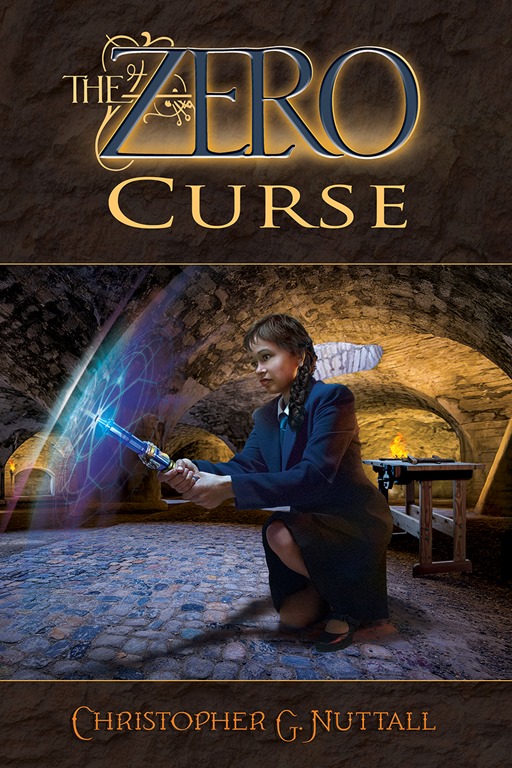
Out Now–The Zero Curse
This is Chris’s newest novel. I edited this book and know it’s an outstanding YA adventure, second in a series (the first is the excellent THE ZERO BLESSING). Go read his blog, check out the free sample, and grab the book!
 Barb Caffrey's Blog